

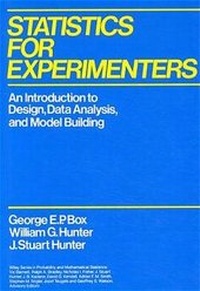
Statistics for Experimenters
An Introduction to Design, Data Analysis, and Model Building
1st Edition
Published on 6. July 1978
Book
Hardback
XVIII, 654 pages
978-0-471-09315-2 (ISBN)
Description
Introduces the philosophy of experimentation and the part that statistics play in experimentation. Emphasizes the need to develop a capability for "statistical thinking" by using examples drawn from actual case studies.
More details
Series
Edition
1., Aufl.
Language
English
Place of publication
New York
United States
Publishing group
John Wiley and Sons Ltd
Target group
College/higher education
Professional and scholarly
Illustrations
illustrations, bibliography, index
Dimensions
Height: 23.7 cm
Width: 16.4 cm
Weight
1068 gr
ISBN-13
978-0-471-09315-2 (9780471093152)
Schweitzer Classification
Other editions
New editions
George E. P. Box | J. Stuart Hunter | William G. Hunter
Statistics for Experimenters
Design, Innovation, and Discovery
Book
07/2005
2nd Edition
Wiley
€166.50
Shipment within 10-20 days
Persons
George E.P. Box is R.A. Fisher Professor of Statistics at the University of Wisconsin. He received the degrees of Ph.D. and D.Sc. in mathematical statistics from the University of London and an Honorary D.Sc. from the University of Rochester. He had many years of experience as a practicing statistician in the British Army and later in Imperial Chemical Industries, Ltd., and has served as a consultant to industry and government. He is a Fellow of the American Academy of Arts and Sciences, and a recipient of the Wilks memorial medal of the American Statistical Association, the Shewhart medal of the American Society for Quality Control, and the Guy medal in silver of the Royal Statistical Society. He is an author of over 100 published papers and of the following books: Time Series Analysis Forecasting and Control (with G. M. Jenkins); Bayesian Inference in Statistical Analysis (with G. C. Tiao); and Evolutionary Operation (with N. R. Draper).
William G. Hunter is Professor of Statistics and Engineering at the University of Wisconsin, Madison. In chemical engineering he received degrees of B.S.E. from Princeton University and M.S. E. from the University of Illinois. In statistics he received M.S. and Ph.D. degrees from the University of Wisconsin. He has also taught at the University of Ife in Nigeria, the University of Singapore, and Imperial College of Science and Technology in England. Dr. Hunter is an author of more than fifty technical articles and is an Associate Editor of Technometrics. A consultant, he ha also rpesented over sixty short courses for industry, government, and such organizations as the American Association for the Advancement of Science, the American Institute of Chemical Engineers, the American Society for Quality Control, and the United Nations.
J. Stuart Hunter is Professor of Civil Engineering at Princeton University. He received his B.S. in electrical engineering, his M.S. in engineering mathematics from North Carolina State University, and his Ph.D. in experimental statistics from the Institute of Statistics at North Carolina State University and the University of North Carolina. A leader in the exposition of statistical methods for over 25 years, Dr. Hunter has served as consultant to many industries and government agencies. He has been a staff member of the National Academy of Science, Committee on National Statistics, and Statistician in Residence at the University of Wisconsin, and is the Founding Editor of Technometrics. He is a member of numerous professional societies, has published extensively, and is the coauthor (with I. Guttman and S.S. Wilks) of Introductory Engineering Statistics, Second Edition (published by Wiley-Interscience).
William G. Hunter is Professor of Statistics and Engineering at the University of Wisconsin, Madison. In chemical engineering he received degrees of B.S.E. from Princeton University and M.S. E. from the University of Illinois. In statistics he received M.S. and Ph.D. degrees from the University of Wisconsin. He has also taught at the University of Ife in Nigeria, the University of Singapore, and Imperial College of Science and Technology in England. Dr. Hunter is an author of more than fifty technical articles and is an Associate Editor of Technometrics. A consultant, he ha also rpesented over sixty short courses for industry, government, and such organizations as the American Association for the Advancement of Science, the American Institute of Chemical Engineers, the American Society for Quality Control, and the United Nations.
J. Stuart Hunter is Professor of Civil Engineering at Princeton University. He received his B.S. in electrical engineering, his M.S. in engineering mathematics from North Carolina State University, and his Ph.D. in experimental statistics from the Institute of Statistics at North Carolina State University and the University of North Carolina. A leader in the exposition of statistical methods for over 25 years, Dr. Hunter has served as consultant to many industries and government agencies. He has been a staff member of the National Academy of Science, Committee on National Statistics, and Statistician in Residence at the University of Wisconsin, and is the Founding Editor of Technometrics. He is a member of numerous professional societies, has published extensively, and is the coauthor (with I. Guttman and S.S. Wilks) of Introductory Engineering Statistics, Second Edition (published by Wiley-Interscience).
Content
Science and Statistics. COMPARING TWO TREATMENTS. Use of External Reference Distribution to Compare Two Means. Random Sampling and the Declaration of Independence. Randomization and Blocking with Paired Comparisons. Significance Tests and Confidence Intervals for Means, Variances, Proportions and Frequences. COMPARING MORE THAN TWO TREATMENTS. Experiments to Compare k Treatment Means. Randomized Block and Two--Way Factorial Designs. Designs with More Than One Blocking Variable. MEASURING THE EFFECTS OF VARIABLES. Empirical Modeling. Factorial Designs at Two Levels. More Applications of Factorial Designs. Fractional Factorial Designs at Two Levels. More Applications of Fractional Factorial Designs. BUILDING MODELS AND USING THEM. Simple Modeling with Least Squares (Regression Analysis). Response Surface Methods. Mechanistic Model Building. Study of Variation. Modeling Dependence: Times Series. Appendix Tables. Index.