

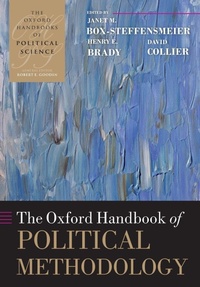
The Oxford Handbook of Political Methodology
Published on 10. June 2010
Book
Paperback/Softback
896 pages
978-0-19-958556-4 (ISBN)
Description
Political methodology has changed dramatically over the past thirty years, and many new methods and techniques have been developed. Both the Political Methodology Society and the Qualitative/Multi-Methods Section of the American Political Science Association have engaged in ongoing research and training programs that have advanced quantitative and qualitative methodology. The Oxford Handbook of Political Methodology presents and synthesizes these developments.
The Handbook provides comprehensive overviews of diverse methodological approaches, with an emphasis on three major themes. First, specific methodological tools should be at the service of improved conceptualization, comprehension of meaning, measurement, and data collection. They should increase analysts' leverage in reasoning about causal relationships and evaluating them empirically by contributing to powerful research designs. Second, the authors explore the many different ways of addressing these tasks: through case-studies and large-n designs, with both quantitative and qualitative data, and via techniques ranging from statistical modelling to process tracing. Finally, techniques can cut across traditional methodological boundaries and can be useful for many different kinds of researchers. Many of the authors thus explore how their methods can inform, and be used by, scholars engaged in diverse branches of methodology.
The Handbook provides comprehensive overviews of diverse methodological approaches, with an emphasis on three major themes. First, specific methodological tools should be at the service of improved conceptualization, comprehension of meaning, measurement, and data collection. They should increase analysts' leverage in reasoning about causal relationships and evaluating them empirically by contributing to powerful research designs. Second, the authors explore the many different ways of addressing these tasks: through case-studies and large-n designs, with both quantitative and qualitative data, and via techniques ranging from statistical modelling to process tracing. Finally, techniques can cut across traditional methodological boundaries and can be useful for many different kinds of researchers. Many of the authors thus explore how their methods can inform, and be used by, scholars engaged in diverse branches of methodology.
Reviews / Votes
Review from previous edition This Handbook contains an extraordinary collection of magisterial articles by many of the best methodological minds in political science. Prominent statisticians, econometricians, and sociologists who have taken an interest in our inferential problems are also well represented. The range is broad and substantive, with quantitative, qualitative, formal-theoretic, historical, and mixed methods discussed in relation to all the empirical subfields of the discipline. Every sect will find something to its taste, and those who celebrate the methodological diversity of the profession will have a feast. The articles are written to be accessible, and graduate students will find no better place to begin developing their own methodological judgment. This book is a splendid achievement. * Christopher H. Achen, Roger Williams Straus Professor of Social Sciences, Princeton University * This extraordinary series offers 'state of the art' assessments that instruct, engage, and provoke. No one who is immersed in the discipline's controversies and possibilities should miss the intellectual stimulation and critical appraisal these works so powerfully provide. * Ira Katznelson, Ruggles Professor of Political Science and History, Columbia University. * This blockbuster set is a must-have for scholars and students alike. Each volume is crafted by a distinguished set of editors who have assembled critical, comprehensive, essays. These volumes will help to shape the discipline for many years to come. * Theda Skocpol, Victor S. Thomas Professor of Government and Sociology, Harvard University. *More details
Series
Language
English
Place of publication
Oxford
United Kingdom
Target group
College/higher education
Dimensions
Height: 244 mm
Width: 170 mm
Thickness: 48 mm
Weight
1513 gr
ISBN-13
978-0-19-958556-4 (9780199585564)
Copyright in bibliographic data and cover images is held by Nielsen Book Services Limited or by the publishers or by their respective licensors: all rights reserved.
Schweitzer Classification
Other editions
Additional editions
Janet M. Box-Steffensmeier | Henry E. Brady | David Collier
The Oxford Handbook of Political Methodology
Book
08/2008
Oxford University Press
€244.90
Shipment within 15-20 days
Persons
Janet Box-Steffensmeier is the Vernal Riffe Professor of Political Science, Director of the Program in Statistics and Methodology, and courtesy faculty of Sociology at the Ohio State University. She holds a B.A. in mathematics and political science from Coe College (1988), and a Ph.D. in Political Science from the University of Texas at Austin (1993).
Henry Brady is Professor of Political Science and Public Policy at University of California, Berkeley. He received his Ph.D. in Economics and Political Science from MIT in 1980. His areas of interest include Quantitative Methodology, American and Canadian Politics, and Political Behavior. He teaches undergraduate courses on political participation and party systems and graduate courses on advanced quantitative methodology.
David Collier is Professor of Political Science at University of California, Berkeley and former President of the American Political Science Association. His fields are comparative politics, Latin American politics, and methodology. His latest book is Rethinking Social Inquiry: Diverse Tools, Shared Standards (Rowman & Littlefield, 2004), of which he is co-editor and co-author with his Berkeley colleague Henry E. Brady.
Henry Brady is Professor of Political Science and Public Policy at University of California, Berkeley. He received his Ph.D. in Economics and Political Science from MIT in 1980. His areas of interest include Quantitative Methodology, American and Canadian Politics, and Political Behavior. He teaches undergraduate courses on political participation and party systems and graduate courses on advanced quantitative methodology.
David Collier is Professor of Political Science at University of California, Berkeley and former President of the American Political Science Association. His fields are comparative politics, Latin American politics, and methodology. His latest book is Rethinking Social Inquiry: Diverse Tools, Shared Standards (Rowman & Littlefield, 2004), of which he is co-editor and co-author with his Berkeley colleague Henry E. Brady.
Content
PART I: INTRODUCTION; PART II: APPROACHES TO SOCIAL SCIENCE METHODOLOGY; PART III: CONCEPTS AND MEASUREMENT; PART IV: CAUSALITY AND EXPLANATION IN SOCIAL RESEARCH; PART V: EXPERIMENTS, QUASI-EXPERIMENTS AND NATURAL EXPERIMENTS; PART VI: QUANTITATIVE TOOLS FOR DESCRIPTIVE AND CAUSAL INFERENCE: GENERAL METHODS; PART VII: QUANTITATIVE TOOLS FOR DESCRIPTIVE AND CAUSAL INFERENCE: SPECIAL TOPICS; PART VIII: QUALITATIVE TOOLS FOR DESCRIPTIVE AND CAUSAL INFERENCE; PART IX: ORGANIZATIONS, INSTITUTIONS, AND MOVEMENTS IN THE FIELD OF METHODOLOGY