

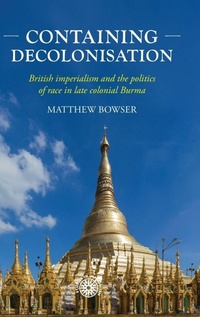
Containing Decolonisation
British Imperialism and the Politics of Race in Late Colonial Burma
Published on 2. September 2025
Book
Hardback
256 pages
978-1-5261-8794-9 (ISBN)
Description
This book examines British imperialism in late colonial Burma to study how imperialists attempted to protect their strategic and economic interests after decolonisation: they did so by supporting ethnonationalism. This process resembles the Cold War tactic of "containment," and the book makes a crucial contribution to the study of modern imperialism by demonstrating the continuity between "containment's" late- and "neo"-colonial manifestations. For Burma/Myanmar, it also explores the origin of the present-day military junta's racial regime: it emphasizes the protection of the ethnoreligious majority from ethnic minority insurgency. The Rohingya people are currently suffering a genocide because of this racial regime. As the country endures civil war against the junta, this book highlights how ethnonationalists in the late colonial period first promoted this racial regime to seize power and prevent revolution, a process supported by British imperialists for their own ends. -- .
More details
Series
Language
English
Place of publication
Manchester
United Kingdom
Target group
College/higher education
Professional and scholarly
Dimensions
Height: 240 mm
Width: 161 mm
Thickness: 18 mm
Weight
552 gr
ISBN-13
978-1-5261-8794-9 (9781526187949)
Copyright in bibliographic data and cover images is held by Nielsen Book Services Limited or by the publishers or by their respective licensors: all rights reserved.
Schweitzer Classification
Other editions
Additional editions
Matthew Bowser
Containing Decolonisation
British Imperialism and the Politics of Race in Late Colonial Burma
E-Book
09/2025
Manchester University Press
€124.99
Available for download
Person
Matthew Bowser is Assistant Professor of Asian History at Alabama A&M University -- .
Content
Introduction
1 Partition and the rise of Burmese ethnonationalism (1929-1936)
2 The Myochit Party and the construction of a racial regime (1936-1938)
3 The pogrom of 1938 and its aftermath (1938-1939)
4 U Pu's Ministry: Active and passive revolutions in conflict (1939-1940)
5 The "Galon Government:" Burmese ethnonationalism in power (1940-1942)
6 The Long March, the Arakanese Civil War, and Burmese politics under Japanese occupation (1942-1945)
7 A 'contained' decolonisation (1945-1948)
Conclusion: Ethnonationalism and Burma since 1948 -- .
1 Partition and the rise of Burmese ethnonationalism (1929-1936)
2 The Myochit Party and the construction of a racial regime (1936-1938)
3 The pogrom of 1938 and its aftermath (1938-1939)
4 U Pu's Ministry: Active and passive revolutions in conflict (1939-1940)
5 The "Galon Government:" Burmese ethnonationalism in power (1940-1942)
6 The Long March, the Arakanese Civil War, and Burmese politics under Japanese occupation (1942-1945)
7 A 'contained' decolonisation (1945-1948)
Conclusion: Ethnonationalism and Burma since 1948 -- .