

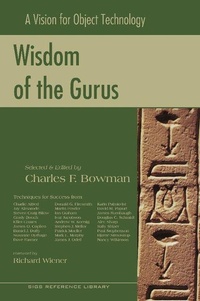
Wisdom of the Gurus
A Vision for Object Technology
Published on 5. February 1998
Book
Paperback/Softback
468 pages
978-0-13-499849-7 (ISBN)
Description
Wisdom of the Gurus contains articles by the top gurus in object technology, including Bilow, Booch, Coplien, Duffy, Jacobson, Meller, Odell, Rumbaugh, and Shlaer. The editor of this volume has culled the best and most relevant articles from OOP, Object Magazine, C++ Report, ROAD, and The Smalltalk Report. The result is a single comprehensive source for advanced information on object technology. Accurate, and advanced, this book covers every facet of the object-oriented paradigm.
More details
Series
Language
English
Place of publication
Upper Saddle River
United States
Publishing group
Pearson Education (US)
Target group
Professional and scholarly
Product notice
Paperback (trade)
Illustrations
Worked examples or Exercises
Dimensions
Height: 229 mm
Width: 152 mm
Thickness: 25 mm
Weight
672 gr
ISBN-13
978-0-13-499849-7 (9780134998497)
Copyright in bibliographic data and cover images is held by Nielsen Book Services Limited or by the publishers or by their respective licensors: all rights reserved.
Schweitzer Classification
Other editions
Additional editions

Book
01/1996
Cambridge University Press
Unfortunately, price unknown
Article exhausted; check for reprint
Previous edition
Book
01/1996
Cambridge University Press
Unfortunately, price unknown
Article exhausted; check for reprint
Persons
Content
Part I. Object Modelling: 1. Association multiplicity D. M. Papurt; 2. Additional aspects of association D. M. Papurt; 3. Well-structured object-oriented architectures G. Booch; 4. From analysis to design using templates, part 1 J. J. Odell and M. Fowler; 5. From analysis to design using templates, part 2 J. J. Odell and M. Fowler; 6. From analysis to design using templates, part 3 J. J. Odell and M. Fowler; 7. A non-procedural process model for object-oriented software development I. Graham; 8. Business rules J. J. Odell; 9. Systems of interconnected systems I. Jacobson, with K. Palmkvist and S. Dyrhage; Part II. Development Methodologies: 10. Object-oriented requirements analysis, part I: finding abstractions and their relationships D. J. Duffy; 11. Object-oriented requirements analysis, part 1: dynamic modeling D. J. Duffy; 12. Object-oriented requirements analysis, part 2: system responsibilities, functional modeling, and scalability issues D. J. Duffy; 13. Use cases in large-scale systems I. Jacobson; 14. Formalizing use-case modeling I. Jacobson; 15. Defining and developing user-interface intensive applications with use cases S. C. Bilow; 16. Use cases: the pros and cons D. G. Firesmith; 17. Formalizing the output N. M. Wilkinson; 18. Formalizing the output, part 2 N. M. Wilkinson; 19. A private workspace: why a shared repository is bad for large projects J. Rumbaugh; 20. Object-oriented regression testing D. G. Firesmith; 21. A vision S. Shlaer; 22. The development team G. Booch; Part III. Patterns: 23. Pattern languages for organization and process J. O. Coplien; 24. Patterns and idioms in circles, complex ellipses, and real bridges J. O. Coplien; 25. Pattern mining J. O. Coplien; 26. Observations on the role of patterns in Object-oriented software development C. Alfred and S. J. Mellor; 27. Using design patterns to evolve system software from UNIX to Windows NT D. C. Schmidt and P. Stephenson; Part IV. Languages: 28. The beauty and power of C++ E. Coates; 29. A perspective on ISO C++ B. Stroustrup; 30. Introduction to iterator adaptors A. W. Koenig; 31. Function objects, templates, and inheritance A. W. Koenig; 32. Managing concurrency conflicts in Smalltalk J. Almarode; 33. Coverage analysis in Smalltalk M. L. Murphy; 34. Processes A. Sharp and D. Farmer; 35. Transactions in Smalltalk J. Almarode; 36. Building a gopher from sockets and widgets P. Mueller.