

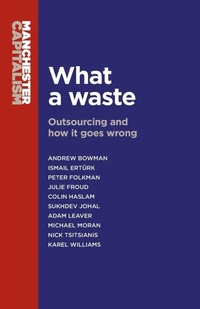
What a Waste
Outsourcing and How it Goes Wrong
Published on 1. September 2015
Book
Paperback/Softback
120 pages
978-0-7190-9953-3 (ISBN)
Description
This is the first ever book to analyse outsourcing - contracting out public services to private business interests. It is an unacknowledged revolution in the British economy, and it has happened quietly, but it is creating powerful new corporate interests, transforming the organisation of government at all levels, and is simultaneously enriching a new business elite and creating numerous fiascos in the delivery of public services. What links the brutal treatment of asylum-seeking detainees, the disciplining of welfare benefit claimants, the profits effortlessly earned by the privatised rail companies, and the fiasco of the management of security at the 2012 Olympics? In a word: outsourcing.
This book, by the renowned research team at the Centre for Research on Socio-Cultural Change in Manchester, is the first to combine 'follow the money' research with accessibility for the engaged citizen, and the first to balance critique with practical suggestions for policy reform. -- .
This book, by the renowned research team at the Centre for Research on Socio-Cultural Change in Manchester, is the first to combine 'follow the money' research with accessibility for the engaged citizen, and the first to balance critique with practical suggestions for policy reform. -- .
More details
Series
Language
English
Place of publication
Manchester
United Kingdom
Target group
Professional and scholarly
Illustrations
Line drawings, black & white
Dimensions
Height: 216 mm
Width: 140 mm
Thickness: 7 mm
Weight
162 gr
ISBN-13
978-0-7190-9953-3 (9780719099533)
Copyright in bibliographic data and cover images is held by Nielsen Book Services Limited or by the publishers or by their respective licensors: all rights reserved.
Schweitzer Classification
Other editions
Additional editions
E-Book
09/2015
Manchester University Press
€17.49
Available for download
Persons
Andrew Bowman is a member of the Centre for Research on Socio Cultural Change
Ismail Ertuerk is a Senior Lecturer at Manchester Business School and a member of CRESC
Peter Folkman is Honorary Professor at Manchester Business School and a member of CRESC
Julie Froud is Professor of Financial Innovation at Manchester Business School and a member of CRESC
Colin Haslam is Professor in Accounting/Finance at Queen Mary, University of London
Sukhdev Johal is Chair in Accounting & Strategy at Queen Mary University of London
Adam Leaver is Senior Lecturer in Business Analysis at Manchester Business School and a member of CRESC
Michael Moran is Professor of Government at Manchester Business School and a member of CRESC
Nick Tsitsianis is Senior Lecturer in Accounting at Queen Mary University of London
Karel Williams is Professor of Accounting and Political Economy at Manchester Business School and a Director of CRESC -- .
Ismail Ertuerk is a Senior Lecturer at Manchester Business School and a member of CRESC
Peter Folkman is Honorary Professor at Manchester Business School and a member of CRESC
Julie Froud is Professor of Financial Innovation at Manchester Business School and a member of CRESC
Colin Haslam is Professor in Accounting/Finance at Queen Mary, University of London
Sukhdev Johal is Chair in Accounting & Strategy at Queen Mary University of London
Adam Leaver is Senior Lecturer in Business Analysis at Manchester Business School and a member of CRESC
Michael Moran is Professor of Government at Manchester Business School and a member of CRESC
Nick Tsitsianis is Senior Lecturer in Accounting at Queen Mary University of London
Karel Williams is Professor of Accounting and Political Economy at Manchester Business School and a Director of CRESC -- .
Content
Introduction
1. Outsourcing fiascos and the dynamics of outsourcing
2. Routine profiteering on contracts
3. Double jeopardy, corporate fragility and the outsourcing sector
4. Centralisation and outsourcing
5. Conclusions
Index -- .
1. Outsourcing fiascos and the dynamics of outsourcing
2. Routine profiteering on contracts
3. Double jeopardy, corporate fragility and the outsourcing sector
4. Centralisation and outsourcing
5. Conclusions
Index -- .