

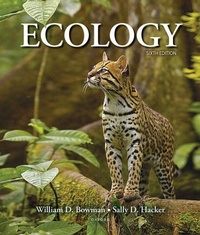
Ecology
6th Edition
Published on 18. August 2023
Book
Paperback/Softback
744 pages
978-0-19-761404-4 (ISBN)
Description
Ecology is an easy-to-read and well-organized text for instructors and students to explore the basics and promote ecological literacy.
Ecology, sixth edition, introduces readers to the beauty of nature and the importance of ecology and provides content in a way that engages students without overwhelming them in the process. The authors motivate students with an engaging case study conceptual approach that highlights relevant applications and data-driven examples.
Ecology, sixth edition, introduces readers to the beauty of nature and the importance of ecology and provides content in a way that engages students without overwhelming them in the process. The authors motivate students with an engaging case study conceptual approach that highlights relevant applications and data-driven examples.
Reviews / Votes
The chapters follow a logical story line with useful case studies and review material extremely helpful to students at different stages of learning and development. It will challenge students, yet provide a framework for understanding the material."- William Hintz, The University of Toledo I think the most compelling features are the comprehensive nature of the text, as well as the online resources for "new" professors."
- Geoffrey Cook, University of Central Florida This ecology textbook edition builds upon rich examples, and current literature. It is also provides multiple tools to engage students and enhance their understanding of important topics."
-Tim Tibbetts, Monmouth College
More details
Edition
6th Revised edition
Language
English
Place of publication
New York
United States
Target group
College/higher education
Edition type
Revised edition
Dimensions
Height: 277 mm
Width: 235 mm
Thickness: 30 mm
Weight
1670 gr
ISBN-13
978-0-19-761404-4 (9780197614044)
Copyright in bibliographic data and cover images is held by Nielsen Book Services Limited or by the publishers or by their respective licensors: all rights reserved.
Schweitzer Classification
Other editions
Previous edition
William Bowman | Sally Hacker | Michael L. Cain
Ecology
Book
03/2017
4th Edition
Oxford University Press Inc
€72.75
Article exhausted; check for reprint
Persons
William D. Bowman is a Professor Emeritus at the University of Colorado at Boulder, affiliated with the Department of Ecology and Evolutionary Biology, Mountain Research Station, and the Institute of Arctic and Alpine Research. He earned his Ph.D. from Duke University. Dr. Bowman has taught courses in introductory ecology, plant ecology, plant-soil interactions, and ecosystems ecology, and for over three decades he directed undergraduate summer field courses and research programs. His research focuses on the intersections of physiological ecology, community dynamics, and ecosystem function, particularly in the context of environmental change.
Sally D. Hacker is a Professor at Oregon State University, Corvallis, where she has been a faculty member since 2004. She has taught courses in introductory ecology, community ecology, and marine biology. She is particularly interested in promoting active and experiential learning for students interested in ecology and field experiences. Dr.
Hacker's research explores the structure, function, and services of natural and managed ecosystems under varying contexts of species interactions and global change. She has conducted research with plants and animals in rocky intertidal, estuarine, and coastal dune ecosystems. Her work has most recently focused on the protective role of coastal ecosystems in mitigating the vulnerability from climate change.
Sally D. Hacker is a Professor at Oregon State University, Corvallis, where she has been a faculty member since 2004. She has taught courses in introductory ecology, community ecology, and marine biology. She is particularly interested in promoting active and experiential learning for students interested in ecology and field experiences. Dr.
Hacker's research explores the structure, function, and services of natural and managed ecosystems under varying contexts of species interactions and global change. She has conducted research with plants and animals in rocky intertidal, estuarine, and coastal dune ecosystems. Her work has most recently focused on the protective role of coastal ecosystems in mitigating the vulnerability from climate change.
Content
1. The Web of Life Unit 1. Organisms and Their Environment 2. The Physical Environment
3. The Biosphere
4. Coping with Environmental Variation: Temperature and Water
5. Coping with Environmental Variation: Energy Unit 2. Evolutionary Ecology
6. Evolution and Ecology
7. Life History
8. Behavioral Ecology Unit 3. Populations
9. Population Distribution and Abundance
10. Population Dynamics
11. Population Growth and Regulation Unit 4. Species Interactions
12. Predation
13. Parasitism
14. Competition
15. Mutualism and Commensalism Unit 5. Communities
16. The Nature of Communities
17. Change in Communities
18. Biogeography
19. Species Diversity in Communities Unit 6. Ecosystems
20. Production
21. Energy Flow and Food Webs
22. Nutrient Supply and Cycling Unit 7. Applied and Large-Scale Ecology
23. Conservation Biology
24. Landscape Ecology and Ecosystem Management
25. Global Ecology
3. The Biosphere
4. Coping with Environmental Variation: Temperature and Water
5. Coping with Environmental Variation: Energy Unit 2. Evolutionary Ecology
6. Evolution and Ecology
7. Life History
8. Behavioral Ecology Unit 3. Populations
9. Population Distribution and Abundance
10. Population Dynamics
11. Population Growth and Regulation Unit 4. Species Interactions
12. Predation
13. Parasitism
14. Competition
15. Mutualism and Commensalism Unit 5. Communities
16. The Nature of Communities
17. Change in Communities
18. Biogeography
19. Species Diversity in Communities Unit 6. Ecosystems
20. Production
21. Energy Flow and Food Webs
22. Nutrient Supply and Cycling Unit 7. Applied and Large-Scale Ecology
23. Conservation Biology
24. Landscape Ecology and Ecosystem Management
25. Global Ecology