

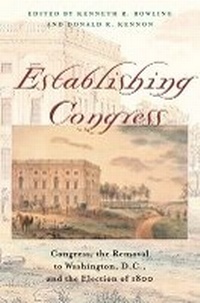
Establishing Congress
The Removal to Washington, D.C., and the Election of 1800
Will be published approx. on 1. January 2005
Book
Hardback
264 pages
978-0-8214-1619-8 (ISBN)
Description
Establishing Congress: The Removal to Washington, D.C., and the Election of 1800 focuses on the end of the 1790s, when, in rapid succession, George Washington died, the federal government moved to Washington, D.C., and the election of 1800 put Thomas Jefferson and the Democratic-Republican Party in charge of the federal government.
Establishing Congress dispels the myths and misinformation that surround the federal government's move to Washington and demonstrates that the election of 1800 changed American party politics forever, establishing the success of the American experiment in government and completing the founding of the Republic. It also contends that the lame-duck session of Congress had far-reaching implications for the governance of the District of Columbia. Later chapters examine aspects of the political iconography of the Capitol-one illuminating Jefferson's role in turning the building into a temple for the legislature and an instrument for nation-building, another analyzing the fascinating decades-long debate over whether to bury George Washington in the Capitol.
The book considers as well the political implications of social life in early Washington, examining the political lobbying by Washington women within a social context and detailing the social and political life in the city's homes, hotels, boardinghouses, and eating messes. Establishing Congress is an invaluable reference work for anyone interested in these pivotal moments in American history.
Establishing Congress dispels the myths and misinformation that surround the federal government's move to Washington and demonstrates that the election of 1800 changed American party politics forever, establishing the success of the American experiment in government and completing the founding of the Republic. It also contends that the lame-duck session of Congress had far-reaching implications for the governance of the District of Columbia. Later chapters examine aspects of the political iconography of the Capitol-one illuminating Jefferson's role in turning the building into a temple for the legislature and an instrument for nation-building, another analyzing the fascinating decades-long debate over whether to bury George Washington in the Capitol.
The book considers as well the political implications of social life in early Washington, examining the political lobbying by Washington women within a social context and detailing the social and political life in the city's homes, hotels, boardinghouses, and eating messes. Establishing Congress is an invaluable reference work for anyone interested in these pivotal moments in American history.
Reviews / Votes
"These essays remind us how crucial the election of 1800 was and emphasize the significance of removing the capital to Washington, D.C., for American politics and culture.... Political history survives. These essays help explain why."More details
Series
Language
English
Place of publication
Athens
United States
Target group
College/higher education
Professional and scholarly
Product notice
Paper over boards
Dimensions
Height: 229 mm
Width: 152 mm
ISBN-13
978-0-8214-1619-8 (9780821416198)
Copyright in bibliographic data and cover images is held by Nielsen Book Services Limited or by the publishers or by their respective licensors: all rights reserved.
Schweitzer Classification
Persons
Kenneth R. Bowling is coeditor of The Documentary History of the First Federal Congress, 1789-1791, and the author of The Creation of Washington, D.C.: The Idea and Location of the American Capital.
Donald R. Kennon is the former chief historian and vice president of the United States Capitol Historical Society. He is editor of the Ohio University Press series Perspectives on the History of Congress, 1789-1801.
Donald R. Kennon is the former chief historian and vice president of the United States Capitol Historical Society. He is editor of the Ohio University Press series Perspectives on the History of Congress, 1789-1801.