

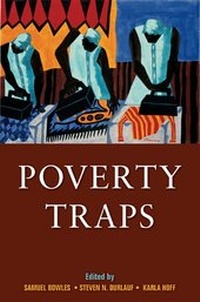
Poverty Traps
Published on 19. March 2006
Book
Hardback
256 pages
978-0-691-12500-8 (ISBN)
Description
Much popular belief--and public policy--rests on the idea that those born into poverty have it in their power to escape. But the persistence of poverty and ever-growing economic inequality around the world have led many economists to seriously question the model of individual economic self-determination when it comes to the poor. In Poverty Traps, Samuel Bowles, Steven Durlauf, Karla Hoff, and the book's other contributors argue that there are many conditions that may trap individuals, groups, and whole economies in intractable poverty. For the first time the editors have brought together the perspectives of economics, economic history, and sociology to assess what we know--and don't know--about such traps. Among the sources of the poverty of nations, the authors assign a primary role to social and political institutions, ranging from corruption to seemingly benign social customs such as kin systems. Many of the institutions that keep nations poor have deep roots in colonial history and persist long after their initial causes are gone.
Neighborhood effects--influences such as networks, role models, and aspirations--can create hard-to-escape pockets of poverty even in rich countries. Similar individuals in dissimilar socioeconomic environments develop different preferences and beliefs that can transmit poverty or affluence from generation to generation. The book presents evidence of harmful neighborhood effects and discusses policies to overcome them, with attention to the uncertainty that exists in evaluating such policies.
Neighborhood effects--influences such as networks, role models, and aspirations--can create hard-to-escape pockets of poverty even in rich countries. Similar individuals in dissimilar socioeconomic environments develop different preferences and beliefs that can transmit poverty or affluence from generation to generation. The book presents evidence of harmful neighborhood effects and discusses policies to overcome them, with attention to the uncertainty that exists in evaluating such policies.
Reviews / Votes
"The collection is a thought-provoking book that provides a comprehensive examination of persistent poverty in both the United States and developing counties... Poverty Traps should be read by any economist, social scientist, policymaker, or anyone else interested in the study of persistent poverty."--William Levernier, Journal of Regional ScienceMore details
Language
English
Place of publication
New Jersey
United States
Target group
Professional and scholarly
College/higher education
Product notice
Trade binding
Illustrations
29 line illus. 8 tables.
Dimensions
Height: 229 mm
Width: 152 mm
Weight
482 gr
ISBN-13
978-0-691-12500-8 (9780691125008)
Copyright in bibliographic data and cover images is held by Nielsen Book Services Limited or by the publishers or by their respective licensors: all rights reserved.
Schweitzer Classification
Other editions
Additional editions
Samuel Bowles | Steven N. Durlauf | Karla Hoff
Poverty Traps
E-Book
10/2011
1st Edition
Princeton University Press
from
€106.95
Available for download
Persons
Samuel Bowles is Research Professor and Director of the Behavioral Sciences Program at the Santa Fe Institute, and Professor of Economics at the University of Siena. He codirects the MacArthur Foundation Research Network on Inequality and Economic Performance, and his books include Microeconomics (Princeton/Russell Sage Foundation). Steven N. Durlauf is Kenneth J. Arrow Professor of Economics at the University of Wisconsin, Madison, and editor of the forthcoming Palgrave Dictionary of Economics. Karla Hoff is a Senior Research Economist at the World Bank and a member of the MacArthur Research Network on Inequality and Economic Performance.
Content
Acknowledgments vii Introduction by Samuel Bowles, Steven N. Durlauf, and Karla Hoff 1 Part One: Threshold Effects 15 Chapter 1: The Theory of Poverty Traps What Have We Learned? by Costas Azariadis 17 Part Two: by Institutions 41 Chapter 2: The Persistence of Poverty in the Americas The Role of Institutions by Stanley L. Engerman and Kenneth L. Sokoloff 43 Chapter 3: Parasites by Halvor Mehlum, Karl Moene, and Ragnar Torvik 79 Chapter 4: The Kin System as a Poverty Trap? byKarla Hoff and Arijit Sen 95 Chapter 5: Institutional Poverty Traps by Samuel Bowles 116 Part Three: Neighborhood Effects 139 Chapter 6: Groups, Social Influences, and Inequality by Steven N. Durlauf 141 Chapter 7: Durable Inequality Spatial Dynamics, Social Processes, and the Persistence of Poverty in Chicago Neighborhoods by Robert J. Sampson and Jeffrey D. Morenoff 176 Chapter 8: Spatial Concentration and Social Stratification Does the Clustering of Disadvantage "Beget " Bad Outcomes?? by Michael E. Sobel 204 Contributors 231 Index 233