

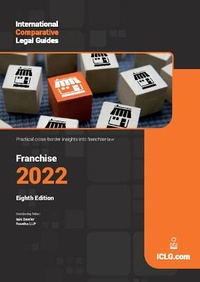
International Comparative Legal Guide - Franchise 2022
8th Edition
Published on 21. October 2021
Book
Paperback/Softback
212 pages
978-1-83918-145-0 (ISBN)
Description
Welcome to ICLG - Franchise 2022, a guide designed for anyone looking to grow their business through franchising, whether considering franchising for the first time or considering expanding an existing franchise system regionally or internationally.
The content of this publication has been provided by lawyers and industry specialists in each country who specialise in franchise law and brand licensing, and who are familiar with the needs of business people who want to gain an understanding of the key regulatory, legal and practical considerations that must be considered when contemplating an expansion strategy using a franchise system. Furthermore, the questions for each country have been formulated based on actual experience of advising clients in relation to international expansion programmes, and have been sense-checked by asking a number of existing international franchisors about the issues they have faced and the specific questions they wanted answers to when they were considering entering a new territory for the first time.
This publication will not make you an instant expert in the laws and practice of franchising. Franchising as a legal concept involves a number of other disciplines that have a material impact on the way you will structure your franchise system in any given country. It is essentially a combination of regulatory compliance (sometimes), contract law, tax-structuring, intellectual property law (in the form of trade mark protection and brand licensing), real estate and competition law issues, with a bit of employment law, corporate law, data privacy compliance and cyber risk (and more) thrown in for good measure. On top of this, if you are looking to franchise internationally, you need to overlay country-specific mandatory legal requirements, a recognition of the difference between civil law and common law jurisdictions, and cultural and business environmental considerations. As such, it is almost certainly the case that you will need to consult local legal counsel who advise on structural issues relating to the set-up of franchise systems and the review and "localisation" of the legal documents in the territory.
What this publication will do is enable you to see, at a glance, what you need to know about building a franchise system for the first time or taking your franchise system into other countries. You can use this publication to get a well-informed insight into the
questions you will undoubtedly have when you decide to create a franchise system or when you take your existing system overseas. It will enable you to be better informed, to anticipate issues, to scope your requirements, and so be better prepared, as well as enabling you to manage the external resources that you will need, in an efficient and cost-effective way.
Expansion, whether domestic or international, should be carefully planned; it should be strategic - carried out with the aim of delivering a pre-defined goal, and with the approach being tailored to deliver your commercial objectives.
The importance of getting the system right from the outset cannot be overemphasised. The success of a franchise system depends on the franchisor providing franchisees with a proven and successful business model. Whilst the costs of setting up the franchise system in the first place and the additional costs of adapting an existing domestic franchise system so that it can be rolled out and successfully replicated in new geographic locations should not be underestimated, investing in developing the system, including a workable and palatable (to a franchisee) set of franchise documents, will repay you many times over.
Welcome to ICLG - Franchise 2022, a guide designed for anyone looking to grow their business through franchising, whether considering franchising for the first time or considering expanding an existing franchise system regionally or internationally.
The content of this publication has been provided by lawyers and industry specialists in each country who specialise in franchise law and brand licensing, and who are familiar with the needs of business people who want to gain an understanding of the key regulatory, legal and practical considerations that must be considered when contemplating an expansion strategy using a franchise system. Furthermore, the questions for each country have been formulated based on actual experience of advising clients in relation to international expansion programmes, and have been sense-checked by asking a number of existing international franchisors about the issues they have faced and the specific questions they wanted answers to when they were considering entering a new territory for the first time.
This publication will not make you an instant expert in the laws and practice of franchising. Franchising as a legal concept involves a number of other disciplines that have a material impact on the way you will structure your franchise system in any given country. It is essentially a combination of regulatory compliance (sometimes), contract law, tax-structuring, intellectual property law (in the form of trade mark protection and brand licensing), real estate and competition law issues, with a bit of employment law, corporate law, data privacy compliance and cyber risk (and more) thrown in for good measure. On top of this, if you are looking to franchise internationally, you need to overlay country-specific mandatory legal requirements, a recognition of the difference between civil law and common law jurisdictions, and cultural and business environmental considerations. As such, it is almost certainly the case that you will need to consult local legal counsel who advise on structural issues relating to the set-up of franchise systems and the review and "localisation" of the legal documents in the territory.
What this publication will do is enable you to see, at a glance, what you need to know about building a franchise system for the first time or taking your franchise system into other countries. You can use this publication to get a well-informed insight into the
questions you will undoubtedly have when you decide to create a franchise system or when you take your existing system overseas. It will enable you to be better informed, to anticipate issues, to scope your requirements, and so be better prepared, as well as enabling you to manage the external resources that you will need, in an efficient and cost-effective way.
Expansion, whether domestic or international, should be carefully planned; it should be strategic - carried out with the aim of delivering a pre-defined goal, and with the approach being tailored to deliver your commercial objectives.
The importance of getting the system right from the outset cannot be overemphasised. The success of a franchise system depends on the franchisor providing franchisees with a proven and successful business model. Whilst the costs of setting up the franchise system in the first place and the additional costs of adapting an existing domestic franchise system so that it can be rolled out and successfully replicated in new geographic locations should not be underestimated, investing in developing the system, including a workable and palatable (to a franchisee) set of franchise documents, will repay you many times over.
The content of this publication has been provided by lawyers and industry specialists in each country who specialise in franchise law and brand licensing, and who are familiar with the needs of business people who want to gain an understanding of the key regulatory, legal and practical considerations that must be considered when contemplating an expansion strategy using a franchise system. Furthermore, the questions for each country have been formulated based on actual experience of advising clients in relation to international expansion programmes, and have been sense-checked by asking a number of existing international franchisors about the issues they have faced and the specific questions they wanted answers to when they were considering entering a new territory for the first time.
This publication will not make you an instant expert in the laws and practice of franchising. Franchising as a legal concept involves a number of other disciplines that have a material impact on the way you will structure your franchise system in any given country. It is essentially a combination of regulatory compliance (sometimes), contract law, tax-structuring, intellectual property law (in the form of trade mark protection and brand licensing), real estate and competition law issues, with a bit of employment law, corporate law, data privacy compliance and cyber risk (and more) thrown in for good measure. On top of this, if you are looking to franchise internationally, you need to overlay country-specific mandatory legal requirements, a recognition of the difference between civil law and common law jurisdictions, and cultural and business environmental considerations. As such, it is almost certainly the case that you will need to consult local legal counsel who advise on structural issues relating to the set-up of franchise systems and the review and "localisation" of the legal documents in the territory.
What this publication will do is enable you to see, at a glance, what you need to know about building a franchise system for the first time or taking your franchise system into other countries. You can use this publication to get a well-informed insight into the
questions you will undoubtedly have when you decide to create a franchise system or when you take your existing system overseas. It will enable you to be better informed, to anticipate issues, to scope your requirements, and so be better prepared, as well as enabling you to manage the external resources that you will need, in an efficient and cost-effective way.
Expansion, whether domestic or international, should be carefully planned; it should be strategic - carried out with the aim of delivering a pre-defined goal, and with the approach being tailored to deliver your commercial objectives.
The importance of getting the system right from the outset cannot be overemphasised. The success of a franchise system depends on the franchisor providing franchisees with a proven and successful business model. Whilst the costs of setting up the franchise system in the first place and the additional costs of adapting an existing domestic franchise system so that it can be rolled out and successfully replicated in new geographic locations should not be underestimated, investing in developing the system, including a workable and palatable (to a franchisee) set of franchise documents, will repay you many times over.
Welcome to ICLG - Franchise 2022, a guide designed for anyone looking to grow their business through franchising, whether considering franchising for the first time or considering expanding an existing franchise system regionally or internationally.
The content of this publication has been provided by lawyers and industry specialists in each country who specialise in franchise law and brand licensing, and who are familiar with the needs of business people who want to gain an understanding of the key regulatory, legal and practical considerations that must be considered when contemplating an expansion strategy using a franchise system. Furthermore, the questions for each country have been formulated based on actual experience of advising clients in relation to international expansion programmes, and have been sense-checked by asking a number of existing international franchisors about the issues they have faced and the specific questions they wanted answers to when they were considering entering a new territory for the first time.
This publication will not make you an instant expert in the laws and practice of franchising. Franchising as a legal concept involves a number of other disciplines that have a material impact on the way you will structure your franchise system in any given country. It is essentially a combination of regulatory compliance (sometimes), contract law, tax-structuring, intellectual property law (in the form of trade mark protection and brand licensing), real estate and competition law issues, with a bit of employment law, corporate law, data privacy compliance and cyber risk (and more) thrown in for good measure. On top of this, if you are looking to franchise internationally, you need to overlay country-specific mandatory legal requirements, a recognition of the difference between civil law and common law jurisdictions, and cultural and business environmental considerations. As such, it is almost certainly the case that you will need to consult local legal counsel who advise on structural issues relating to the set-up of franchise systems and the review and "localisation" of the legal documents in the territory.
What this publication will do is enable you to see, at a glance, what you need to know about building a franchise system for the first time or taking your franchise system into other countries. You can use this publication to get a well-informed insight into the
questions you will undoubtedly have when you decide to create a franchise system or when you take your existing system overseas. It will enable you to be better informed, to anticipate issues, to scope your requirements, and so be better prepared, as well as enabling you to manage the external resources that you will need, in an efficient and cost-effective way.
Expansion, whether domestic or international, should be carefully planned; it should be strategic - carried out with the aim of delivering a pre-defined goal, and with the approach being tailored to deliver your commercial objectives.
The importance of getting the system right from the outset cannot be overemphasised. The success of a franchise system depends on the franchisor providing franchisees with a proven and successful business model. Whilst the costs of setting up the franchise system in the first place and the additional costs of adapting an existing domestic franchise system so that it can be rolled out and successfully replicated in new geographic locations should not be underestimated, investing in developing the system, including a workable and palatable (to a franchisee) set of franchise documents, will repay you many times over.
More details
Series
Edition
8th Revised edition
Language
English
Place of publication
London
United Kingdom
Target group
Professional and scholarly
Edition type
Revised edition
Dimensions
Height: 297 mm
Width: 210 mm
Thickness: 9 mm
ISBN-13
978-1-83918-145-0 (9781839181450)
Copyright in bibliographic data and cover images is held by Nielsen Book Services Limited or by the publishers or by their respective licensors: all rights reserved.
Schweitzer Classification
Other editions
New editions

Book
10/2022
9th Edition
Global Legal Group Ltd
€438.97
Article exhausted; check for reprint
Previous edition
Book
10/2020
7th Edition
Global Legal Group Ltd
€438.97
Article exhausted; check for reprint
Content
IFA: Protecting, Promoting and Enhancing the Franchise Model, International Franchise Association 1
British Franchise Association: Uniting Voices in the Franchise Sector, Pip Wilkins QFP & Emily Price QFP, British Franchise Association 3
Austria - THUM Rechtsanwaltskanzlei Law Firm: Dr. Hubertus Thum 8
Brazil - Pitanga Bastos: Monica Pinheiro & Rodrigo Rodrigues 20
Canada - Dentons Canada LLP: Helen Fotinos, John Papagiannis & Stacy Shields 29
China - Jones & Co.: Paul Jones & Xin (Leo) Xu 40
England & Wales - Freeths LLP: Iain Bowler 49
France - LINKEA: Cecile Peskine & Clemence Casanova 61
Germany - Noerr PartGmbB: Dr. Tom Billing & Dr. Jasmin Schulzweida 70
Hungary - Bogsch & Partners Law Firm: Dr. Tamas Goedoelle, Dr. Pal Andras Gaspardy & Dr. Mark Pecsvarady 81
India - LexOrbis: C. R. Jacob & Dr. Shivani Shrivastava 90
Indonesia - Waruwu & Partners: Iyarman Waruwu, Restu Nalita Santika, Mikael Adlan Husni & Sazha Alisha 97
Japan - Anderson Mori & Tomotsune: Kenichi Sadaka & Aoi Inoue 105
Malaysia - Wong Jin Nee & Teo: Jin Nee Wong 114
Netherlands - Kennedy Van der Laan: Martine de Koning 125
Nigeria - AELEX: Davidson Oturu, Tiwalola Osazuwa & Frances Obiago 137
South Africa - Andersen: Ian Jacobsberg & Jackie Peart 145
Spain - ELZABURU: Javier Fernandez-Lasquetty Quintana & Alberto Lopez Cazalilla 153
Switzerland - Birgelen Wehrli Attorneys: Dr. Jeannette Wibmer 161
United Arab Emirates - BSA Ahmad Bin Hezeem & Associates: Munir Suboh, Amala Atieh & Felicity Hammond 171
USA - Rosen Karol Salis, PLLC: Richard L. Rosen, Leonard S. Salis & John A. Karol 180
British Franchise Association: Uniting Voices in the Franchise Sector, Pip Wilkins QFP & Emily Price QFP, British Franchise Association 3
Austria - THUM Rechtsanwaltskanzlei Law Firm: Dr. Hubertus Thum 8
Brazil - Pitanga Bastos: Monica Pinheiro & Rodrigo Rodrigues 20
Canada - Dentons Canada LLP: Helen Fotinos, John Papagiannis & Stacy Shields 29
China - Jones & Co.: Paul Jones & Xin (Leo) Xu 40
England & Wales - Freeths LLP: Iain Bowler 49
France - LINKEA: Cecile Peskine & Clemence Casanova 61
Germany - Noerr PartGmbB: Dr. Tom Billing & Dr. Jasmin Schulzweida 70
Hungary - Bogsch & Partners Law Firm: Dr. Tamas Goedoelle, Dr. Pal Andras Gaspardy & Dr. Mark Pecsvarady 81
India - LexOrbis: C. R. Jacob & Dr. Shivani Shrivastava 90
Indonesia - Waruwu & Partners: Iyarman Waruwu, Restu Nalita Santika, Mikael Adlan Husni & Sazha Alisha 97
Japan - Anderson Mori & Tomotsune: Kenichi Sadaka & Aoi Inoue 105
Malaysia - Wong Jin Nee & Teo: Jin Nee Wong 114
Netherlands - Kennedy Van der Laan: Martine de Koning 125
Nigeria - AELEX: Davidson Oturu, Tiwalola Osazuwa & Frances Obiago 137
South Africa - Andersen: Ian Jacobsberg & Jackie Peart 145
Spain - ELZABURU: Javier Fernandez-Lasquetty Quintana & Alberto Lopez Cazalilla 153
Switzerland - Birgelen Wehrli Attorneys: Dr. Jeannette Wibmer 161
United Arab Emirates - BSA Ahmad Bin Hezeem & Associates: Munir Suboh, Amala Atieh & Felicity Hammond 171
USA - Rosen Karol Salis, PLLC: Richard L. Rosen, Leonard S. Salis & John A. Karol 180