

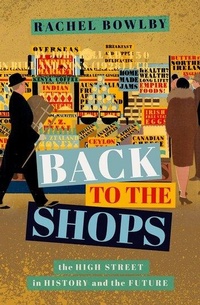
Back to the Shops
The High Street in History and the Future
Published on 24. February 2022
Book
Hardback
286 pages
978-0-19-881591-4 (ISBN)
Description
What will become of the shops? More than ever, the high street appears to be under mortal threat, its shops boarded up as the sad 'bricks and mortar' survivals of a pre-online retail world. But behind the bleak appearance, there is more to see.
Back to the Shops offers a set of short and surprising chapters, each one a window into a different shop type or mode of selling. Old shopping streets are seen from new angles; fast fashion shows up in eighteenth-century edits. Here are pedlars and pop-ups, mail order catalogues and mobile greengrocers' shops. Here too are food markets open till late on a Saturday night, and tiny subscription libraries tucked away at the back of the sweet shop.
Over time, shops have occupied radically different places in cultural arguments and in our everyday lives. They are essential sources of daily provisions, but they are also the visible evidence of consuming excess. They are local community hubs and they are dreamlands of distraction.
Shops are inherently spaces of imagination as well as of practicality. They belong with their own surrounding streets and town; they bring back the times and places of our lives. They linger in stories of all kinds, whether far-fetched or round the corner. From butcher to baker and from markets to motor vans-after reading this book, you will want to go back to the shops.
Back to the Shops offers a set of short and surprising chapters, each one a window into a different shop type or mode of selling. Old shopping streets are seen from new angles; fast fashion shows up in eighteenth-century edits. Here are pedlars and pop-ups, mail order catalogues and mobile greengrocers' shops. Here too are food markets open till late on a Saturday night, and tiny subscription libraries tucked away at the back of the sweet shop.
Over time, shops have occupied radically different places in cultural arguments and in our everyday lives. They are essential sources of daily provisions, but they are also the visible evidence of consuming excess. They are local community hubs and they are dreamlands of distraction.
Shops are inherently spaces of imagination as well as of practicality. They belong with their own surrounding streets and town; they bring back the times and places of our lives. They linger in stories of all kinds, whether far-fetched or round the corner. From butcher to baker and from markets to motor vans-after reading this book, you will want to go back to the shops.
Reviews / Votes
This is a thoroughly enjoyable book for anyone interested in the twentieth century and it is a good place to start for anyone seeking a social history research project. * Rosemary Conely, Open History * She skillfully interweaves accounts from British literature, both well known (e.g., those by Charles Dickens or Jane Austen) and more obscure works with other sources to examine the evolving nature of consumer culture in modern Britain. * A. C. Stanley, CHOICE * Bowlby has been thinking about shops and shopping the length of her distinguished career as a critic of commerce and culture...Short chapters on different shops or modes of selling...offer a tour dhorizon that is both rich and unexpected. The commentary is concise and precise, featuring attention to language and flourishes of glee. * Norma Clarke, Times Literary Supplement * By looking to the historical role of a vast array of shops across two centuries, this book makes a spirited argument for their central, and continued, place in society. Its also packed with stories, case studies and diverting detours, including a consideration of the honourable tradition of hairdressers with punning names. * , BBC History Revealed * With the rise of internet shopping throwing future of the high street into uncertainty, this is a timely and intriguing read * BBC History Magazine * Rachel Bowlby has captured the essence of shopping all the way from the 18th century to todays chain stores and pop-ups in her fascinating social history... Well worth shopping for! * , People's Friend * A book for everyone... so readable * Tony Jasper, Methodist Recorder * Written throughout with a gait, a lilt and a swagger that are rather captivating, resonant with a personal voice that inhabits both time and space, collecting and recollecting gestures, images, imprints and practices as it does so Bowlby has a talent for words, for the world of associations and images that they can conjure and retrieve, for the incisiveness with which they can allow a mind like hers to read each step along the human journey of shopping and trade It is a fine journey into history, a resonant jaunt towards what we may well want to visit in the uncertain after * Mika Provata-Carlone, Bookanista * not only informative...but also a really lively and entertaining read * , Shiny New Books * A broad-based, long-run, and finely judged survey of our shopping history: this is the book to give us a necessary perspective on the twenty-first-century transformation now under way. * David Kynaston, author of Austerity Britain, Family Britain, and Modernity Britain * This book traces retailing trends from the first market stalls to internet shopping and is a timely indicator of how our town centres could develop over the next 50 years. * Sir John Timpson, Chair of Timpson and champion of town centre regeneration initiatives * Bowlby's book can be read as a whole. But it can equally well be dipped into and individual chapters read and reflected on. As such it is an invaluable addition to the literature on the history of shops and shopping in Britain. And it is a thoroughly good read * Ian Mitchell, History of Retailing and Consumption * This vital social function, and the significance of what Bowlby calls 'the small shopping cultures of daily purchasing life', absent from the online world, are powerfully advocated for in Back to the Shops. So too is the imaginative wealth to be found in the sheer variety of shopkeeping and shopping practices through history. * Miranda El-Rayess, Women: A Cultural Review *More details
Language
English
Place of publication
Oxford
United Kingdom
Target group
College/higher education
Product notice
sewn/stitched
Cloth over boards
Dimensions
Height: 220 mm
Width: 140 mm
Thickness: 25 mm
Weight
464 gr
ISBN-13
978-0-19-881591-4 (9780198815914)
Copyright in bibliographic data and cover images is held by Nielsen Book Services Limited or by the publishers or by their respective licensors: all rights reserved.
Schweitzer Classification
Other editions
Additional editions
E-Book
02/2022
1st Edition
OUP eBook
€11.49
Available for download
E-Book
02/2022
1st Edition
OUP eBook
€11.49
Available for download
Person
Rachel Bowlby teaches courses on the history and theory of consumer culture at University College London, where she is Professor of Comparative Literature. Previous books include Just Looking (on department stores), Shopping with Freud, and Carried Away (on supermarkets).
Content
List of Illustrations
Introduction
SETTINGS 1 Chain stores 2 Convenience 3 Fixed prices 4 Local shops 5 Mail order 6 Markets 7 Self-service and supermarkets 8 Shopping centres 9 Shop windows 10 Sources
ROLES 11 Collections 12 Counters 13 Credit and credibility 14 Customer loyalty 15 Motor vans and motor buses 16 Nineteenth-century bazaars 17 Pedlars 18 Saturday nights and Sundays 19 Scenes of shopping 20 Shopworkers and shopkeepers
SPECIALITIES 21 Bakers 22 Butchers 23 Chemists 24 Florists 25 Furniture shops 26 Haberdashery 27 Household goods 28 Jewellers 29 Sweet shops 30 Umbrella shops
Afterword
Acknowledgements Index
Introduction
SETTINGS 1 Chain stores 2 Convenience 3 Fixed prices 4 Local shops 5 Mail order 6 Markets 7 Self-service and supermarkets 8 Shopping centres 9 Shop windows 10 Sources
ROLES 11 Collections 12 Counters 13 Credit and credibility 14 Customer loyalty 15 Motor vans and motor buses 16 Nineteenth-century bazaars 17 Pedlars 18 Saturday nights and Sundays 19 Scenes of shopping 20 Shopworkers and shopkeepers
SPECIALITIES 21 Bakers 22 Butchers 23 Chemists 24 Florists 25 Furniture shops 26 Haberdashery 27 Household goods 28 Jewellers 29 Sweet shops 30 Umbrella shops
Afterword
Acknowledgements Index