

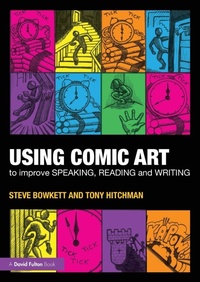
Using Comic Art to Improve Speaking, Reading and Writing
1st Edition
Published on 16. December 2011
Book
Paperback/Softback
186 pages
978-0-415-67551-2 (ISBN)
Description
Using Comic Art to Improve Speaking, Reading and Writing uses children's interest in pictures, comics and graphic novels as a way of developing their creative writing abilities, reading skills and oracy. The book's underpinning strategy is the use of comic art images as a visual analogue to help children generate, organise and refine their ideas when writing and talking about text.
In reading comic books children are engaging with highly complex and structured narrative forms. Whether they realise it or not, their emergent visual literacy promotes thinking skills and develops wider metacognitive abilities. Using Comic Art not only motivates children to read more widely, but also enables them to enjoy a richer imagined world when reading comics, text based stories and their own written work.
The book sets out a range of practical techniques and activities which focus on various aspects of narrative, including:
using comic art as a visual organiser for planning writing
openings and endings
identifying with the reader, using different genres and developing characters
creating pace, drama, tension and anticipation
includes 'Kapow!' techniques to kick start lessons
an afterword on the learning value of comics.
The activities in Using Comic Art start from this baseline of confident and competent comic-book readers, and show how skills they already possess can be transferred to a range of writing tasks. For instance, the way the panels on a comic's page are arranged can serve as a template for organising paragraphs in a written story or a piece of non-fiction writing. The visual conventions of a graphic novel - the shape of speech bubbles or the way the reader's attention is directed - can inform children in the use of written dialogue and the inclusion of vivid and relevant details.
A creative and essential resource for every primary classroom, Using Comic Art is ideal for primary and secondary school teachers and TAs, as well as primary PGCE students and BEd, BA Primary Undergraduates.
In reading comic books children are engaging with highly complex and structured narrative forms. Whether they realise it or not, their emergent visual literacy promotes thinking skills and develops wider metacognitive abilities. Using Comic Art not only motivates children to read more widely, but also enables them to enjoy a richer imagined world when reading comics, text based stories and their own written work.
The book sets out a range of practical techniques and activities which focus on various aspects of narrative, including:
using comic art as a visual organiser for planning writing
openings and endings
identifying with the reader, using different genres and developing characters
creating pace, drama, tension and anticipation
includes 'Kapow!' techniques to kick start lessons
an afterword on the learning value of comics.
The activities in Using Comic Art start from this baseline of confident and competent comic-book readers, and show how skills they already possess can be transferred to a range of writing tasks. For instance, the way the panels on a comic's page are arranged can serve as a template for organising paragraphs in a written story or a piece of non-fiction writing. The visual conventions of a graphic novel - the shape of speech bubbles or the way the reader's attention is directed - can inform children in the use of written dialogue and the inclusion of vivid and relevant details.
A creative and essential resource for every primary classroom, Using Comic Art is ideal for primary and secondary school teachers and TAs, as well as primary PGCE students and BEd, BA Primary Undergraduates.
More details
Language
English
Place of publication
London
United Kingdom
Publishing group
Taylor & Francis Ltd
Target group
College/higher education
Professional and scholarly
Professional and Professional Practice & Development
Illustrations
97 s/w Abbildungen
97 Illustrations, black and white
Dimensions
Height: 246 mm
Width: 174 mm
Thickness: 11 mm
Weight
356 gr
ISBN-13
978-0-415-67551-2 (9780415675512)
Copyright in bibliographic data and cover images is held by Nielsen Book Services Limited or by the publishers or by their respective licensors: all rights reserved.
Schweitzer Classification
Other editions
Additional editions
Steve Bowkett
Using Comic Art to Improve Speaking, Reading and Writing
E-Book
07/2012
1st Edition
Routledge
€41.99
Available for download
Steve Bowkett
Using Comic Art to Improve Speaking, Reading and Writing
E-Book
07/2012
1st Edition
Routledge
€41.99
Available for download
Steve Bowkett
Using Comic Art to Improve Speaking, Reading and Writing
Book
12/2011
1st Edition
Routledge
€185.80
Shipment within 15-20 days
Persons
Steve Bowkett taught English for twenty years and is now a full-time educational consultant, writer and storyteller. He is the author of more than fifty-five books including Jumpstart! Creativity and The Countdown to Writing series for Routledge.
Tony Hitchman has over thirty-five years of experience teaching throughout the primary age range in a variety of schools, culminating in eleven years as a primary headteacher. He has written scripts for the comic publisher DC Thompson and contributed cartoons to various small press publications.
Tony Hitchman has over thirty-five years of experience teaching throughout the primary age range in a variety of schools, culminating in eleven years as a primary headteacher. He has written scripts for the comic publisher DC Thompson and contributed cartoons to various small press publications.
Content
Introduction - comic art as a visual organiser for planning writing
Chapter 1: Strong Openings.
Chapter 2: Opening lines.
Chapter 3: What do you want the reader to see?
Chapter 4: Details add to the tension.
Chapter 5: Jump into the action.
Chapter 6: Small Important Details.
Chapter 7: Drawing as visual shorthand.
Chapter 8: Scripting.
Chapter 9 Strong Endings.
Chapter 10: Creating Quick Characters.
Chapter 11: Don't take that tone with me.
Chapter 12: Heroes and Villains.
Chapter 13: Controlling Pace.
Chapter 14: Build up the drama.
Chapter 15: Anticipation.
Chapter 16: Genre.
Chapter 17: Using Kapow Techniques for Art Appreciation.
Chapter 18: Kapow techniques and non-fiction writing.
Chapter 19: A note on rough layouts.
Chapter 20: Afterword - the learning value of comics.
Bibliography
Index.
Chapter 1: Strong Openings.
Chapter 2: Opening lines.
Chapter 3: What do you want the reader to see?
Chapter 4: Details add to the tension.
Chapter 5: Jump into the action.
Chapter 6: Small Important Details.
Chapter 7: Drawing as visual shorthand.
Chapter 8: Scripting.
Chapter 9 Strong Endings.
Chapter 10: Creating Quick Characters.
Chapter 11: Don't take that tone with me.
Chapter 12: Heroes and Villains.
Chapter 13: Controlling Pace.
Chapter 14: Build up the drama.
Chapter 15: Anticipation.
Chapter 16: Genre.
Chapter 17: Using Kapow Techniques for Art Appreciation.
Chapter 18: Kapow techniques and non-fiction writing.
Chapter 19: A note on rough layouts.
Chapter 20: Afterword - the learning value of comics.
Bibliography
Index.