

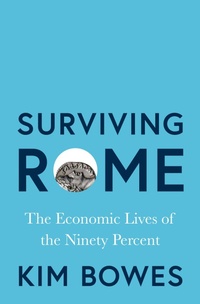
Surviving Rome
The Economic Lives of the Ninety Percent
Published on 4. November 2025
Book
Hardback
512 pages
978-0-691-27333-4 (ISBN)
Description
A radical revision-and worker's-eye view-of everything we thought we knew about the ancient Roman economy
The story of ancient Rome is predominantly one of great men with great fortunes. Surviving Rome unearths another history, one of ordinary Romans, who worked with their hands and survived through a combination of grit and grinding labor.
Focusing on the working majority, Kim Bowes tells the stories of people like the tenant farmer Epimachus, Faustilla the moneylender, and the pimp Philokles. She reveals how the economic changes of the period created a set of bitter challenges and opportunistic hustles for everyone from farmers and craftspeople to day laborers and slaves. She finds working people producing a consumer revolution, making and buying all manner of goods from fine pottery to children's toys. Many of the poorest working people probably pieced together a living from multiple sources of income, including wages. And she suggests that Romans' most daunting challenge was the struggle to save. Like many modern people, saving enough to buy land or start a business was a slow, precarious slog. Bowes shows how these economies of survival were shared by a wide swath of the populace, blurring the lines between genders, ages, and legal status.
Drawing on new archaeological and textual evidence, Surviving Rome presents a radical new perspective on the economy of ancient Rome while speaking to the challenges of today's laborers and gig workers surviving in an unforgiving global world.
The story of ancient Rome is predominantly one of great men with great fortunes. Surviving Rome unearths another history, one of ordinary Romans, who worked with their hands and survived through a combination of grit and grinding labor.
Focusing on the working majority, Kim Bowes tells the stories of people like the tenant farmer Epimachus, Faustilla the moneylender, and the pimp Philokles. She reveals how the economic changes of the period created a set of bitter challenges and opportunistic hustles for everyone from farmers and craftspeople to day laborers and slaves. She finds working people producing a consumer revolution, making and buying all manner of goods from fine pottery to children's toys. Many of the poorest working people probably pieced together a living from multiple sources of income, including wages. And she suggests that Romans' most daunting challenge was the struggle to save. Like many modern people, saving enough to buy land or start a business was a slow, precarious slog. Bowes shows how these economies of survival were shared by a wide swath of the populace, blurring the lines between genders, ages, and legal status.
Drawing on new archaeological and textual evidence, Surviving Rome presents a radical new perspective on the economy of ancient Rome while speaking to the challenges of today's laborers and gig workers surviving in an unforgiving global world.
Reviews / Votes
"A revolution in our understanding of the economic lives of the ancient Romans that [Bowes] masterfully summarises...The result is thrilling, because it overturns so many earlier assumptions."---Felix Martin, Financial Times "Superb."---Peter Jones, The Spectator "[A] magnificent account of how the 90 percent of the population of the Roman Empire . . . lived, worked, and died."---Paolo Tedesco, Jacobin "Dispensing with marble-clad elites and imperial triumphs, this eye-opening study brings ancient Rome down to street level-into the fields, workshops, and crowded tenements where real economic life unfolded. . . . [Bowes] challenges long-held myths about Roman prosperity and instead reveals a gritty, improvisational economy that resonates uncannily with our own."---Ghalib Dhalla, Indulge Magazine "Surviving Rome is that rarest of birds, an innovative and (yes) utterly gripping piece of economic history that any non-specialist can read with pleasure and excitement. . . a book of luminous humanity. . . Bowes takes us into the most intimate details of the lives of the Roman working majority. . . [her] admiration for these people's stubbornness, resilience and grit is tangible. She has done them proud."---Peter Thonemann, Times Literary SupplementMore details
Language
English
Place of publication
New Jersey
United States
Target group
College/higher education
Professional and scholarly
Product notice
Trade binding
Illustrations
69 b/w illus. 4 b/w maps. 16 tables.
Dimensions
Height: 241 mm
Width: 160 mm
Thickness: 43 mm
Weight
888 gr
ISBN-13
978-0-691-27333-4 (9780691273334)
Copyright in bibliographic data and cover images is held by Nielsen Book Services Limited or by the publishers or by their respective licensors: all rights reserved.
Schweitzer Classification
Other editions
Additional editions
E-Book
11/2025
1st Edition
Princeton University Press
€39.49
Available for download
Person
Kim Bowes is professor of archaeology and ancient history at the University of Pennsylvania. She is the author of Houses and Society in the Later Roman Empire and Private Worship, Public Values, and Religious Change in Late Antiquity.