

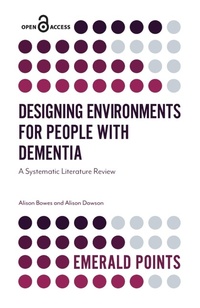
Designing Environments for People with Dementia
A Systematic Literature Review
Published on 8. February 2019
Book
Paperback/Softback
136 pages
978-1-78769-974-8 (ISBN)
Description
The ebook edition of this title is Open Access and is freely available to read online. This review systematically explores and assesses the quality of the evidence base for effective and supportive design of living environments for people living with Dementia.
Dementia is a major challenge for all countries, as the population with the condition is growing rapidly. Societies desperately need to identify measures which mean that they can continue to thrive with a large population of people who are cognitively impaired. Medical treatments are poor, and there is little indication of better medications appearing in the coming decades. There is urgent need for non-medical advances which can address the challenge including ensuring environments are conducive to living better with Dementia. Whilst there is a lot of activity in this area of Dementia friendly design, the evidence base remains poorly synthesized and weak.
This book pulls evidence together to provide a solid reference point from which further research and further developments in the field of Dementia care and support can proceed.;
Dementia is a major challenge for all countries, as the population with the condition is growing rapidly. Societies desperately need to identify measures which mean that they can continue to thrive with a large population of people who are cognitively impaired. Medical treatments are poor, and there is little indication of better medications appearing in the coming decades. There is urgent need for non-medical advances which can address the challenge including ensuring environments are conducive to living better with Dementia. Whilst there is a lot of activity in this area of Dementia friendly design, the evidence base remains poorly synthesized and weak.
This book pulls evidence together to provide a solid reference point from which further research and further developments in the field of Dementia care and support can proceed.;
Reviews / Votes
Sociologists Bowes and Dawson update a 2009 review of research into designing environments that will help people with dementia lead better lives. Their goal is to offer a foundation for practical design work in relation such environments. In previous studies, they have shown that much available advice on design has mixed provenance: while some design measures that are widely promoted have a strong evidence base, others have little. They argue that rigorous review of evidence is therefore well merited, and seek to provide it here. -- Annotation (c)2019 * (protoview.com) *More details
Series
Language
English
Place of publication
Bingley
United Kingdom
Target group
Professional and scholarly
Dimensions
Height: 198 mm
Width: 129 mm
Thickness: 8 mm
Weight
153 gr
ISBN-13
978-1-78769-974-8 (9781787699748)
Copyright in bibliographic data and cover images is held by Nielsen Book Services Limited or by the publishers or by their respective licensors: all rights reserved.
Schweitzer Classification
Persons
Alison Bowes is Professor in Sociology and Dean of the Faculty of Social Sciences in the University of Stirling, UK.
Alison Dawson is Research Fellow in the Faculty of Social Sciences, University of Stirling, UK.
Alison Dawson is Research Fellow in the Faculty of Social Sciences, University of Stirling, UK.
Content
Background
Methods
Identification of Relevant Literature
Screening Processes
Review of Full Text Items and Assessment of Quality
Overview of Results
Discussion of Literature
Assistive Technology
Bathrooms
Care Homes
Communication and Interaction
Environmental Factors and Agitation
Hospitals
Kitchens
Mealtimes and Eating
Multisensory Environments
Outside Spaces
Other Services
Particular Items
Quality of Life
Sensory Issues
Support at Home
Using Guidelines/Evidence
'Wandering'
Wayfinding
Methodological Issues
Conclusion
Methodological Issues
Care Settings
Rooms, Fixtures and Fittings
Design Guidelines for People with Dementia
Methods
Identification of Relevant Literature
Screening Processes
Review of Full Text Items and Assessment of Quality
Overview of Results
Discussion of Literature
Assistive Technology
Bathrooms
Care Homes
Communication and Interaction
Environmental Factors and Agitation
Hospitals
Kitchens
Mealtimes and Eating
Multisensory Environments
Outside Spaces
Other Services
Particular Items
Quality of Life
Sensory Issues
Support at Home
Using Guidelines/Evidence
'Wandering'
Wayfinding
Methodological Issues
Conclusion
Methodological Issues
Care Settings
Rooms, Fixtures and Fittings
Design Guidelines for People with Dementia