

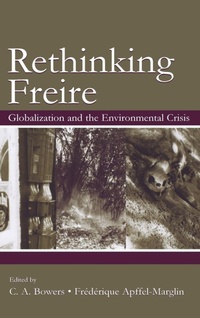
Rethinking Freire
Globalization and the Environmental Crisis
Published on 11. October 2004
Book
Hardback
222 pages
978-0-8058-5114-4 (ISBN)
Description
This landmark collection of essays by Third World activists highlights two major world changes which, they argue, have been neglected by Freire and his many followers: the Third World grass-roots cultural resistance to economic globalization, and the ecological crisis.
One source of the activist-authors' criticisms of Freire's pedagogy is rooted in their attempts to combine consciousness raising with literacy programs in such diverse cultural settings as Bolivia, Peru, India, Southern Mexico, and Cambodia, where they discovered that Freire's pedagogy is based on western assumptions that undermine indigenous knowledge systems. Equally important, these authors make the case in various ways that a major limitation with Freire's ideas, and which is reproduced in the writings of his followers, is that he did not recognize the cultural implications of the world's ecological crisis.
Several essays in the collection focus directly on how the cultural assumptions Freire took for granted were also the assumptions that gave conceptual and moral legitimacy to the Industrial Revolution--and continue to be the basis of the thinking behind economic globalization. The essays also explain why cultural diversity is essential to the preservation of biological diversity, and how intergenerational knowledge and patterns of mutual aid within different cultures provide alternatives to a consumer dependent lifestyle.
In his Afterword, C.A. Bowers addresses the need to adopt a more ecological way of thinking--one that recognizes the many ways the individual is nested in the interdependent networks of culture and how diverse cultures are nested in natural systems. It also stresses that one of the tasks of educators is to help students recognize the patterns and relationships of everyday life, and to assess them in terms of their contribution to less consumer dependent relationships and activities. As the essays in this volume affirm, this involves facilitating students' awareness of differences between cultures, the impact of consumerism on ecosystems, and the connections between hyper-consumerism and environmental racism and the colonizing relationship of the South by the North. Re-Thinking Freire: Globalization and the Environmental Crisis is a major contribution to this critical endeavor.
One source of the activist-authors' criticisms of Freire's pedagogy is rooted in their attempts to combine consciousness raising with literacy programs in such diverse cultural settings as Bolivia, Peru, India, Southern Mexico, and Cambodia, where they discovered that Freire's pedagogy is based on western assumptions that undermine indigenous knowledge systems. Equally important, these authors make the case in various ways that a major limitation with Freire's ideas, and which is reproduced in the writings of his followers, is that he did not recognize the cultural implications of the world's ecological crisis.
Several essays in the collection focus directly on how the cultural assumptions Freire took for granted were also the assumptions that gave conceptual and moral legitimacy to the Industrial Revolution--and continue to be the basis of the thinking behind economic globalization. The essays also explain why cultural diversity is essential to the preservation of biological diversity, and how intergenerational knowledge and patterns of mutual aid within different cultures provide alternatives to a consumer dependent lifestyle.
In his Afterword, C.A. Bowers addresses the need to adopt a more ecological way of thinking--one that recognizes the many ways the individual is nested in the interdependent networks of culture and how diverse cultures are nested in natural systems. It also stresses that one of the tasks of educators is to help students recognize the patterns and relationships of everyday life, and to assess them in terms of their contribution to less consumer dependent relationships and activities. As the essays in this volume affirm, this involves facilitating students' awareness of differences between cultures, the impact of consumerism on ecosystems, and the connections between hyper-consumerism and environmental racism and the colonizing relationship of the South by the North. Re-Thinking Freire: Globalization and the Environmental Crisis is a major contribution to this critical endeavor.
Reviews / Votes
"The whole book offers a timely challenge to any northern educator who assumes that their work is liberating and giving voice to the oppressed anywhere....the book is a breath of fresh air....it should appeal both to the academic and the practitioner reader, with its range of contributions from practical accounts to theoretical speculation."-The Developmental Education Journal"...this book's various contributions help to enhance Bower's call for a more central relationship to 'intergenerational knowledge and his Afterward presents a cogent summary of the many points raised in his latest books that will be useful for those who want to grasp Bower's Ecojustice platform."-TCRecord
More details
Series
Language
English
Place of publication
New York
United States
Publishing group
Taylor & Francis Inc
Target group
Professional and scholarly
Dimensions
Height: 235 mm
Width: 157 mm
Thickness: 17 mm
Weight
482 gr
ISBN-13
978-0-8058-5114-4 (9780805851144)
Copyright in bibliographic data and cover images is held by Nielsen Book Services Limited or by the publishers or by their respective licensors: all rights reserved.
Schweitzer Classification
Other editions
Additional editions
Chet A. Bowers | Frederique Apffel-Marglin
Rethinking Freire
Globalization and the Environmental Crisis
Book
05/2015
1st Edition
Routledge
€82.40
Shipment within 10-20 days
Chet A. Bowers | Fr'd'rique Apffel-Marglin
Re-Thinking Freire
Globalization and the Environmental Crisis
E-Book
12/2004
1st Edition
Routledge
€108.69
Available for download
Chet A. Bowers | Frederique Apffel-Marglin
Rethinking Freire
Globalization and the Environmental Crisis
E-Book
12/2004
Routledge
€76.49
Available for download
Chet A. Bowers | Frederique Apffel-Marglin
Rethinking Freire
Globalization and the Environmental Crisis
E-Book
12/2004
1st Edition
Routledge
€76.49
Available for download
Persons
Chet A. Bowers, Fr'd'rique Apffel-Marglin
Content
Contents: Preface. C.A. Bowers, Introduction. G. Esteva, D.L. Stuchul, M.S. Prakash, From a Pedagogy for Liberation to Liberation From Pedagogy. G.R. Vasquez, Nurturance in the Andes. B.L.S. Bejarano, Who Are the Oppressed? G. Teran, Vernacular Education for Cultural Regeneration: An Alternative to Paulo Freire's Vision of Emancipation. Siddhartha, From Conscientization to Interbeing: A Personal Journey. P. Robinson, Whose Oppression Is This? The Cultivation of Compassionate Action in Dissolving the Dualistic Barrier. D. Rasmussen, Cease to Do Evil, Then Learn to Do Good (A Pedagogy for the Oppressor). C.A. Bowers, How the Ideas of Paulo Freire Contribute to the Cultural Roots of the Ecological Crisis. C.A. Bowers, Afterword.