

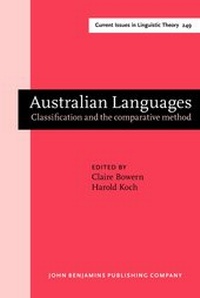
Australian Languages
Classification and the comparative method
Published on 18. March 2004
Book
Hardback
377 pages
978-90-272-4761-2 (ISBN)
Description
This book addresses controversial issues in the application of the comparative method to the languages of Australia which have recently come to international prominence. Are these languages 'different' in ways that challenge the fundamental assumptions of historical linguistics? Can subgrouping be successfully undertaken using the Comparative Method? Is the genetic construct of a far-flung 'Pama-Nyungan' language family supportable by classic methods of reconstruction? Contrary to increasingly established views of the Australian scene, this book makes a major contribution to the demonstration that traditional methods can indeed be applied to these languages. These studies, introduced by chapters on subgrouping methodology and the history of Australian linguistic classification, rigorously apply the comparative method to establishing subgroups among Australian languages and justifying the phonology of Proto-Pama-Nyungan. Individual chapters can profitably be read either for their contribution to Australian linguistic prehistory or as case studies in the application of the comparative method.
Reviews / Votes
"This volume critically assesses interrelationships between Australian languages in the light of the most recent descriptive data and a detailed understanding of the most recent developments in the comparative method. The result is a wonderfully detailed and convincing rebuttal of claims that Australian languages have been subject to different kinds of forces." Terry Crowley, University of Waikato; "It's by far the best statement I've ever seen on issues of subgrouping methodology; [...] it would be ideal for assignment to students of historical linguistics who need to know about these issues. It is also, of course, a valuable introduction to the issues for specialists in Australian historical linguistics." [on the Introduction] Sarah Thomason, University of Michigan; "This book marks a coming of age of Australian historical linguistics. It is the first concerted attempt by Australianists to apply the classical comparative method to the core issues of subgrouping, reconstruction and diffusion and it does so with considerable success." Andrew Pawley, Australian National University"More details
Series
Language
English
Place of publication
Amsterdam
Netherlands
Target group
Professional and scholarly
Illustrations
(incl. CD-Rom)
Dimensions
Height: 245 mm
Width: 164 mm
Weight
670 gr
ISBN-13
978-90-272-4761-2 (9789027247612)
Copyright in bibliographic data and cover images is held by Nielsen Book Services Limited or by the publishers or by their respective licensors: all rights reserved.
Schweitzer Classification
Other editions
Additional editions
E-Book
03/2004
1st Edition
John Benjamins Publishing Company
€155.99
Available for download
Persons
Content
1. Acknowledgements; 2. Map; 3. Contributor's addresses; 4. Foreword (by Campbell, Lyle); 5. Introduction: subgrouping methodology in historical linguistics (by Bowern, Claire); 6. A methodological history of Australian linguistic classification (by Koch, Harold); 7. Pama-Nyungan as a genetic entity (by Miceli, Luisa); 8. The coherence and distinctiveness of the Pama-Nyungan language family within the Australian linguistic phylum (by O'Grady, Geoffrey); 9. Pama-Nyungan: phonological reconstruction and status as a phylogenetic group (by Alpher, Barry); 10. The Arandic subgroup of Australian languages (by Koch, Harold); 11. The Ngumpin-Yapa subgroup (by McConvell, Patrick); 12. Thura-Yura as a subgroup (by Simpson, Jane); 13. The Yarli languages (by Hercus, Luise); 14. Evolution of the verb conjugations in the Ngarna languages (by Breen, Gavan); 15. The failure of the evidence of shared innovations in Cape York Peninsula (by Black, Paul); 16. Diagnostic similarities and differences between Nyulnyulan and neighbouring languages (by Bowern, Claire); 17. Revisiting Proto-Mirndi (by Green, Ian); 18. Stem forms and paradigm reshaping in Gunwinyguan (by Baker, Brett); 19. Combined references; 20. Language index; 21. Subject index; 22. Appendices