

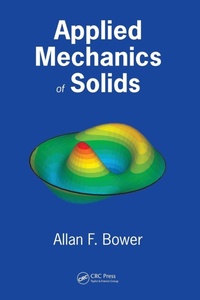
Applied Mechanics of Solids
1st Edition
Published on 5. October 2009
Book
Hardback
820 pages
978-1-4398-0247-2 (ISBN)
Description
Modern computer simulations make stress analysis easy. As they continue to replace classical mathematical methods of analysis, these software programs require users to have a solid understanding of the fundamental principles on which they are based.
Develop Intuitive Ability to Identify and Avoid Physically Meaningless Predictions
Applied Mechanics of Solids is a powerful tool for understanding how to take advantage of these revolutionary computer advances in the field of solid mechanics. Beginning with a description of the physical and mathematical laws that govern deformation in solids, the text presents modern constitutive equations, as well as analytical and computational methods of stress analysis and fracture mechanics. It also addresses the nonlinear theory of deformable rods, membranes, plates, and shells, and solutions to important boundary and initial value problems in solid mechanics.
The author uses the step-by-step manner of a blackboard lecture to explain problem solving methods, often providing the solution to a problem before its derivation is presented. This format will be useful for practicing engineers and scientists who need a quick review of some aspect of solid mechanics, as well as for instructors and students.
Select and Combine Topics Using Self-Contained Modules and Subsections
Borrowing from the classical literature on linear elasticity, plasticity, and structural mechanics, this book:
Introduces concepts, analytical techniques, and numerical methods used to analyze deformation, stress, and failure in materials or components
Discusses the use of finite element software for stress analysis
Assesses simple analytical solutions to explain how to set up properly posed boundary and initial-value problems
Provides an understanding of algorithms implemented in software code
Complemented by the author's website, which features problem sets and sample code for self study, this book offers a crucial overview of problem solving for solid mechanics. It will help readers make optimal use of commercial finite element programs to achieve the most accurate prediction results possible.
Develop Intuitive Ability to Identify and Avoid Physically Meaningless Predictions
Applied Mechanics of Solids is a powerful tool for understanding how to take advantage of these revolutionary computer advances in the field of solid mechanics. Beginning with a description of the physical and mathematical laws that govern deformation in solids, the text presents modern constitutive equations, as well as analytical and computational methods of stress analysis and fracture mechanics. It also addresses the nonlinear theory of deformable rods, membranes, plates, and shells, and solutions to important boundary and initial value problems in solid mechanics.
The author uses the step-by-step manner of a blackboard lecture to explain problem solving methods, often providing the solution to a problem before its derivation is presented. This format will be useful for practicing engineers and scientists who need a quick review of some aspect of solid mechanics, as well as for instructors and students.
Select and Combine Topics Using Self-Contained Modules and Subsections
Borrowing from the classical literature on linear elasticity, plasticity, and structural mechanics, this book:
Introduces concepts, analytical techniques, and numerical methods used to analyze deformation, stress, and failure in materials or components
Discusses the use of finite element software for stress analysis
Assesses simple analytical solutions to explain how to set up properly posed boundary and initial-value problems
Provides an understanding of algorithms implemented in software code
Complemented by the author's website, which features problem sets and sample code for self study, this book offers a crucial overview of problem solving for solid mechanics. It will help readers make optimal use of commercial finite element programs to achieve the most accurate prediction results possible.
Reviews / Votes
"It's an impressive piece of work. It covers an immense amount of material and is well written."-James R. Barber, University of Michigan, Ann Arbor, USA
"A valuable treatise in mechanics of solids."
-David L. McDowell, Georgia Institute of Technology, Atlanta, USA
"This book is great for materials science and engineering students who are interested in both classic and state-of-the-art materials research. With both in-depth discussion and authoritative summary, it will be widely used in teaching and research in theoretical and computational mechanics of materials."
-Yanfei Gao, University of Tennessee, Knoxville, USA
More details
Language
English
Place of publication
Bosa Roca
United States
Publishing group
Taylor & Francis Inc
Target group
College/higher education
Senior undergraduate and graduate students in engineering and applied physics.
Product notice
Paper over boards
Illustrations
511 s/w Abbildungen, 37 s/w Tabellen
37 Tables, black and white; 511 Illustrations, black and white
Dimensions
Height: 260 mm
Width: 183 mm
Thickness: 48 mm
Weight
1711 gr
ISBN-13
978-1-4398-0247-2 (9781439802472)
Copyright in bibliographic data and cover images is held by Nielsen Book Services Limited or by the publishers or by their respective licensors: all rights reserved.
Schweitzer Classification
Other editions
New editions
Allan F. Bower
Applied Mechanics of Solids
Book
11/2025
2nd Edition
CRC Press
€119.50
Shipment within 15-20 days
Additional editions

Allan F. Bower
Applied Mechanics of Solids
Book
approx. 12/2023
1st Edition
CRC Press
approx.
€107.89
Not yet published
Person
Allan Bower is a professor of engineering at Brown University, where he teaches in the undergraduate mechanical engineering program and the graduate program in mechanics of solids. He earned undergraduate and graduate degrees from the University of Cambridge and spent a short period on the faculty at Cambridge before joining Brown in 1992. His research involves developing and using computer simulations to model deformation and failure in materials. Applications of interest include modeling wear, plasticity, and contact fatigue between contacting surfaces; fracture in composites and ceramics; and mechanical failure processes in microelectronic circuits.
Content
Overview of Solid Mechanics. Governing Equations. Constitutive Equations: Relations between Stress and Strain. Simple Boundary and Initial Value Problems. Solutions for Linear Elastic Solids. Solutions for Plastic Solids. Finite Element Analysis: An Introduction . Finite Element Analysis: Theory and Implementation. Modeling Material Failure. Solutions for Rods, Beams, Membranes, Plates and Shells. Appendix A: Review of Vectors and Matrices. Appendix B: A Brief Introduction to Tensors and Their Properties. Appendix C: Index Notation for Vector and Tensor Operations. Appendix D: Vector and Tensor Operations in Polar Coordinates. Appendix E: Miscellaneous Derivations.