

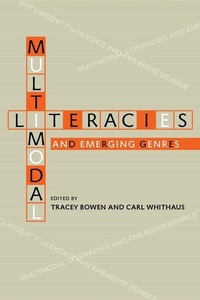
Multimodal Literacies and Emerging Genres
Published on 1. April 2013
Book
Paperback/Softback
368 pages
978-0-8229-6216-8 (ISBN)
Description
A student's avatar navigates a virtual world and communicates the desires, emotions, and fears of its creator. Yet, how can her writing instructor interpret this form
of meaningmaking?
Today, multiple modes of communication and information technology are challenging pedagogies in composition and across the disciplines. Writing instructors grapple with incorporating new forms into their curriculums and relating them to established literary practices. Administrators confront the application of new technologies to the restructuring of courses and the classroom itself.
Multimodal Literacies and Emerging Genres examines the possibilities, challenges, and realities of mutimodal composition as an effective means of communication. The chapters view the ways that writing instructors and their students are exploring the spaces where communication occurs, while also asking \u201cwhat else is possible.\u201d The genres of film, audio, photography, graphics, speeches, storyboards, PowerPoint presentations, virtual environments, written works, and others are investigated to discern both their capabilities and limitations. The contributors highlight the responsibility of instructors to guide students in the consideration of their audience and ethical responsibility, while also maintaining the ability to \u201cspeak well.\u201d Additionally, they focus on the need for programmatic changes and a shift in institutional philosophy to close a possible \u201cdigital divide\u201d and remain relevant in digital and global economies.
Embracing and advancing multimodal communication is essential to both higher education and students. The contributors therefore call for the examination of how writing programs, faculty, and administrators are responding to change, and how the many purposes writing serves can effectively converge within composition curricula.
of meaningmaking?
Today, multiple modes of communication and information technology are challenging pedagogies in composition and across the disciplines. Writing instructors grapple with incorporating new forms into their curriculums and relating them to established literary practices. Administrators confront the application of new technologies to the restructuring of courses and the classroom itself.
Multimodal Literacies and Emerging Genres examines the possibilities, challenges, and realities of mutimodal composition as an effective means of communication. The chapters view the ways that writing instructors and their students are exploring the spaces where communication occurs, while also asking \u201cwhat else is possible.\u201d The genres of film, audio, photography, graphics, speeches, storyboards, PowerPoint presentations, virtual environments, written works, and others are investigated to discern both their capabilities and limitations. The contributors highlight the responsibility of instructors to guide students in the consideration of their audience and ethical responsibility, while also maintaining the ability to \u201cspeak well.\u201d Additionally, they focus on the need for programmatic changes and a shift in institutional philosophy to close a possible \u201cdigital divide\u201d and remain relevant in digital and global economies.
Embracing and advancing multimodal communication is essential to both higher education and students. The contributors therefore call for the examination of how writing programs, faculty, and administrators are responding to change, and how the many purposes writing serves can effectively converge within composition curricula.
Reviews / Votes
Bowen and Whithaus's Multimodal Literacies and Emerging Genres assembles an impressive range of experiences and theoretical frameworks. This volume is sure to be of great use to writing teachers interested in expanding their thinking about and teaching with computers. * Johndan Johnson-Eilola, Clarkson University * This collection is a must-read for anyone interested in multimodal composition (and that should include all of us). Each chapter weaves together theory, perspectives from multiple stakeholders, and practical examples for classrooms and programs. Together, the chapters model how to consider thoughtfully the impact of intertwined modes, media, and genres. * Karen Lunsford, University of California, Santa Barbara *More details
Series
Language
English
Place of publication
Pittsburgh PA
United States
Target group
Adult education
Product notice
Paperback (trade)
Dimensions
Height: 226 mm
Width: 152 mm
Thickness: 28 mm
Weight
544 gr
ISBN-13
978-0-8229-6216-8 (9780822962168)
Copyright in bibliographic data and cover images is held by Nielsen Book Services Limited or by the publishers or by their respective licensors: all rights reserved.
Schweitzer Classification
Other editions
Additional editions
Tracey Bowen | Carl Whithaus
Multimodal Literacies and Emerging Genres
E-Book
04/2013
David & Charles
€58.99
Available for download
Persons
Tracey Bowen (Editor)
Tracey Bowen is a lecturer at the Institute of Communication, Culture and Information Technology at the University of Toronto Mississauga. She is coeditor of Cultural Production in Virtual and Imagined Worlds.
Carl Whithaus (Editor)
Carl Whithaus is a professor of writing and rhetoric at the University of California, Davis. He studies writing technologies and digital cultures, edits the Journal of Writing Assessment, and works on a variety of projects related to writing in the sciences, engineering, and agriculture. His books include Multimodal Literacies and Emerging Genres, Writing across Distances and Disciplines: Research and Pedagogy in Distributed Learning, and Teaching and Evaluating Writing in the Age of Computers and High-Stakes Testing.
Tracey Bowen is a lecturer at the Institute of Communication, Culture and Information Technology at the University of Toronto Mississauga. She is coeditor of Cultural Production in Virtual and Imagined Worlds.
Carl Whithaus (Editor)
Carl Whithaus is a professor of writing and rhetoric at the University of California, Davis. He studies writing technologies and digital cultures, edits the Journal of Writing Assessment, and works on a variety of projects related to writing in the sciences, engineering, and agriculture. His books include Multimodal Literacies and Emerging Genres, Writing across Distances and Disciplines: Research and Pedagogy in Distributed Learning, and Teaching and Evaluating Writing in the Age of Computers and High-Stakes Testing.