

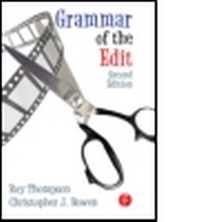
Grammar of the Edit
2nd Edition
Published on 8. April 2009
Book
Paperback/Softback
224 pages
978-0-240-52120-6 (ISBN)
Description
Learn the basic "grammar" of editing films and videos in Grammar of the Edit! This book shows you in no uncertain terms (independently of software) what you absolutely need to know to edit your video production. Whether you are just learning how to edit or you need a refresher, this book gives you a basic toolkit to understand the basic terms and the common practices of editing to help create a coherent and meaningful story or visual presentation. This book concentrates on where and how an edit is made and teaches you how to answer the simple question: 'What do I need to do in order to make a good edit between two shots?'
Grammar of the Edit begins with an explanation of the basic rules of visual construction that will allow you to arrange your footage logically. The book takes you from the basic vocabulary of editing, to knowing when to cut (and why), to transitions, and finally to good working practices. Designed as an easy-to-use reference, each topic is covered succinctly and is accompanied by clear photographs and diagrams that illustrate the key concepts presented in the book. Simple, elegant, and easy to use, Grammar of the Edit is a staple of any filmmaker's library.
Don't miss the companion volume, Grammar of the Shot 2e, 9780240521213!
Grammar of the Edit begins with an explanation of the basic rules of visual construction that will allow you to arrange your footage logically. The book takes you from the basic vocabulary of editing, to knowing when to cut (and why), to transitions, and finally to good working practices. Designed as an easy-to-use reference, each topic is covered succinctly and is accompanied by clear photographs and diagrams that illustrate the key concepts presented in the book. Simple, elegant, and easy to use, Grammar of the Edit is a staple of any filmmaker's library.
Don't miss the companion volume, Grammar of the Shot 2e, 9780240521213!
Reviews / Votes
A review on amazon.com of the first edition:"This book describes in no uncertain terms what ABSOLUTELY MUST BE IN EACH AND EVERY SHOT-so that the successful filmmaker can build a story that flows smoothly. This book will help you to be artistic, but will also help you to avoid confusing your audience. A small book that is easily read in the space of an hour, the student or novice film-maker will find himself using it as a quick reference many times over. Highly recommended."
More details
Edition
2nd New edition
Language
English
Place of publication
Oxford
United Kingdom
Publishing group
Taylor & Francis Ltd
Target group
College/higher education
Novice filmmakers, students, or videographers who want a concise guide to the principles of editing
Edition type
New edition
Illustrations
Approx. 280 illustrations
Dimensions
Height: 229 mm
Width: 152 mm
Weight
318 gr
ISBN-13
978-0-240-52120-6 (9780240521206)
Copyright in bibliographic data and cover images is held by Nielsen Book Services Limited or by the publishers or by their respective licensors: all rights reserved.
Schweitzer Classification
Other editions
New editions
Book
07/2017
4th Edition
Routledge
€45.00
Article exhausted; check for reprint
Christopher J. Bowen | Roy Thompson
Grammar of the Edit
Book
03/2013
3rd Edition
Focal Press
€28.46
Article exhausted; check for reprint
Persons
Instructor of cinematography and film production at Framingham State College, formerly of Boston University; Avid certified instructor; Creative Director/Production Manager, Fellsway Creatives
Instructor of cinematography and film production at Framingham State College, formerly of Boston University; Avid certified instructor; Creative Director/Production Manager, Fellsway Creatives
Instructor of cinematography and film production at Framingham State College, formerly of Boston University; Avid certified instructor; Creative Director/Production Manager, Fellsway Creatives
Content
Introduction
Chapter 1 Editing Basics
A Little Editing History
What Factors May Impact Your Editing Choices?
The Basic Editing Transitions
Stages of the Editing Process
Review
Chapter 2 Understanding the Footage
Basic Shot Types
Shot Descriptions
Increasing Shot Complexity
Simple Shots
Complex Shots
Developing Shots
Reviewing the Footage-Selecting the Best Shots
What Could Make or Break a Shot?
Focus
Audio Quality
Exposure and Color Temperature
Framing and Composition
Screen Direction
180 Degree Rule/Axis of Action
30 Degree Rule
Matching Angles
Matching Eye-Line
Continuity of Action
Continuity of Dialogue
Performance
Be Familiar with All the Footage
So How Does All of This Help You?
Review
Chapter 3 When to Cut and Why?
What Factors Help Make a Transition a Good Edit?
Information
Motivation
Shot Composition
Camera Angle
Continuity
Sound
Is there a Right or Wrong Reason for a Cut?
Review
Chapter 4 Transitions and Edit Categories
The Cut
The Dissolve
The Wipe
The Fade
The Five Major Categories of Edit Types
Will I Be Quizzed on Any of This?
Review
Chapter 5 General Practices for Editors
Sound and Vision are Partners and Not Rivals
A New Shot Should Contain New Information
There Should Be a Reason for Every Edit
Observe the Action Line
Select the Appropriate Form of Edit
The Better the Edit, the Less It Is Noticed
Editing is Creating
Review
Chapter 6 Working Practices
Working Practices
Review
Chapter 7 The Final Cut: Additional Editing Topics You are Bound to Encounter
Additional Editing Terms
Making Your Way into the World of Editing
Digital Workflow
The Role of an Assistant Editor
In Conclusion
Review
Glossary
Index
Chapter 1 Editing Basics
A Little Editing History
What Factors May Impact Your Editing Choices?
The Basic Editing Transitions
Stages of the Editing Process
Review
Chapter 2 Understanding the Footage
Basic Shot Types
Shot Descriptions
Increasing Shot Complexity
Simple Shots
Complex Shots
Developing Shots
Reviewing the Footage-Selecting the Best Shots
What Could Make or Break a Shot?
Focus
Audio Quality
Exposure and Color Temperature
Framing and Composition
Screen Direction
180 Degree Rule/Axis of Action
30 Degree Rule
Matching Angles
Matching Eye-Line
Continuity of Action
Continuity of Dialogue
Performance
Be Familiar with All the Footage
So How Does All of This Help You?
Review
Chapter 3 When to Cut and Why?
What Factors Help Make a Transition a Good Edit?
Information
Motivation
Shot Composition
Camera Angle
Continuity
Sound
Is there a Right or Wrong Reason for a Cut?
Review
Chapter 4 Transitions and Edit Categories
The Cut
The Dissolve
The Wipe
The Fade
The Five Major Categories of Edit Types
Will I Be Quizzed on Any of This?
Review
Chapter 5 General Practices for Editors
Sound and Vision are Partners and Not Rivals
A New Shot Should Contain New Information
There Should Be a Reason for Every Edit
Observe the Action Line
Select the Appropriate Form of Edit
The Better the Edit, the Less It Is Noticed
Editing is Creating
Review
Chapter 6 Working Practices
Working Practices
Review
Chapter 7 The Final Cut: Additional Editing Topics You are Bound to Encounter
Additional Editing Terms
Making Your Way into the World of Editing
Digital Workflow
The Role of an Assistant Editor
In Conclusion
Review
Glossary
Index