

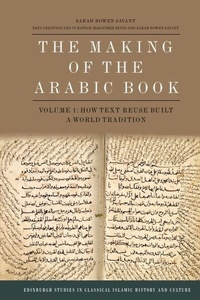
The Making of the Arabic Book, Volume 1
How Text Reuse Built a World Tradition
Will be published approx. on 31. December 2026
Book
Hardback
312 pages
978-1-3995-3793-3 (ISBN)
Description
For most historic Arabic authors, creating new works began with reusing existing ones. They reissued, abbreviated, expanded upon, excerpted and otherwise mined their predecessors' texts as they created fresh new works. In the process, authors produced an enormously intertextual tradition. To reconstruct these relations, the KITAB (Knowledge, Information Technology, and the Arabic Book) project built a digital corpus of thousands of early Arabic books, written over eight centuries from Iberia to Central and South Asia. The team then utilised a text reuse detection algorithm to create an original dataset that documents near-verbatim relationships among all of these books.
This volume investigates the broad patterns from the dataset and forensically analyses individual writers' practices to see how their reuse of earlier works made the Arabic tradition. Using the tools, methods and approaches of the digital humanities, it aims to inspire scholars of all world literatures to investigate the origins and growth of written traditions in novel ways.More details
Person
Sarah Bowen Savant is a Professor of History and founding director of the Aga Khan University's Centre for Digital Humanities. Her books include The New Muslims of Post-Conquest Iran: Tradition, Memory, and Conversion (Cambridge University Press, 2013); as editor, Genealogy and Knowledge in Muslim Societies: Understanding the Past (Edinburgh University Press, 2014); as translator (with Peter Webb), The Excellence of the Arabs. A Translation of Ibn Qutaybah's Faḍl al-ʿArab wa l-tanbīh ʿalā ʿulūmihā (Library of Arabic Literature, 2017), plus other edited volumes, book chapters, articles, and data sets (available via Zenodo).