

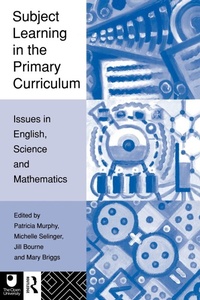
Subject Learning in the Primary Curriculum
Issues in English, Science and Maths
Published on 16. March 1995
Book
Paperback/Softback
344 pages
978-0-415-12537-6 (ISBN)
Description
The emphasis on subject knowledge in primary curricula is a world-wide phenomenon and has become increasingly the focus of attention in England, with the introduction of the National Curriculum and the appointment of subject co-ordinators in schools. Yet what exactly constitutes a subject and its practice remains controversial.
The book is organised into five parts. Part one examines the general aims of primary education, in order to give a background for a more detailed exploration of UK curriculum development. Parts two, three and four examine the core subjects of English, science and mathematics, whilst constantly bearing in mind the full range of views about the purpose of education and the nature of knowledge. Part five introduces key debates about approaches to knowledge, and raises issues about the future organisation of the curriculum. Subject Learning in the Primary Curriculum is the OU reader for Module 832, Teaching and Learning in the Primary Core Curriculum in the MA in Education.
The book is organised into five parts. Part one examines the general aims of primary education, in order to give a background for a more detailed exploration of UK curriculum development. Parts two, three and four examine the core subjects of English, science and mathematics, whilst constantly bearing in mind the full range of views about the purpose of education and the nature of knowledge. Part five introduces key debates about approaches to knowledge, and raises issues about the future organisation of the curriculum. Subject Learning in the Primary Curriculum is the OU reader for Module 832, Teaching and Learning in the Primary Core Curriculum in the MA in Education.
Reviews / Votes
`It would be of value to anyone studying teaching and learning in primary schools at post-graduate level. Well known authors provide the reader with a variety of stimulating ideas and one is challenged to draw one's own conclusions rather than be persuaded one way or the other.' - Management in EducationMore details
Language
English
Place of publication
London
United Kingdom
Publishing group
Taylor & Francis Ltd
Target group
College/higher education
Dimensions
Height: 234 mm
Width: 156 mm
Thickness: 19 mm
Weight
524 gr
ISBN-13
978-0-415-12537-6 (9780415125376)
Copyright in bibliographic data and cover images is held by Nielsen Book Services Limited or by the publishers or by their respective licensors: all rights reserved.
Schweitzer Classification
Other editions
Additional editions
Jill Bourne | Mary Briggs | Patricia Murphy
Subject Learning in the Primary Curriculum
Issues in English, Science and Maths
Book
08/2017
1st Edition
Routledge
€193.13
Shipment within 10-20 days

Jill Bourne | Mary Briggs | Patricia Murphy
Subject Learning in the Primary Curriculum
Issues in English, Science and Maths
E-Book
08/2005
1st Edition
Routledge
€0.00
Available for download
Jill Bourne | Mary Briggs | Patricia Murphy
Subject Learning in the Primary Curriculum
Issues in English, Science and Maths
E-Book
08/2005
Routledge
€0.00
Available for download
Persons
Bourne, Jill; Briggs, Mary; Murphy, Patricia; Selinger, Michelle
Content
Introduction Patricia Murphy Part 1. Curriculum Influences 1.1 Introduction Patricia Murphy 1.2 The aims of primary education in member states of the Council of Europe Norman Thomas 1.3 Knowledge for the masses: World models and National Curricula 1920 - 1986 Aaron Benavot, Yun-Kyung Cha, David H. Kamens, John Meyer, and Suk-ying Wong 1.4 Education, Majorism and the Curriculum of the Dead Stephen Ball 1.5 Analysing views of practice Robin Alexander Part 2. English: Literacy practices in the primary classroom 2.1 Introduction Jill Bourne 2.2 The schooling of Literacy Joanna C. Street and Brian V. Street 2.3 What counts as reading in this class: Children's views of reading Eve Gregory 2.4 Disciplining English: The construction of a national subject Jill Bourne and Deborah Cameron 2.5 Young children's writing: from spoken to written genre rances Christie 2.6 Planning for writing across the curriculum Beverly Derewianka Part 3. Science: views of the domain and learning 3.1 Introduction Patricia Murphy 3.2 Constructivism and quality in science education Joan Solomon 3.3 Young people's understanding of science concepts Rosalind Driver, John Leach, Philip Scott, and Colin Wood-Robinson 3.4 Procedural and conceptual knowledge in science Richard Gott, Sandra Duggan, Robin Millar and Fred Lubben 3.5 Learning about physics through peer interaction Christine Howe Part 4. Mathematics - teaching strategies, perspectives on numeracy 4.1 Introduction Michelle Selinger 4.2 Scaffolding in maths, science and technology Mike Askew, John Bliss and Sheila Macrae 4.3 A proposed framework for examining basic number sense Alistaim McIntosh, Barbara J. Reys, and Robert E. Reys 4.4 Learning through problem-solving: A constructivist approach to second grade mathematics Paul Cobb, Terry Wood, and Erna Yackel 4.5 Telling and asking Eric Love and John Mason Part 5. Approaches to knowledge in the future curriculum? 5.1 Introduction Patricia Murphy 5.2 Expert knowledge Robert Glaser 5.3 The thinking curriculum John Nisbet 5.4 Situated cognition John Seely Brown, Allan Collins, and Paul Duguid