

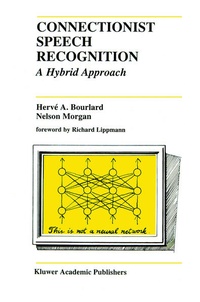
Connectionist Speech Recognition
A Hybrid Approach
Published on 15. December 2012
Book
Paperback/Softback
XXIX, 313 pages
978-1-4613-6409-2 (ISBN)
Description
Connectionist Speech Recognition: A Hybrid Approach
describes the theory and implementation of a method to incorporate neural network approaches into state of the art continuous speech recognition systems based on hidden Markov models (HMMs) to improve their performance. In this framework, neural networks (and in particular, multilayer perceptrons or MLPs) have been restricted to well-defined subtasks of the whole system, i.e. HMM emission probability estimation and feature extraction.
The book describes a successful five-year international collaboration between the authors. The lessons learned form a case study that demonstrates how hybrid systems can be developed to combine neural networks with more traditional statistical approaches. The book illustrates both the advantages and limitations of neural networks in the framework of a statistical systems.
Using standard databases and comparison with some conventional approaches, it is shown that MLP probability estimation can improve recognition performance. Other approaches are discussed, though there is no such unequivocal experimental result for these methods.
Connectionist Speech Recognition is of use to anyone intending to use neural networks for speech recognition or within the framework provided by an existing successful statistical approach. This includes research and development groups working in the field of speech recognition, both with standard and neural network approaches, as well as other pattern recognition and/or neural network researchers. The book is also suitable as a text for advanced courses on neural networks or speech processing.
The book describes a successful five-year international collaboration between the authors. The lessons learned form a case study that demonstrates how hybrid systems can be developed to combine neural networks with more traditional statistical approaches. The book illustrates both the advantages and limitations of neural networks in the framework of a statistical systems.
Using standard databases and comparison with some conventional approaches, it is shown that MLP probability estimation can improve recognition performance. Other approaches are discussed, though there is no such unequivocal experimental result for these methods.
Connectionist Speech Recognition is of use to anyone intending to use neural networks for speech recognition or within the framework provided by an existing successful statistical approach. This includes research and development groups working in the field of speech recognition, both with standard and neural network approaches, as well as other pattern recognition and/or neural network researchers. The book is also suitable as a text for advanced courses on neural networks or speech processing.
More details
Series
Edition
Softcover reprint of the original 1st ed. 1994
Language
English
Place of publication
New York
United States
Target group
Professional and scholarly
Research
Illustrations
XXIX, 313 p.
Dimensions
Height: 235 mm
Width: 155 mm
Thickness: 19 mm
Weight
528 gr
ISBN-13
978-1-4613-6409-2 (9781461364092)
DOI
10.1007/978-1-4615-3210-1
Schweitzer Classification
Other editions
Additional editions
Book
10/1993
Kluwer Academic Publishers
€213.99
Shipment within 15-20 days
Content
1 Introduction.- 2 Statistical Pattern Classification.- 3 Hidden Markov Models.- 4 Multilayer Perceptrons.- 5 Speech Recognition Using ANNs.- 6 Statistical Inference in MLPs.- 7 The Hybrid HMM/MLP Approach.- 8 Experimental Systems.- 9 Context-Dependent MLPs.- 10 System Tradeoffs.- 11 Training Hardware and Software.- 12 Cross-Validation In Mlp Training.- 13 Hmm/Mlp And Predictive Models.- 14 Feature Extraction By Mlp.- 15 Final System Overview.- 16 Conclusions.- Acronyms.