

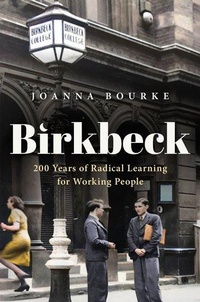
Birkbeck
200 Years of Radical Learning for Working People
Published on 8. September 2022
Book
Hardback
646 pages
978-0-19-284663-1 (ISBN)
Description
Birkbeck traces the 200-year history of Birkbeck, University of London from its founding at a time when social elites deplored the notion of educated working people to the present day. Joanna Bourke writes a lively history of the institution, and how it contributed to the shaping of modern British higher education.
Two hundred years ago, Birkbeck was founded as the London Mechanics' Institution (LMI). When it was established in 1823, one third of all men and half of all women were unable to read or write. British elites were vehemently hostile to educating working people. The country was in political turmoil and it was feared that education would destroy society. This was the context in which the LMI was established. From its foundation, it was unique. Birkbeck traces its history from 1823 to the present, with Joanna Bourke using the history of Birkbeck to reflect on life and culture in London over the past two centuries. What does it mean to be educated? Why have Birkbeck's students been prepared to give up so much in order to study for a higher degree? How does education help us become fully human and self-fulfilled by learning how to use all our faculties - knowledge, imagination, sympathy? The story of Birkbeck contains some blood, oceans of scholarly sweat, and not a few tears. But it is also a story of laughter, intellectual excitement, scholarly eccentricity, collective as well as personal ambition, and, most of all, the quirky passions and personalities that make up the Birkbeck community. It is a story of a unique university but also of higher education of Britain. It shows how knowledge can empower people to better themselves and improve the world.
Two hundred years ago, Birkbeck was founded as the London Mechanics' Institution (LMI). When it was established in 1823, one third of all men and half of all women were unable to read or write. British elites were vehemently hostile to educating working people. The country was in political turmoil and it was feared that education would destroy society. This was the context in which the LMI was established. From its foundation, it was unique. Birkbeck traces its history from 1823 to the present, with Joanna Bourke using the history of Birkbeck to reflect on life and culture in London over the past two centuries. What does it mean to be educated? Why have Birkbeck's students been prepared to give up so much in order to study for a higher degree? How does education help us become fully human and self-fulfilled by learning how to use all our faculties - knowledge, imagination, sympathy? The story of Birkbeck contains some blood, oceans of scholarly sweat, and not a few tears. But it is also a story of laughter, intellectual excitement, scholarly eccentricity, collective as well as personal ambition, and, most of all, the quirky passions and personalities that make up the Birkbeck community. It is a story of a unique university but also of higher education of Britain. It shows how knowledge can empower people to better themselves and improve the world.
Reviews / Votes
The book succeeds in establishing Birkbeck as unique and with many special achievements. There are illustrations...There is a great deal to cover but reading it will certainly help convince anyone of its contribution to the world. In the chapter on teaching Bourke reminds us that the nature of the student cohorts meant lecturers had to be entertaining as well as knowledgeable. She has extended this approach to this impressive book. * Tim Lomas, The Local Historian *More details
Series
Language
English
Place of publication
Oxford
United Kingdom
Target group
College/higher education
Illustrations
over 100 black and white illustrations
Dimensions
Height: 241 mm
Width: 162 mm
Thickness: 35 mm
Weight
1200 gr
ISBN-13
978-0-19-284663-1 (9780192846631)
Copyright in bibliographic data and cover images is held by Nielsen Book Services Limited or by the publishers or by their respective licensors: all rights reserved.
Schweitzer Classification
Other editions
Person
Joanna Bourke is Professor of History at Birkbeck College, University of London. She is the prize-winning author of books on multiple subjects, including histories of modern warfare, military medicine, psychology and psychiatry, the emotions, and rape. Among others, she is the author of An Intimate History of Killing (1999), Fear: A Cultural History (2005), Rape: A History from 1860 to the Present (2007), What it Means to be Human: Reflections from 1791 to the Present (2011), and The Story of Pain: From Prayer to Painkillers. An Intimate History of Killing won the Wolfson Prize and the Fraenkel Prize. She is also a frequent contributor to TV and radio shows, and a regular newspaper correspondent.
Content
Preface 1: Introduction Part I: From Mechanics to Graduates 2: The Crown and Anchor Tavern 3: Education for Whom? 4: Useful Knowledge 5: The Birkbeck Schools 6: Ravenscroft's Birkbeck Bank 7: Governing the College 8: What is a University? Part II: Pleasure and Preferences 9: Art and Architecture 10: Dancing the Polka 11: The New Woman 12: Minoritised Communities Part III: Student Life 13: 'Tea and Kippers' 14: Rabbits v. Hares; Or, Social Lives 15: Man v. Rabbits 16: Students' 'Joy-Night' Part IV: War and Politics 17: Worlds at War, 1914-1918 18: Worlds at War, 1939-1945 19: Reds in the Classroom 20: Radical Intellectuals Part V: Classrooms 21: Science in the World 22: Disciplines 23: Numerical Automation; Or, Computing 24: Paranormal Sciences 25: Teaching Part VI: Battles for Birkbeck 26: 'Birkbeck's Unique Mission?' 27: Containing the Crisis Part VII: Conclusion 28: Into the Twenty-First Century