

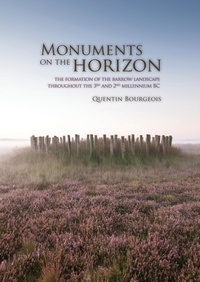
Monuments on the Horizon
The formation of the barrow landscape throughout the 3rd and 2nd millennium BC
1st Edition
Published on 31. December 2012
Book
Paperback/Softback
252 pages
978-90-8890-104-1 (ISBN)
Description
Barrows, as burial markers, are ubiquitous throughout North-Western Europe. In some regions dense concentrations of monuments form peculiar configurations such as long alignments while in others they are spread out extensively, dotting vast areas with hundreds of mounds. These vast barrow landscapes came about through thousands of years of additions by several successive prehistoric and historic communities. Yet little is known about how these landscapes developed and came about.
That is what this research set out to do. By unravelling the histories of specific barrow landscapes in the Low Countries, several distinct activity phases of intense barrow construction could be recognised. Each of these phases contributed in a particular fashion to how the barrow landscape developed and reveals shifting attitudes to these landscape monuments.
By creating new monuments in a specific place and in a particular fashion, prehistoric communities purposefully transformed the form and shape of the barrow landscape. Using several GIS-techniques such as a skyline-analysis, this research was able to demonstrate how each barrow then took up a specific (and different) position within such a social landscape. While the majority of the barrows were only visible from relatively close by, specific monuments took up a dominating position, cresting the horizon, and they were visible from much further away.
It was argued that these burial mounds remained important landscape monuments on the purple heathlands. They continued to attract attention, and by their visibility ensured to endure in the collective memory of the communities shaping themselves around these monuments.
This publication is part of the Ancestral Mounds Research Project of the University of Leiden.
That is what this research set out to do. By unravelling the histories of specific barrow landscapes in the Low Countries, several distinct activity phases of intense barrow construction could be recognised. Each of these phases contributed in a particular fashion to how the barrow landscape developed and reveals shifting attitudes to these landscape monuments.
By creating new monuments in a specific place and in a particular fashion, prehistoric communities purposefully transformed the form and shape of the barrow landscape. Using several GIS-techniques such as a skyline-analysis, this research was able to demonstrate how each barrow then took up a specific (and different) position within such a social landscape. While the majority of the barrows were only visible from relatively close by, specific monuments took up a dominating position, cresting the horizon, and they were visible from much further away.
It was argued that these burial mounds remained important landscape monuments on the purple heathlands. They continued to attract attention, and by their visibility ensured to endure in the collective memory of the communities shaping themselves around these monuments.
This publication is part of the Ancestral Mounds Research Project of the University of Leiden.
More details
Thesis
Doctoral thesis
Edition
1. Auflage
Language
English
Place of publication
Leiden
Netherlands
Target group
College/higher education
Illustrations
74x01 | 78x02
Dimensions
Height: 297 mm
Width: 210 mm
Thickness: 16 mm
Weight
743 gr
ISBN-13
978-90-8890-104-1 (9789088901041)
Copyright in bibliographic data and cover images is held by Nielsen Book Services Limited or by the publishers or by their respective licensors: all rights reserved.
Schweitzer Classification
Person
Quentin performed his PhD study within the research project Ancestral Mounds.In his research he dealt with groups of barrows and their position within the landscape. Through extensive GIS-analyses he attempted to shed some light on the choice of location for the placement of the burial monuments. Why were they placed there, what could be seen from that location, and how did this develop through time?