

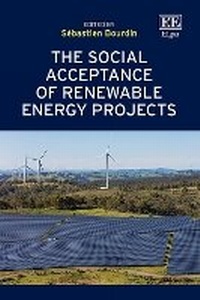
The Social Acceptance of Renewable Energy Projects
Will be published approx. on 28. January 2026
Book
Hardback
372 pages
978-1-0353-4874-9 (ISBN)
Description
This timely book analyses why various communities support or oppose low-carbon projects in light of the global shift towards renewable energy. It presents a wide range of cases and disciplinary perspectives to explore how trust, fairness and meaningful participation shape public responses to wind, solar, hydro and bioenergy.
Leading scholars examine how community approval depends not only on technical design or environmental performance, but on how projects align with local values and regional identities. They explore the key levers of social acceptance, including participation, governance and justice alongside controversies, resistance and territorial anchoring. By drawing on empirical case studies across diverse technologies and locations, this book demonstrates how successful sustainable energy transitions require more than just consent: they require a form of shared involvement that gives communities a real role in shaping outcomes.
This book is beneficial to scholars and students in the fields of environmental and energy studies, as well as human geography, sociology and political science. It is also an essential resource for policymakers, researchers and energy professionals looking to understand the social dimensions of renewable energy.
Leading scholars examine how community approval depends not only on technical design or environmental performance, but on how projects align with local values and regional identities. They explore the key levers of social acceptance, including participation, governance and justice alongside controversies, resistance and territorial anchoring. By drawing on empirical case studies across diverse technologies and locations, this book demonstrates how successful sustainable energy transitions require more than just consent: they require a form of shared involvement that gives communities a real role in shaping outcomes.
This book is beneficial to scholars and students in the fields of environmental and energy studies, as well as human geography, sociology and political science. It is also an essential resource for policymakers, researchers and energy professionals looking to understand the social dimensions of renewable energy.
Reviews / Votes
'The Social Acceptance of Renewable Energy Projects is crucial for a successful low-carbon transition. While social acceptance is often treated as a matter of personal attitudes, this book aims for a better understanding of the underlying social processes and preconditions for the acceptance and legitimacy of renewable energy projects. This book is a timely and sought-after contribution to a deeper understanding of the social acceptance of renewable energy projects, a contribution which links this concept to the social dynamics of the energy transition, its political urgency, contestedness and entanglement with the transformation of our social and political systems.' -- Harald Rohracher, Linkoeping University, Sweden 'All too often, discussions of renewable energy focus on technology, innovation, or economics, or on only one side of the topic. This refreshing book takes a much-needed different perspective, bringing to light topics such as norms and values, justice, governance. It also explores multiple sides to acceptance, including social opposition, resistance, and controversy. In doing so, it marshals a superstar team of global academics who harness state-of-the-art thinking along with insights from multiple disciplines.' -- Benjamin Sovacool, Boston University, USA and Sussex University, UKMore details
Language
English
Place of publication
Cheltenham
United Kingdom
Target group
Professional and scholarly
Dimensions
Height: 234 mm
Width: 156 mm
ISBN-13
978-1-0353-4874-9 (9781035348749)
Copyright in bibliographic data and cover images is held by Nielsen Book Services Limited or by the publishers or by their respective licensors: all rights reserved.
Schweitzer Classification
Person
Edited by Sebastien Bourdin, Professor of Economic Geography and Environmental Management, IESEG School of Management, France