

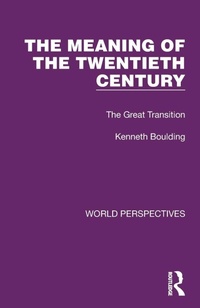
The Meaning of the Twentieth Century
The Great Transition
1st Edition
Published on 19. December 2023
Book
Paperback/Softback
212 pages
978-1-032-18913-0 (ISBN)
Description
Originally published in 1965 and written by a noted economist and leader in the field of conflict resolution, this book traces the forces which have brought the 20th century 'post-civilisation' into being: the ever-increasing power of science and the scientific attitude, the global communication network, the high efficiency of industrial societies. New conditions pointed to a life of ease but also enormous problems. The book discusses how though our technical resources have become immense, social and psychological conflicts remain. The author's training in psychology and economics combines with a deep sense of history to create a book which is as relevant now as when it was first published.
More details
Series
Language
English
Place of publication
London
United Kingdom
Publishing group
Taylor & Francis Ltd
Target group
College/higher education
General, Postgraduate, and Undergraduate
Dimensions
Height: 198 mm
Width: 129 mm
Thickness: 12 mm
Weight
235 gr
ISBN-13
978-1-032-18913-0 (9781032189130)
Copyright in bibliographic data and cover images is held by Nielsen Book Services Limited or by the publishers or by their respective licensors: all rights reserved.
Schweitzer Classification
Other editions
Additional editions
Book
12/2021
1st Edition
Routledge
€141.35
Shipment within 10-20 days
E-Book
12/2021
1st Edition
Routledge
€44.99
Available for download
E-Book
12/2021
1st Edition
Routledge
€44.99
Available for download
Person
Kenneth Boulding was an English-born American peace activist, economist, educator and philosopher.
Content
1. The Great Transition 2. Science as the Basis of the Great Transition 3. The Significance of the Social Sciences 4. The War Trap 5. Economic Development: The Difficult Take-Off 6. The Population Trap 7. The Entropy Trap 8. The Role of Ideology in the Great Transition 9. A Strategy for the Transition.