

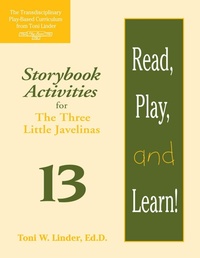
Read, Play, and Learn! (R) Module 13
Storybook Activities for the Three Little Javelinas
Will be published approx. on 30. September 1999
Book
Paperback/Softback
80 pages
978-1-55766-415-0 (ISBN)
Description
This Read, Play, and Learn! storybook module contains 10 days of activities linked to the popular storybook The Three Little Javelinas. The module contains the following sections:
The Story: A brief summary of the storybook, with information on where to get the book.
The Planning Sheets: Charts for at-a-glance reference to all of the suggested activities for the 2 weeks.
Vocabulary: A list of the key words and concepts, including labels, action words, and descriptors, to which children can be introduced in the module.
Materials: A list of the toys and equipment, supplies, food, and other items needed for the module.
Areas/Centers: A description of 10 days of different activities for each area or center in the classroom, plus suggested modifications for children functioning at the sensorimotor, functional, and symbolic levels of learning.
How to Involve Families: Sample letters with recommendations to help keep family members or other caregivers informed.
More Suggestions: Additional storybooks and other activities (e.g., songs, fingerplays, resources, computer games) that can be used with the module.
The storybooks themselves are not included with this module or the collections. This module is part of an innovative, play-based curriculum for children 3 - 6 years of age that promotes general development and boosts cognitive, sensorimotor, communication/language, social, and emerging literacy skills.
The Story: A brief summary of the storybook, with information on where to get the book.
The Planning Sheets: Charts for at-a-glance reference to all of the suggested activities for the 2 weeks.
Vocabulary: A list of the key words and concepts, including labels, action words, and descriptors, to which children can be introduced in the module.
Materials: A list of the toys and equipment, supplies, food, and other items needed for the module.
Areas/Centers: A description of 10 days of different activities for each area or center in the classroom, plus suggested modifications for children functioning at the sensorimotor, functional, and symbolic levels of learning.
How to Involve Families: Sample letters with recommendations to help keep family members or other caregivers informed.
More Suggestions: Additional storybooks and other activities (e.g., songs, fingerplays, resources, computer games) that can be used with the module.
The storybooks themselves are not included with this module or the collections. This module is part of an innovative, play-based curriculum for children 3 - 6 years of age that promotes general development and boosts cognitive, sensorimotor, communication/language, social, and emerging literacy skills.
More details
Edition
-Tpbi2/">Tpba2 and Tpbi2.≪/ edition
Language
English
Place of publication
Baltimore
United States
Target group
Primary & secondary/elementary & high school
Product notice
Paperback (trade)
Dimensions
Height: 279 mm
Width: 216 mm
Weight
283 gr
ISBN-13
978-1-55766-415-0 (9781557664150)
Copyright in bibliographic data and cover images is held by Nielsen Book Services Limited or by the publishers or by their respective licensors: all rights reserved.
Schweitzer Classification
Persons
> Dr. Toni Linder is Professor Emeritus in the Child, Family, and School Psychology Program at the Morgridge College of Education at the University of Denver in Denver, Colorado. Dr. Linder has been a leader in the development of authentic assessment for young children and is known for her work on Transdisciplinary Play-Based Assessment and Transdisciplinary Play-Based Intervention (1990, 1993, 2008). In addition, she developed Read, Play, and Learn (1999), an inclusive, literature and play-based curriculum for preschool and kindergarten learning and development. She consults nationally and internationally on assessment, intervention, early childhood education, program development, and family involvement issues. Dr. Linder has conducted research on a variety of issues, including transdisciplinary influences on development, parent-child interaction, curriculum outcomes, and using technology for professional development in rural areas.
In 2012 Dr. Linder formed Early Learning Dynamics LLC to serve as a platform for her continuing consulting, curriculum development, and play-based assessments. Dr. Linder will use Early Learning Dynamics to serve children worldwide.