

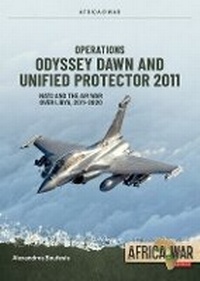
Operations Odyssey Dawn and Unified Protector 2011
NATO and the Air War over Libya, 2011-2020
Will be published approx. on 15. June 2026
Book
Paperback/Softback
96 pages
978-1-80672-024-8 (ISBN)
Description
Operation Unified Protector marked a historic moment as the first time NATO assumed command of an allied military campaign, taking over from the US-led Operation Odyssey Dawn. Tasked with protecting civilians from Muammar Qaddafi's forces during the 2011 Libyan Civil War, the operation exposed significant capability gaps within the alliance. NATO's heavy reliance on the United States for aerial refuelling, ISR (intelligence, surveillance, and reconnaissance), suppression of enemy air defences (SEAD), electronic warfare, command and control, and target acquisition underscored structural weaknesses that remain unresolved to this day. These limitations have only become more pressing in light of Russia's invasion of Ukraine and the prospect of future US strategic prioritisation of the Asia-Pacific theatre.
Initially hampered by a dysfunctional command and control structure and an overly cautious targeting process, the air campaign drifted into stalemate. Only when rebel forces launched a coordinated ground offensive from Misrata and the Nafusa Mountains did the tide turn. The fall of Tripoli, followed by the battle for Sirte and the death of Qaddafi, brought an end to the operation--but ushered in a decade of instability.
In the post-intervention vacuum, Libya descended into chaos. The emergence of General Khalifa Haftar as a dominant figure and his campaigns--initially aimed at rooting out Islamist elements and the Islamic State--were backed by several foreign powers and hailed by some as a source of stability. However, Turkey's armed intervention in support of the UN-recognised Government of National Accord (GNA) not only halted Haftar's advance on Tripoli, but also triggered new geopolitical tensions in the Eastern Mediterranean. Ankara's maritime ambitions clashed directly with the interests of Greece and Egypt, complicating regional security and maritime boundary disputes.
As with all titles in Helion's @ War series, this volume is illustrated throughout with rare photographs, detailed colour artworks, maps, and organisational charts. It provides a thorough, critical analysis of NATO's first major air campaign of the 21st century and its profound consequences for the alliance, Libya, and the evolving balance of power in the Mediterranean and beyond.
Initially hampered by a dysfunctional command and control structure and an overly cautious targeting process, the air campaign drifted into stalemate. Only when rebel forces launched a coordinated ground offensive from Misrata and the Nafusa Mountains did the tide turn. The fall of Tripoli, followed by the battle for Sirte and the death of Qaddafi, brought an end to the operation--but ushered in a decade of instability.
In the post-intervention vacuum, Libya descended into chaos. The emergence of General Khalifa Haftar as a dominant figure and his campaigns--initially aimed at rooting out Islamist elements and the Islamic State--were backed by several foreign powers and hailed by some as a source of stability. However, Turkey's armed intervention in support of the UN-recognised Government of National Accord (GNA) not only halted Haftar's advance on Tripoli, but also triggered new geopolitical tensions in the Eastern Mediterranean. Ankara's maritime ambitions clashed directly with the interests of Greece and Egypt, complicating regional security and maritime boundary disputes.
As with all titles in Helion's @ War series, this volume is illustrated throughout with rare photographs, detailed colour artworks, maps, and organisational charts. It provides a thorough, critical analysis of NATO's first major air campaign of the 21st century and its profound consequences for the alliance, Libya, and the evolving balance of power in the Mediterranean and beyond.
More details
Series
Language
English
Place of publication
Solihull
United Kingdom
Target group
Adult education
Product notice
Paperback (trade)
Unsewn / adhesive bound
Illustrations
120 colour photos, 20 colour profiles, 4 colour maps
Dimensions
Height: 297 mm
Width: 210 mm
ISBN-13
978-1-80672-024-8 (9781806720248)
Copyright in bibliographic data and cover images is held by Nielsen Book Services Limited or by the publishers or by their respective licensors: all rights reserved.
Schweitzer Classification
Person
Alexandros Boufesis is a holder of an Msc in International Security Studies (London Metropolitan University) and a PgC in Counter-Terrorism (St Andrews University). He has worked for many years as an investigative journalist in the areas of defence, geopolitics and military history.