

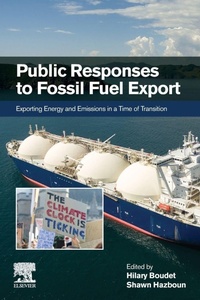
Public Responses to Fossil Fuel Export
Exporting Energy and Emissions in a Time of Transition
Published on 21. February 2022
Book
Paperback/Softback
294 pages
978-0-12-824046-5 (ISBN)
Description
Public Responses to Fossil Fuel Export provides wide-ranging theoretical and methodological international contributions on the human dimensions of fossil fuel export, with a distinctive focus on exporting countries, some of which are new entrants into the marketplace.
What do members of the public think about exporting fossil fuels in places where it is happening? What do they see as its main risks and benefits? What connections are being made to climate change and the impending energy transition?
How have affected communities responded to proposals related to fossil fuel export, broadly defined to include transport by rail, pipeline, and ship? Contributions to the work are presented in three parts. The first part synopsizes the background of the project, outlines major social science theories and relevant previous research, and identifies global trends in energy production. Regional and national case studies related to public opinion on fossil fuel export are included in part two of the manuscript. Part three highlights community-based case studies. Implications for research and practice feature in the concluding chapter.
What do members of the public think about exporting fossil fuels in places where it is happening? What do they see as its main risks and benefits? What connections are being made to climate change and the impending energy transition?
How have affected communities responded to proposals related to fossil fuel export, broadly defined to include transport by rail, pipeline, and ship? Contributions to the work are presented in three parts. The first part synopsizes the background of the project, outlines major social science theories and relevant previous research, and identifies global trends in energy production. Regional and national case studies related to public opinion on fossil fuel export are included in part two of the manuscript. Part three highlights community-based case studies. Implications for research and practice feature in the concluding chapter.
More details
Language
English
Place of publication
United States
Target group
Professional and scholarly
Early career researchers, students, and practitioners within the public, private and NGO sectors interested in fossil fuel export, energy transitions and public participation/community impacts from energy development. Readers will come from a wide array of social science disciplines and fields, although it would be accessible for interested engineers and natural scientists as well.
Product notice
Paperback (trade)
Dimensions
Height: 229 mm
Width: 152 mm
Thickness: 16 mm
Weight
397 gr
ISBN-13
978-0-12-824046-5 (9780128240465)
Copyright in bibliographic data and cover images is held by Nielsen Book Services Limited or by the publishers or by their respective licensors: all rights reserved.
Schweitzer Classification
Other editions
Additional editions
Hilary Boudet | Shawn Hazboun
Public Responses to Fossil Fuel Export
Exporting Energy and Emissions in a Time of Transition
E-Book
01/2022
Elsevier
€109.00
Available for download
Persons
Hilary Boudet is an Associate Professor of Sociology in the School of Public Policy at Oregon State University. She has written extensively on public perceptions of and community response to energy development, particularly natural gas. Before joining the faculty at Oregon State University, Hilary was a Postdoctoral Scholar at Stanford University, where she also completed her PhD in Environment and Resources. She holds a BA in Environmental Engineering and Political Science from Rice University. Shawn Olson Hazboun is a Member of the Faculty in the Graduate Program on the Environment at The Evergreen State College. Her research focuses on the social dimensions of energy systems, including community impacts from energy production and public perceptions about energy and related infrastructure. She has a PhD in Sociology from Utah State University and an MS from the University of Colorado - Boulder.
Content
PART I Introduction
1. An introduction to the social dimensions of fossil fuel export in an era of energy transition 3
PART II The new landscape of fossil fuel technology,supply, and policy
2. The new global energy order: shifting players, policies, and power dynamics
3. Fossil fuel export as a climate policy problem
PART III Public opinion on export
4. The evolution of US public attitudes toward natural gas export: a pooled cross-sectional analysis of time series data (2013-2017)
5. Drivers of US regulatory preferences for natural gas export
6. Energy and export transitions: from oil exports to renewable energy goals in Aotearoa New Zealand
7. Trends in Norwegian views on oil and gas export
8. A "thin green line? of resistance? Assessing public views on oil, natural gas, and coal export in the Pacific Northwest region of the United States and Canada
PART IV Community response to export projects
9. Global discourses, national priorities, and community experiences of participation in the energy infrastructure projects in northern Russia
10. Indigenous ambivalence? It's not about the pipeline...:Indigenous responses to fossil fuel export projects in Western Canada
11. The primacy of place: a community's response to a proposed liquefied natural gas export facility
12. Impact geographies of gas terminal development in thenorthern Australian context: insights from Gladstone and Darwin
13. Community risk or resilience? Perceptions and responses to oil train traffic in four US rail communities
14. Leave it in the ground, or send it abroad? Assessing themes in community response to coal export proposals using topic modeling of local news
PART V The future of fossil fuel export in an era of energy transition
15. Social dimensions of fossil fuel export: summary of learnings and implications for research and practice
1. An introduction to the social dimensions of fossil fuel export in an era of energy transition 3
PART II The new landscape of fossil fuel technology,supply, and policy
2. The new global energy order: shifting players, policies, and power dynamics
3. Fossil fuel export as a climate policy problem
PART III Public opinion on export
4. The evolution of US public attitudes toward natural gas export: a pooled cross-sectional analysis of time series data (2013-2017)
5. Drivers of US regulatory preferences for natural gas export
6. Energy and export transitions: from oil exports to renewable energy goals in Aotearoa New Zealand
7. Trends in Norwegian views on oil and gas export
8. A "thin green line? of resistance? Assessing public views on oil, natural gas, and coal export in the Pacific Northwest region of the United States and Canada
PART IV Community response to export projects
9. Global discourses, national priorities, and community experiences of participation in the energy infrastructure projects in northern Russia
10. Indigenous ambivalence? It's not about the pipeline...:Indigenous responses to fossil fuel export projects in Western Canada
11. The primacy of place: a community's response to a proposed liquefied natural gas export facility
12. Impact geographies of gas terminal development in thenorthern Australian context: insights from Gladstone and Darwin
13. Community risk or resilience? Perceptions and responses to oil train traffic in four US rail communities
14. Leave it in the ground, or send it abroad? Assessing themes in community response to coal export proposals using topic modeling of local news
PART V The future of fossil fuel export in an era of energy transition
15. Social dimensions of fossil fuel export: summary of learnings and implications for research and practice