

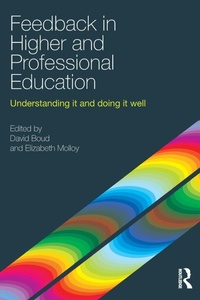
Feedback in Higher and Professional Education
Understanding it and doing it well
1st Edition
Published on 29. November 2012
Book
Paperback/Softback
240 pages
978-0-415-69229-8 (ISBN)
Description
Learners complain that they do not get enough feedback, and educators resent that although they put considerable time into generating feedback, students take little notice of it. Both parties agree that it is very important.
Feedback in Higher and Professional Education explores what needs to be done to make feedback more effective. It examines the problem of feedback and suggests that there is a lack of clarity and shared meaning about what it is and what constitutes doing it well. It argues that new ways of thinking about feedback are needed.
There has been considerable development in research on feedback in recent years, but surprisingly little awareness of what needs to be done to improve it and good ideas are not translated into action. The book provides a multi-disciplinary and international account of the role of feedback in higher and professional education. It challenges three conventional assumptions about feedback in learning:
That feedback constitutes one-way flow of information from a knowledgeable person to a less knowledgeable person.
That the job of feedback is complete with the imparting of performance-related information.
That a generic model of best-practice feedback can be applied to all learners and all learning situations
It seeking a new approach to feedback, it proposes that it is necessary to recognise that learners need to be much more actively involved in seeking, generating and using feedback. Rather than it being something they are subjected to, it must be an activity that they drive.
Feedback in Higher and Professional Education explores what needs to be done to make feedback more effective. It examines the problem of feedback and suggests that there is a lack of clarity and shared meaning about what it is and what constitutes doing it well. It argues that new ways of thinking about feedback are needed.
There has been considerable development in research on feedback in recent years, but surprisingly little awareness of what needs to be done to improve it and good ideas are not translated into action. The book provides a multi-disciplinary and international account of the role of feedback in higher and professional education. It challenges three conventional assumptions about feedback in learning:
That feedback constitutes one-way flow of information from a knowledgeable person to a less knowledgeable person.
That the job of feedback is complete with the imparting of performance-related information.
That a generic model of best-practice feedback can be applied to all learners and all learning situations
It seeking a new approach to feedback, it proposes that it is necessary to recognise that learners need to be much more actively involved in seeking, generating and using feedback. Rather than it being something they are subjected to, it must be an activity that they drive.
Reviews / Votes
"This book is timely and interesting and is to be recommended as a core read for all practitioners in understanding both their learners and the feedback process better."- David Ross, Director of the Centre for Academic Practice and Learning Development at the University of the West of ScotlandMore details
Language
English
Place of publication
London
United Kingdom
Publishing group
Taylor & Francis Ltd
Target group
Professional and scholarly
Academic and Professional Practice & Development
Illustrations
15 s/w Abbildungen, 10 s/w Tabellen
10 Tables, black and white; 15 Illustrations, black and white
Dimensions
Height: 234 mm
Width: 156 mm
Thickness: 13 mm
Weight
371 gr
ISBN-13
978-0-415-69229-8 (9780415692298)
Copyright in bibliographic data and cover images is held by Nielsen Book Services Limited or by the publishers or by their respective licensors: all rights reserved.
Schweitzer Classification
Other editions
Additional editions
David Boud | Elizabeth Molloy
Feedback in Higher and Professional Education
Understanding it and doing it well
E-Book
12/2012
1st Edition
Routledge
€51.49
Available for download
David Boud | Elizabeth Molloy
Feedback in Higher and Professional Education
Understanding it and doing it well
E-Book
12/2012
1st Edition
Routledge
€51.49
Available for download
David Boud | Elizabeth Molloy
Feedback in Higher and Professional Education
Understanding it and doing it well
Book
11/2012
1st Edition
Routledge
€206.40
Shipment within 15-20 days
Persons
David Boud is Professor of Adult Education in the Faculty of Arts and Social Sciences at the University of Technology, Sydney, Australia.
Elizabeth Molloy is an Associate Professor in the Health Professions Education and Educational Research Unit in the Faculty of Medicine, Nursing and Health Sciences at Monash University, Melbourne, Australia.
Elizabeth Molloy is an Associate Professor in the Health Professions Education and Educational Research Unit in the Faculty of Medicine, Nursing and Health Sciences at Monash University, Melbourne, Australia.
Content
1. The Problem with Feedback 2. Changing Conceptions of Feedback 3. Resituating Feedback from the Reactive to the Proactive 4. The Impact of Emotions in Feedback 5. Socio-cultural Considerations in Feedback 6. Trust and Sustainable Feedback for the Development of Student Learning Dispositions 7. Written Feedback: What is it good for and how can we do it well? 8. Feedback in the Digital Environment 9. Feedback on Skills in Simulation 10. Implementing Multisource Feedback 11. The Role of Peers in Feedback Processes 12. Utilising the Voice of Others: The example of consumer-delivered feedback 13. Decision-making for Feedback