

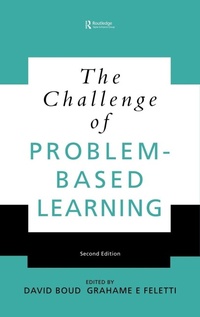
The Challenge of Problem-based Learning
2nd Edition
Published on 1. August 1997
Book
Hardback
336 pages
978-0-7494-2291-2 (ISBN)
Description
Problem-based learning is a way of constructing and teaching courses using problems as the stimulus and focus for student activity. This edition looks at the topic in the light of changes since the first edition (1991). There are new chapters on the impact of PBL, and inquiry and action learning.
More details
Edition
2. Auflage
Language
English
Place of publication
London
United Kingdom
Publishing group
Taylor & Francis Ltd
Target group
College/higher education
Professional and scholarly
Dimensions
Height: 240 mm
Width: 161 mm
Thickness: 24 mm
Weight
699 gr
ISBN-13
978-0-7494-2291-2 (9780749422912)
Copyright in bibliographic data and cover images is held by Nielsen Book Services Limited or by the publishers or by their respective licensors: all rights reserved.
Schweitzer Classification
Other editions
Additional editions
David Boud | Grahame Feletti
The Challenge of Problem-based Learning
E-Book
11/2013
1st Edition
Routledge
€76.49
Available for download
David Boud | Grahame Feletti
The Challenge of Problem-based Learning
E-Book
11/2013
1st Edition
Routledge
€76.49
Available for download
David Boud | Grahame Feletti
The Challenge of Problem-based Learning
Book
05/1998
2nd Edition
Kogan Page Ltd
€83.80
Shipment within 10-20 days
Persons
David Boud, Grahame Feletti
Content
Not just a method; framework for PBL; why is PBL a challenge; good planning; persevering with PBL; conversion to PBL; PBL at Harvard; organizational impediments; selection of health problems; innovation in nursing issues in conventional programme; preparing tertiary teachers; hybrid model at Harvard; case writing at Harvard; becoming a PBL tutor; PBL in mechanical engineering; PBL in social work; PBL in optometry; PBL in architecture; PBL in inquiry and action learning; PBL in law practice; industrial enhancement; PBL in management; assessment in architecture; what should be assessed; strategies for assessment; learning for assessment; evaluating the impact of PBL; PBL - only way? praxis of situation improving; limits of PBL.