

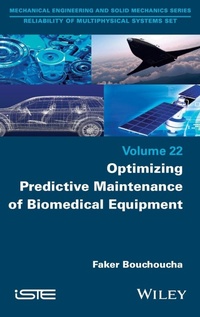
Optimizing Predictive Maintenance of Biomedical Equipment
1st Edition
Will be published approx. on 23. April 2026
Book
Hardback
256 pages
978-1-83669-120-4 (ISBN)
Description
In today's healthcare landscape, the reliability and availability of biomedical equipment are crucial for delivering safe and effective patient care. Dialysis machines, in particular, demand consistent performance, as equipment failure can directly impact patient survival. This book bridges the gap between engineering and healthcare by presenting advanced maintenance strategies that move beyond traditional corrective and preventive approaches toward predictive, data-driven methods.
Combining reliability theory, probabilistic modeling and statistical tools such as Weibull analysis, Fault Tree Analysis and Bayesian Networks, Optimizing Predictive Maintenance of Biomedical Equipment demonstrates how failure histories and real-time monitoring can guide proactive maintenance decisions. It provides practical guidance for optimizing equipment reliability and availability, while reducing downtime and resource waste. Designed for engineers, healthcare professionals and decision-makers, this book emphasizes step-by-step implementation of predictive maintenance frameworks in real-world clinical environments. By integrating technical rigor with patient-centered outcomes, this work highlights how strategic maintenance not only enhances equipment performance, but ultimately safeguards human lives.
Combining reliability theory, probabilistic modeling and statistical tools such as Weibull analysis, Fault Tree Analysis and Bayesian Networks, Optimizing Predictive Maintenance of Biomedical Equipment demonstrates how failure histories and real-time monitoring can guide proactive maintenance decisions. It provides practical guidance for optimizing equipment reliability and availability, while reducing downtime and resource waste. Designed for engineers, healthcare professionals and decision-makers, this book emphasizes step-by-step implementation of predictive maintenance frameworks in real-world clinical environments. By integrating technical rigor with patient-centered outcomes, this work highlights how strategic maintenance not only enhances equipment performance, but ultimately safeguards human lives.
More details
Series
Language
English
Place of publication
London
United Kingdom
Target group
Professional and scholarly
Product notice
Laminated cover
Dimensions
Height: 234 mm
Width: 156 mm
Thickness: 16 mm
Weight
540 gr
ISBN-13
978-1-83669-120-4 (9781836691204)
Copyright in bibliographic data and cover images is held by Nielsen Book Services Limited or by the publishers or by their respective licensors: all rights reserved.
Schweitzer Classification
Other editions
Additional editions
Faker Bouchoucha
Optimizing Predictive Maintenance of Biomedical Equipment
E-Book
04/2026
1st Edition
Wiley
€146.99
Available for download
Faker Bouchoucha
Optimizing Predictive Maintenance of Biomedical Equipment
E-Book
04/2026
1st Edition
Wiley
€146.99
Available for download
Person
Faker Bouchoucha is Associate Professor of Mechanical Engineering at IPEIN, Carthage University, Tunisia. His research focuses on predictive maintenance, biomedical equipment reliability, stochastic modeling, probability and statistics, structural dynamics, and vibro-acoustics applied to engineering systems.
Content
Preface xi
Abstract xiii
Organization of the Book xvii
Introduction xxi
Chapter 1. Medical Equipment Management in Healthcare Facilities 1
1.1. Introduction 1
1.2. The central role of medical equipment in care delivery 3
1.3. Organization and responsibilities of the biomedical maintenance department 4
1.4. Regulatory and normative framework of medical devices 8
1.4.1. Typology of regulations applicable to medical devices. 9
1.4.2. Typology of standards applicable to medical devices 11
1.5. Managing uncertainty and random data 13
1.5.1. Sources of uncertainty in biomedical equipment maintenance 14
1.5.2. Extended implications 16
1.6. Probabilistic methods 16
1.6.1. Weibull distribution 16
1.6.2. Exponential distribution 17
1.6.3. Log-normal distribution 17
1.6.4. Other distributions 18
1.6.5. AI integration and real-time data 18
1.6.6. Limitations and future directions 18
1.7. Advanced Predictive maintenance strategies for medical devices 19
1.7.1. Analysis of reliability, maintainability and availability. 19
1.7.2. Advanced statistical tools 20
1.7.3. Operational applications 23
1.7.4. Real-time data integration 23
1.7.5. Limitations and best practices 24
1.7.6. Perspectives 24
1.8. Integrating digitalization and AI into hospital maintenance 24
1.8.1. Benefits and implications 25
1.8.2. Challenges and considerations 25
1.9. Economic, environmental and strategic challenges in medical equipment management 26
1.10. Conclusion 28
Chapter 2. Description of the Dialysis Machine 29
2.1. Introduction 29
2.2. Functions and operational principles of a hemodialysis machine 30
2.2.1. Basic functions: the core dialysis process 32
2.2.2. Safety functions: the automated vigilance system 35
2.2.3. Disinfection circuit: ensuring microbiological safety 35
2.3. Dialysis machine features 38
2.3.1. Operator controls 38
2.3.2. Patient connections 39
2.3.3. Data interfaces 39
2.3.4. Mechanism 40
2.3.5. Processing 41
2.3.6. Power supply 42
2.4. Maintenance strategies for hemodialysis machines: types, components and a real case study 43
2.4.1. Preventive maintenance 43
2.4.2. Corrective maintenance 44
2.4.3. Predictive maintenance 44
2.4.4. Condition-based maintenance 44
2.5. Presentation of the studied dialysis machines 45
2.5.1. Characteristics of the Fresinus hemodialysis machine 45
2.5.2. Overview of dialysis machine failure history 46
Chapter 3. Weibull Distribution 51
3.1. Introduction 51
3.2. Description of the Weibull distribution 52
3.3. Weibull distribution characteristics 54
3.3.1. Advantages 54
3.3.2. Limitations and disadvantages 54
3.3.3. Application domains 55
3.3.4. Real-world example 55
3.4. Estimation of the Weibull parameters 55
3.4.1. Least square method 56
3.4.2. Maximum likelihood method 57
3.4.3. Method of moments 59
3.4.4. Interpretation and comparative analysis 60
3.5. Conclusion 60
Chapter 4. Reliability, Maintainability and Availability Analysis Through Weibull Distribution 63
4.1. Introduction 63
4.2. General concept of failure 64
4.3. Systems degradation models 65
4.4. Factors influencing the reliability 65
4.5. Reliability, maintainability and availability analysis of medical equipment using the Weibull distribution 67
4.5.1. Introduction 67
4.5.2. Application to reliability of medical equipment 68
4.5.3. Maintainability modeling using Weibull parameters 69
4.5.4. Availability analysis and system performance 70
4.5.5. Degradation modeling and preventive maintenance 71
4.5.6. Case studies and practical implications 72
4.5.7. Conclusion 72
4.6. Failure mode and effects analysis, fault tree analysis and Bayesian networks for dialysis machine reliability 73
4.6.1. Introduction 73
4.6.2. Failure mode and effects analysis 73
4.6.3. Fault tree analysis 77
4.6.4. Bayesian networks 82
4.6.5. Comparative summary and relevance to dialysis machines 86
4.6.6. Conclusion 87
4.7. Probabilistic analysis of dialysis interruption: fault tree and Bayesian network approaches with Weibull distribution integration 88
4.7.1. Introduction: Weibull distribution and biomedical equipment 88
4.7.2. Case study: dialysis interruption 88
4.8. Conclusion 92
Chapter 5. Reliability, Maintainability and Availability of the Dialysis Machines based on the Failure History Through Weibull Distribution 95
5.1. Introduction 95
5.2. Overview of dialysis machine failure history 96
5.3. Pareto analysis method 103
5.4. Estimation of the Weibull parameters 107
5.4.1. Goodness-of-fit 115
5.4.2. Kolmogorov-Smirnov (K-S) test 116
5.5. Reliability analysis through Weibull distribution. 119
5.6. Maintainability study 124
5.7. Availability study 127
5.7.1. Theoretical intrinsic availability 127
5.7.2. Instantaneous availability 128
5.8. The systematic inspection period 130
5.9. Development of a maintenance plan for hemodialysis machines 131
5.10. Conclusion 135
Chapter 6. Effect of the Stochastic Weibull Parameters on the Reliability of the Dialysis Machine 137
6.1. Introduction 137
6.2. Estimation of the stochastic Weibull parameters 141
6.3. Random reliability analysis 146
6.3.1. The random failure rate estimation 146
6.3.2. The random reliability estimation 151
6.3.3. The random probability density function estimation 156
6.3.4. The random systematic inspection period of dialysis machines 160
6.4. Conclusion 162
Chapter 7. Fault Tree and Bayesian Network-Based Probabilistic Modeling for Predictive Maintenance of Dialysis Machines 165
7.1. Introduction 165
7.2. Literature review 166
7.3. Reliability and failure analysis of hemodialysis machines using clinical data 169
7.4. FTA of dialysis machines 172
7.4.1. Fault tree construction 172
7.4.2. Probability calculation of basic failure causes 173
7.4.3. Probability calculation of intermediate failure events 174
7.5. BN analysis of dialysis machines 175
7.5.1. BN construction 175
7.5.2. Probability calculation of intermediate failure events 177
7.6. Interpretation of results 179
7.7. Conclusion 181
Conclusion 183
Appendices 187
Appendix 1. Table for Gamma Function ? 189
Appendix 2. One-Sample Kolmogorov-Smirnov Table 191
Appendix 3. The Gaussian Distribution 193
Appendix 4. Taylor Series 197
References 203
Index 217
Abstract xiii
Organization of the Book xvii
Introduction xxi
Chapter 1. Medical Equipment Management in Healthcare Facilities 1
1.1. Introduction 1
1.2. The central role of medical equipment in care delivery 3
1.3. Organization and responsibilities of the biomedical maintenance department 4
1.4. Regulatory and normative framework of medical devices 8
1.4.1. Typology of regulations applicable to medical devices. 9
1.4.2. Typology of standards applicable to medical devices 11
1.5. Managing uncertainty and random data 13
1.5.1. Sources of uncertainty in biomedical equipment maintenance 14
1.5.2. Extended implications 16
1.6. Probabilistic methods 16
1.6.1. Weibull distribution 16
1.6.2. Exponential distribution 17
1.6.3. Log-normal distribution 17
1.6.4. Other distributions 18
1.6.5. AI integration and real-time data 18
1.6.6. Limitations and future directions 18
1.7. Advanced Predictive maintenance strategies for medical devices 19
1.7.1. Analysis of reliability, maintainability and availability. 19
1.7.2. Advanced statistical tools 20
1.7.3. Operational applications 23
1.7.4. Real-time data integration 23
1.7.5. Limitations and best practices 24
1.7.6. Perspectives 24
1.8. Integrating digitalization and AI into hospital maintenance 24
1.8.1. Benefits and implications 25
1.8.2. Challenges and considerations 25
1.9. Economic, environmental and strategic challenges in medical equipment management 26
1.10. Conclusion 28
Chapter 2. Description of the Dialysis Machine 29
2.1. Introduction 29
2.2. Functions and operational principles of a hemodialysis machine 30
2.2.1. Basic functions: the core dialysis process 32
2.2.2. Safety functions: the automated vigilance system 35
2.2.3. Disinfection circuit: ensuring microbiological safety 35
2.3. Dialysis machine features 38
2.3.1. Operator controls 38
2.3.2. Patient connections 39
2.3.3. Data interfaces 39
2.3.4. Mechanism 40
2.3.5. Processing 41
2.3.6. Power supply 42
2.4. Maintenance strategies for hemodialysis machines: types, components and a real case study 43
2.4.1. Preventive maintenance 43
2.4.2. Corrective maintenance 44
2.4.3. Predictive maintenance 44
2.4.4. Condition-based maintenance 44
2.5. Presentation of the studied dialysis machines 45
2.5.1. Characteristics of the Fresinus hemodialysis machine 45
2.5.2. Overview of dialysis machine failure history 46
Chapter 3. Weibull Distribution 51
3.1. Introduction 51
3.2. Description of the Weibull distribution 52
3.3. Weibull distribution characteristics 54
3.3.1. Advantages 54
3.3.2. Limitations and disadvantages 54
3.3.3. Application domains 55
3.3.4. Real-world example 55
3.4. Estimation of the Weibull parameters 55
3.4.1. Least square method 56
3.4.2. Maximum likelihood method 57
3.4.3. Method of moments 59
3.4.4. Interpretation and comparative analysis 60
3.5. Conclusion 60
Chapter 4. Reliability, Maintainability and Availability Analysis Through Weibull Distribution 63
4.1. Introduction 63
4.2. General concept of failure 64
4.3. Systems degradation models 65
4.4. Factors influencing the reliability 65
4.5. Reliability, maintainability and availability analysis of medical equipment using the Weibull distribution 67
4.5.1. Introduction 67
4.5.2. Application to reliability of medical equipment 68
4.5.3. Maintainability modeling using Weibull parameters 69
4.5.4. Availability analysis and system performance 70
4.5.5. Degradation modeling and preventive maintenance 71
4.5.6. Case studies and practical implications 72
4.5.7. Conclusion 72
4.6. Failure mode and effects analysis, fault tree analysis and Bayesian networks for dialysis machine reliability 73
4.6.1. Introduction 73
4.6.2. Failure mode and effects analysis 73
4.6.3. Fault tree analysis 77
4.6.4. Bayesian networks 82
4.6.5. Comparative summary and relevance to dialysis machines 86
4.6.6. Conclusion 87
4.7. Probabilistic analysis of dialysis interruption: fault tree and Bayesian network approaches with Weibull distribution integration 88
4.7.1. Introduction: Weibull distribution and biomedical equipment 88
4.7.2. Case study: dialysis interruption 88
4.8. Conclusion 92
Chapter 5. Reliability, Maintainability and Availability of the Dialysis Machines based on the Failure History Through Weibull Distribution 95
5.1. Introduction 95
5.2. Overview of dialysis machine failure history 96
5.3. Pareto analysis method 103
5.4. Estimation of the Weibull parameters 107
5.4.1. Goodness-of-fit 115
5.4.2. Kolmogorov-Smirnov (K-S) test 116
5.5. Reliability analysis through Weibull distribution. 119
5.6. Maintainability study 124
5.7. Availability study 127
5.7.1. Theoretical intrinsic availability 127
5.7.2. Instantaneous availability 128
5.8. The systematic inspection period 130
5.9. Development of a maintenance plan for hemodialysis machines 131
5.10. Conclusion 135
Chapter 6. Effect of the Stochastic Weibull Parameters on the Reliability of the Dialysis Machine 137
6.1. Introduction 137
6.2. Estimation of the stochastic Weibull parameters 141
6.3. Random reliability analysis 146
6.3.1. The random failure rate estimation 146
6.3.2. The random reliability estimation 151
6.3.3. The random probability density function estimation 156
6.3.4. The random systematic inspection period of dialysis machines 160
6.4. Conclusion 162
Chapter 7. Fault Tree and Bayesian Network-Based Probabilistic Modeling for Predictive Maintenance of Dialysis Machines 165
7.1. Introduction 165
7.2. Literature review 166
7.3. Reliability and failure analysis of hemodialysis machines using clinical data 169
7.4. FTA of dialysis machines 172
7.4.1. Fault tree construction 172
7.4.2. Probability calculation of basic failure causes 173
7.4.3. Probability calculation of intermediate failure events 174
7.5. BN analysis of dialysis machines 175
7.5.1. BN construction 175
7.5.2. Probability calculation of intermediate failure events 177
7.6. Interpretation of results 179
7.7. Conclusion 181
Conclusion 183
Appendices 187
Appendix 1. Table for Gamma Function ? 189
Appendix 2. One-Sample Kolmogorov-Smirnov Table 191
Appendix 3. The Gaussian Distribution 193
Appendix 4. Taylor Series 197
References 203
Index 217