


Theory of Financial Risks
From Statistical Physics to Risk Management
Published on 17. August 2000
Book
Hardback
232 pages
978-0-521-78232-6 (ISBN)
Description
This book summarizes recent theoretical developments inspired by statistical physics in the description of the potential moves in financial markets, and its application to derivative pricing and risk control. The possibility of accessing and processing huge quantities of data on financial markets opens the path to new methodologies where systematic comparison between theories and real data not only becomes possible, but mandatory. This book takes a physicist's point of view to financial risk by comparing theory with experiment. Starting with important results in probability theory, the authors discuss the statistical analysis of real data, the empirical determination of statistical laws, the definition of risk, the theory of optimal portfolio, and the problem of derivatives (forward contracts, options). This book will be of interest to physicists interested in finance, quantitative analysts in financial institutions, risk managers and graduate students in mathematical finance.
Reviews / Votes
'... provides a very useful stepping stone to understand the limitations of the Black-Scholes world to that of a more generalized theory of financial markets ... Bouchard and Potters will then provide the reader with an insight and generalization that they may otherwise miss with direct application of more 'traditional' theory to the financial markets. To the experienced reader of financial theory, the book provides a useful reminder of the limitations of traditional theories and a number of useful tools that can be used in the more generalized world of financial risk.' David A. Scott C. Math.FIMA, Mathematics Today 'This book does not try to be a comprehensive text on theoretical finance, but instead picks out classical problems in finance that are overlooked by the generalizations introduced by beautiful, ideal models such as the Black and Scholes model and discusses tools, concepts and paradigms of statistical finance that can contribute to the resolution of such problems ... However, given the themes treated by the book and the expertise and knowledge of the authors, Theory of Financial Risks should certainly find a place on the bookshelves of professionals in risk management who are interested in new quantitative methods of risk minimization.' Rosario Mantegna, Institute of Physics ' ... addresses the expert who is interested in statistical properties of financial time series and the problem of constructing 'good' hedge strategies in the presence of unavoidable residual risk.' Zentralblatt fuer Mathematik und ihre Grenzgebiete Mathematics AbstractsMore details
Language
English
Place of publication
Cambridge
United Kingdom
Target group
Professional and scholarly
Illustrations
4 Tables, unspecified; 55 Line drawings, unspecified
Dimensions
Height: 255 mm
Width: 181 mm
Thickness: 23 mm
Weight
619 gr
ISBN-13
978-0-521-78232-6 (9780521782326)
Copyright in bibliographic data and cover images is held by Nielsen Book Services Limited or by the publishers or by their respective licensors: all rights reserved.
Schweitzer Classification
Other editions
New editions
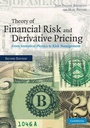
Jean-Philippe Bouchaud | Marc Potters
Theory of Financial Risk and Derivative Pricing
From Statistical Physics to Risk Management
Book
12/2003
2nd Edition
Cambridge University Press
€160.00
Shipment within 15-20 days
Additional editions
Jean-Philippe Bouchaud | Marc Potters
Theory of Financial Risks
From Statistical Physics to Risk Management
E-Book
08/2000
1st Edition
Cambridge University Press
€41.49
Available for download
Previous edition
Jean-Philippe Bouchaud | Marc Potters
Theory of Financial Risk and Derivative Pricing
From Statistical Physics to Risk Management
Book
12/2003
2nd Edition
Cambridge University Press
€160.00
Shipment within 15-20 days
Persons
Content
1. Probability theory: basic notions; 2. Statistics of real prices; 3. Extreme risks and optimal portfolios; 4. Futures and options: fundamental concepts; 5. Options: some more specific problems; Glossary.