

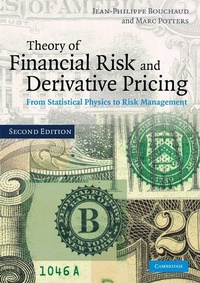
Theory of Financial Risk and Derivative Pricing
From Statistical Physics to Risk Management
2nd Edition
Published on 22. January 2009
Book
Paperback/Softback
400 pages
978-0-521-74186-6 (ISBN)
Description
Risk control and derivative pricing have become of major concern to financial institutions, and there is a real need for adequate statistical tools to measure and anticipate the amplitude of the potential moves of the financial markets. Summarising theoretical developments in the field, this 2003 second edition has been substantially expanded. Additional chapters now cover stochastic processes, Monte-Carlo methods, Black-Scholes theory, the theory of the yield curve, and Minority Game. There are discussions on aspects of data analysis, financial products, non-linear correlations, and herding, feedback and agent based models. This book has become a classic reference for graduate students and researchers working in econophysics and mathematical finance, and for quantitative analysts working on risk management, derivative pricing and quantitative trading strategies.
Reviews / Votes
From reviews of the first edition: '... provides a very useful stepping stone to understand the limitations of the Black-Scholes world to that of a more generalized theory of financial markets ... Bouchard and Potters will then provide the reader with an insight and generalization that they may otherwise miss with direct application of more 'traditional' theory to the financial markets. To the experienced reader of financial theory, the book provides a useful reminder of the limitations of traditional theories and a number of useful tools that can be used in the more generalized world of financial risk.' David A. Scott C. Math. FIMA, Mathematics Today 'This book does not try to be a comprehensive text on theoretical finance, but instead picks out classical problems in finance that are overlooked by the generalizations introduced by beautiful, ideal models such as the Black and Scholes model and discusses tools, concepts and paradigms of statistical finance that can contribute to the resolution of such problems ... However, given the themes treated by the book and the expertise and knowledge of the authors, Theory of Financial Risks should certainly find a place on the bookshelves of professionals in risk management who are interested in new quantitative methods of risk minimization.' Rosario Mantegna, Institute of Physics 'The book is well written and self-contained ... It is recommended to anyone interested in a new and fresh approach to the dynamics of financial markets.' Journal of Statistical Physics 'The authors dutifully thread the relations between different financial securities and statistical estimation, rewarding the reader with an understanding that could never be obtained from a purely statistical text ... the feeling one is left with after putting the book down is one of time well spent.' Risk 'Coming to the data with fewer preconceptions than those with professional training in finance, and applying sophisticated tools, the authors offer fresh and valuable insights into financial markets.' Mathematical Reviews 'This is a terrific book. Some extremely exciting new ideas, questions, and techniques are coming from physics, and many were pioneered by the authors. This book will teach both academics and practitioners a new way of doing finance.' Xavier Gabaix, MIT 'An outstanding and original presentation of quantitative finance from a physics perspective.' Nassin Nicholas Taleb, Empirica LLC, author of Fooled by Randomness 'It is rare to read a quantitative finance book that has anything new to say. It is even rarer to find such a book written by those who know what they are talking about. Bouchaud and Potters are two of the most innovative, imaginative and experienced researches in finance. In this second edition of their ground-breaking work, they go even further into their field of econo-physics, a field that is changing the way we view the financial markets. Each page is packed with more ideas than most people put into an entire book. An inspirational book to be studied carefully and savoured.' Paul WilmottMore details
Edition
2nd Revised edition
Language
English
Place of publication
Cambridge
United Kingdom
Target group
Professional and scholarly
Edition type
Revised edition
Product notice
Paperback (trade)
Illustrations
20 Tables, unspecified
Dimensions
Height: 254 mm
Width: 178 mm
Thickness: 22 mm
Weight
750 gr
ISBN-13
978-0-521-74186-6 (9780521741866)
Copyright in bibliographic data and cover images is held by Nielsen Book Services Limited or by the publishers or by their respective licensors: all rights reserved.
Schweitzer Classification
Other editions
Additional editions
Jean-Philippe Bouchaud | Marc Potters
Theory of Financial Risk and Derivative Pricing
From Statistical Physics to Risk Management
E-Book
12/2004
2nd Edition
Cambridge University Press
€58.99
Available for download
Jean-Philippe Bouchaud | Marc Potters
Theory of Financial Risk and Derivative Pricing
From Statistical Physics to Risk Management
Book
12/2003
2nd Edition
Cambridge University Press
€160.00
Shipment within 15-20 days
Persons
Jean-Philippe Bouchaud co-founded the company Science & Finance, which merged with Capital Fund Management (CFM) in 2000, where he now supervises the research team with Marc Potters. He teaches statistical mechanics and finance in various Grandes Ecoles, and has worked at CRNS and CEA-Saclay. He was awarded the CRNS Silver Medal in 1996. Marc Potters has been Head of Research at CFM since 1998, where he supervises thirty physics PhD's. He has published numerous articles in the new field of statistical finance, in particular on Random Matrix Theory applied to portfolio management. He works on various concrete applications of financial forecasting, option pricing and risk control.
Content
Foreword; Preface; 1. Probability theory: basic notions; 2. Maximum and addition of random variables; 3. Continuous time limit, Ito calculus and path integrals; 4. Analysis of empirical data; 5. Financial products and financial markets; 6. Statistics of real prices: basic results; 7. Non-linear correlations and volatility fluctuations; 8. Skewness and price-volatility correlations; 9. Cross-correlations; 10. Risk measures; 11. Extreme correlations and variety; 12. Optimal portfolios; 13. Futures and options: fundamental concepts; 14. Options: hedging and residual risk; 15. Options: the role of drift and correlations; 16. Options: the Black and Scholes model; 17. Options: some more specific problems; 18. Options: minimum variance Monte-Carlo; 19. The yield curve; 20. Simple mechanisms for anomalous price statistics; Index of most important symbols; Index.