

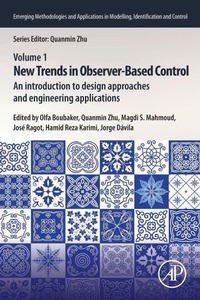
New Trends in Observer-Based Control
An Introduction to Design Approaches and Engineering Applications
Published on 19. March 2019
Book
Paperback/Softback
490 pages
978-0-12-817038-0 (ISBN)
Description
New Trends in Observer-Based Control: An Introduction to Design Approaches and Engineering Applications, Volume One presents a clear-and-concise introduction to the latest advances in observer-based control design. It provides a comprehensive tutorial on new trends in the design of observer-based controllers for which the separation principle is well established. In addition, since the theoretical developments remain more advanced than the engineering applications, more experimental results are still needed. A wide range of applications are covered, and the book contains worked examples which make it ideal for both advanced courses and researchers starting in the field.
More details
Series
Language
English
Place of publication
San Diego
United States
Publishing group
Elsevier Science Publishing Co Inc
Target group
Professional and scholarly
College/higher education
KEYWORDS: observer design; observer-based control; robust control; Adaptive Control; predictive control; fuzzy controller; fault tolerant control; robust observer; unknown input observer; switched systems; polytopic systems; descriptor systems; time-delay systems; stochastic systems; LMIs; power systems; flight systems; robotics; automotive
Product notice
Paperback (trade)
Illustrations
Approx. 200 illustrations
Dimensions
Height: 229 mm
Width: 152 mm
Thickness: 25 mm
Weight
651 gr
ISBN-13
978-0-12-817038-0 (9780128170380)
Copyright in bibliographic data and cover images is held by Nielsen Book Services Limited or by the publishers or by their respective licensors: all rights reserved.
Schweitzer Classification
Other editions
Additional editions
Olfa Boubaker | Quanmin Zhu | Magdi S. Mahmoud
New Trends in Observer-Based Control
An Introduction to Design Approaches and Engineering Applications
E-Book
03/2019
Academic Press
€131.00
Available for download
Persons
Pr. Olfa Boubaker is a full professor at the National Institute of Applied Sciences and Technology (INSAT) at the University of Carthage, Tunisia, where she specializes in control theory, nonlinear systems, and robotics. She holds a Ph.D. in Electrical Engineering from the National Engineering School of Tunis and a Habilitation Universitaire in Control Engineering from the National Engineering School of Sfax. Prof. Boubaker is the series editor of the book series Medical Robots and Devices: New Developments and Advances."
Quanmin Zhu is Professor of control systems at the Department of Engineering Design and Mathematics, University of the West of England, Bristol, UK. He obtained his MSc in Harbin Institute of Technology, China in 1983 and Ph.D. in Faculty of Engineering, University of Warwick, UK in 1989. His main research interest is in the area of nonlinear system modelling, identification, and control. His other research interest is in investigating electrodynamics of acupuncture points and sensory stimulation effects in human body, modelling of human meridian systems, and building up electro-acupuncture instruments. He has published over 200 papers on these topics, edited five Springer books and one book for the other publisher, and provided consultancy to various industries. Currently, Professor Zhu is acting as Editor of International Journal of Modelling, Identification and Control, Editor of International Journal of Computer Applications in Technology, Member of Editorial Committee of Chinese Journal of Scientific Instrument, and editor of Elsevier book series of Emerging Methodologies and Applications in Modelling, Identification and Control. He is the founder and president of series annual International Conference on Modelling, Identification and Control. MagdiSadek Mahmoud obtained B. Sc. (Honors) in communication engineering, M. Sc. in electronic engineering and Ph. D. in systems engineering, all from Cairo University in 1968, 1972 and 1974, respectively. He has been a professor of engineering since 1984. He is now a Distinguished Professor at KFUPM, Saudi Arabia. He was on the faculty at different universities worldwide including Egypt (CU, AUC), Kuwait (KU), UAE (UAEU), UK (UMIST), USA (Pitt, Case Western), Singapore (Nanyang) and Australia (Adelaide). He lectured in Venezuela (Caracas), Germany (Hanover), UK ((Kent), USA (UoSA), Canada (Montreal) and China (BIT, Yanshan). He is the principal author of forty-six (46) books, inclusive book-chapters and the author/co-author of more than 580 peer-reviewed papers.
He is currently actively engaged in teaching and research in the development of modern methodologies to distributed control and filtering, networked-control systems, triggering mechanisms in dynamical systems, renewable-energy systems, and information technology. He is a fellow of the IEE, a senior member of the IEEE, a member of Sigma Xi, the CEI (UK), the Egyptian Engineers society, the Kuwait Engineers society and a registered consultant engineer of information engineering and systems (Egypt). Jose RAGOT received the "Diplome d'Ingenieur" (Engineer Degree) with specialization in control from the Ecole Centrale de Nantes (France) in 1969. Then, he joined the University of Nancy (France) where is received the "Diplome d'Etudes Approfondies" (Master Degree) in 1970. In 1973 he obtained the "Diplome de Doctorat" (Ph. D. degree), a position as assistant professor at University Henri Poincare in Nancy, and in 1980 the "Diplome de Doctorat-es-Sciences". Jose Ragot moved up to professor in 1985 at the Institut National Polytechnique de Lorraine (INPL, National Polytechnic Institute of Lorraine).
His major research fields include data validation and reconciliation, process diagnosis, fault detection, and isolation. Another part of his activities is devoted to modelisation and state estimation adapted to process diagnosis and mainly in the field of multi-models.
Prof. Ragot is a researcher in the "Centre de Recherche en Automatique de Nancy" (CRAN, CNRS UMR 7039) where he was the head of the group "process diagnosis" during 12 years. Presently he is an Emeritus Professor (with the degree "Classe Exceptionnelle") at the "Ecole Nationale Superieure de Geologie" (french "Grande Ecole") where he has been in charge the formation in automatic control. Dr. Karimi received the B.Sc. (First Hons.) degree in power systems from the Sharif University of Technology, Tehran, Iran, in 1998, and the M.Sc. and Ph.D. (First Hons.) degrees in control systems engineering from the University of Tehran, Tehran, in 2001 and 2005, respectively. His research interests are in the areas of control systems/theory, mechatronics, networked control systems, intelligent control systems, signal processing, vibration control, ground vehicles, structural control, wind turbine control and cutting processes. He is an Editorial Board Member for some international journals and several Technical Committee. Prof. Karimi has been presented a number of national and international awards, including Alexander-von-Humboldt Research Fellowship Award (in Germany), JSPS Research Award (in Japan), DAAD Research Award (in Germany), August-Wilhelm-Scheer Award (in Germany) and been invited as visiting professor at a number of universities in Germany, France, Italy, Poland, Spain, China, Korea, Japan, India. Jorge Davila received the Ph.D. degree (2008) in Electrical Engineering from the National Autonomous University of Mexico (UNAM). He was awarded the Alfonso Caso Medal to the best Ph.D. student of the National Autonomous University of Mexico, UNAM, in 2010.
Prof. Davila is a member of the Mexican National Research System, since January 2010, and he was awarded the distinction of National Researcher Level 2. He has published 27 journal articles, coauthored five book chapters and contributed with 68 conference papers. His works in observation, identification, and control of linear and nonlinear systems have been cited more than 1400 times (source: SCOPUS), he possesses h-index=16. Prof. Davila was guest editor of the Special Issue: "Variable Structure Methods for Hybrid Systems,? International Journal of Systems Science, Volume 42, Issue 11, 2011. And currently is associate Editor of the Conference Editorial Board of IEEE Control Systems Society (since 2016).
Quanmin Zhu is Professor of control systems at the Department of Engineering Design and Mathematics, University of the West of England, Bristol, UK. He obtained his MSc in Harbin Institute of Technology, China in 1983 and Ph.D. in Faculty of Engineering, University of Warwick, UK in 1989. His main research interest is in the area of nonlinear system modelling, identification, and control. His other research interest is in investigating electrodynamics of acupuncture points and sensory stimulation effects in human body, modelling of human meridian systems, and building up electro-acupuncture instruments. He has published over 200 papers on these topics, edited five Springer books and one book for the other publisher, and provided consultancy to various industries. Currently, Professor Zhu is acting as Editor of International Journal of Modelling, Identification and Control, Editor of International Journal of Computer Applications in Technology, Member of Editorial Committee of Chinese Journal of Scientific Instrument, and editor of Elsevier book series of Emerging Methodologies and Applications in Modelling, Identification and Control. He is the founder and president of series annual International Conference on Modelling, Identification and Control. MagdiSadek Mahmoud obtained B. Sc. (Honors) in communication engineering, M. Sc. in electronic engineering and Ph. D. in systems engineering, all from Cairo University in 1968, 1972 and 1974, respectively. He has been a professor of engineering since 1984. He is now a Distinguished Professor at KFUPM, Saudi Arabia. He was on the faculty at different universities worldwide including Egypt (CU, AUC), Kuwait (KU), UAE (UAEU), UK (UMIST), USA (Pitt, Case Western), Singapore (Nanyang) and Australia (Adelaide). He lectured in Venezuela (Caracas), Germany (Hanover), UK ((Kent), USA (UoSA), Canada (Montreal) and China (BIT, Yanshan). He is the principal author of forty-six (46) books, inclusive book-chapters and the author/co-author of more than 580 peer-reviewed papers.
He is currently actively engaged in teaching and research in the development of modern methodologies to distributed control and filtering, networked-control systems, triggering mechanisms in dynamical systems, renewable-energy systems, and information technology. He is a fellow of the IEE, a senior member of the IEEE, a member of Sigma Xi, the CEI (UK), the Egyptian Engineers society, the Kuwait Engineers society and a registered consultant engineer of information engineering and systems (Egypt). Jose RAGOT received the "Diplome d'Ingenieur" (Engineer Degree) with specialization in control from the Ecole Centrale de Nantes (France) in 1969. Then, he joined the University of Nancy (France) where is received the "Diplome d'Etudes Approfondies" (Master Degree) in 1970. In 1973 he obtained the "Diplome de Doctorat" (Ph. D. degree), a position as assistant professor at University Henri Poincare in Nancy, and in 1980 the "Diplome de Doctorat-es-Sciences". Jose Ragot moved up to professor in 1985 at the Institut National Polytechnique de Lorraine (INPL, National Polytechnic Institute of Lorraine).
His major research fields include data validation and reconciliation, process diagnosis, fault detection, and isolation. Another part of his activities is devoted to modelisation and state estimation adapted to process diagnosis and mainly in the field of multi-models.
Prof. Ragot is a researcher in the "Centre de Recherche en Automatique de Nancy" (CRAN, CNRS UMR 7039) where he was the head of the group "process diagnosis" during 12 years. Presently he is an Emeritus Professor (with the degree "Classe Exceptionnelle") at the "Ecole Nationale Superieure de Geologie" (french "Grande Ecole") where he has been in charge the formation in automatic control. Dr. Karimi received the B.Sc. (First Hons.) degree in power systems from the Sharif University of Technology, Tehran, Iran, in 1998, and the M.Sc. and Ph.D. (First Hons.) degrees in control systems engineering from the University of Tehran, Tehran, in 2001 and 2005, respectively. His research interests are in the areas of control systems/theory, mechatronics, networked control systems, intelligent control systems, signal processing, vibration control, ground vehicles, structural control, wind turbine control and cutting processes. He is an Editorial Board Member for some international journals and several Technical Committee. Prof. Karimi has been presented a number of national and international awards, including Alexander-von-Humboldt Research Fellowship Award (in Germany), JSPS Research Award (in Japan), DAAD Research Award (in Germany), August-Wilhelm-Scheer Award (in Germany) and been invited as visiting professor at a number of universities in Germany, France, Italy, Poland, Spain, China, Korea, Japan, India. Jorge Davila received the Ph.D. degree (2008) in Electrical Engineering from the National Autonomous University of Mexico (UNAM). He was awarded the Alfonso Caso Medal to the best Ph.D. student of the National Autonomous University of Mexico, UNAM, in 2010.
Prof. Davila is a member of the Mexican National Research System, since January 2010, and he was awarded the distinction of National Researcher Level 2. He has published 27 journal articles, coauthored five book chapters and contributed with 68 conference papers. His works in observation, identification, and control of linear and nonlinear systems have been cited more than 1400 times (source: SCOPUS), he possesses h-index=16. Prof. Davila was guest editor of the Special Issue: "Variable Structure Methods for Hybrid Systems,? International Journal of Systems Science, Volume 42, Issue 11, 2011. And currently is associate Editor of the Conference Editorial Board of IEEE Control Systems Society (since 2016).
Editor
Full Professor, National Institute of Applied Sciences and Technology (INSAT), University of Carthage, Tunisia
Department of Engineering Design and Mathematics, University of the West of England, Bristol, UK
King Fahd University of Petroleum and Minerals, Dhahran, Saudi Arabia
Centre de Recherche en Automatique de Nancy, Universite de Lorraine, Vandoeuvre-les-Nancy Cedex, France
Professor of Applied Mechanics, Department of Mechanical Engineering, Politecnico di Milano, Milan, Italy
Instituto Politecnico Nacional (IPN), Mexico DF, Mexico
Content
PART I: Observer Design
1. On Dynamic Observers Design for Descriptor Systems (Survey Chapter)
2. Adaptive Observers of Nonlinear Large-Scale Interconnected Systems
3. On the Observer Design Problem for Switched and Hybrid Linear Systems with Unknown Inputs
4. On Unknown Inputs Observer Design For Linear Systems with Multiple Delays In States and Inputs
PART II: Observer based control Design
5. Observer-based Control Design: Basics, progress and outlook (Survey chapter)
6. Observer-Based Stabilization of Switched Discrete-Time Linear Systems with Parameter Uncertainties: New Scenarios of LMI Conditions
7. Practical Study of Derivative- Free Observers based Nonlinear Adaptive Predictive Control
8. A Robust Decentralized Observer-Based Stabilization Method for Interconnected Nonlinear Systems. Novel LMI Conditions
PART III: Observer based fault detection and tolerant control
9. Polytopic Models for Observer and Fault Tolerant Control Designs
10. Disturbances Observer based Fault Tolerant Control for a Class of Additive Faults
11. Robust State and Fault Estimation for Linear Descriptor and Nonlinear Stochastic Systems with Disturbances
12. Fault and Switching Instants Estimation for Switched Linear Systems
13. Observer-based Event-triggered Attack-Tolerant Control Design for Cyber-physical Systems
1. On Dynamic Observers Design for Descriptor Systems (Survey Chapter)
2. Adaptive Observers of Nonlinear Large-Scale Interconnected Systems
3. On the Observer Design Problem for Switched and Hybrid Linear Systems with Unknown Inputs
4. On Unknown Inputs Observer Design For Linear Systems with Multiple Delays In States and Inputs
PART II: Observer based control Design
5. Observer-based Control Design: Basics, progress and outlook (Survey chapter)
6. Observer-Based Stabilization of Switched Discrete-Time Linear Systems with Parameter Uncertainties: New Scenarios of LMI Conditions
7. Practical Study of Derivative- Free Observers based Nonlinear Adaptive Predictive Control
8. A Robust Decentralized Observer-Based Stabilization Method for Interconnected Nonlinear Systems. Novel LMI Conditions
PART III: Observer based fault detection and tolerant control
9. Polytopic Models for Observer and Fault Tolerant Control Designs
10. Disturbances Observer based Fault Tolerant Control for a Class of Additive Faults
11. Robust State and Fault Estimation for Linear Descriptor and Nonlinear Stochastic Systems with Disturbances
12. Fault and Switching Instants Estimation for Switched Linear Systems
13. Observer-based Event-triggered Attack-Tolerant Control Design for Cyber-physical Systems