

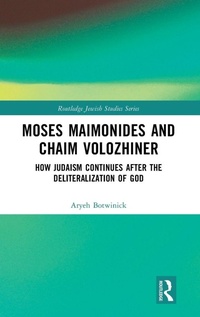
Moses Maimonides and Chaim Volozhiner
How Judaism Continues after the Deliteralization of God
1st Edition
Published on 20. May 2026
Book
Hardback
308 pages
978-1-032-64795-1 (ISBN)
Description
Moses Maimonides and Reb Chaim Volozhiner are among the most famous and influential medieval and early modern writers offering theoretical resolutions about how to comprehend the concept of God.
Aryeh Botwinick explores some of the broad based philosophical and theological issues about human understanding of God, the role of Messianism in worldly affairs, and the mystical notion of Eyn Sof. He forefronts the privacy of language and highlights the continuity between monotheistic discourse, scientific discourse, moral discourse, and common sense. In particular he analyses the views of the famed medieval Jewish philosopher, Moses Maimonides (1138-1204), and the modern Talmudic master, Chaim Volozhiner (1749-1841). The author's contention is that the scope of their contributions is much wider than is generally understood.
This book will appeal to readers with an interest in Talmudic and Maimonidean studies; students of intellectual history of various monotheistic religions; and scholars and journalists specializing in Mideast conflict as well as in domestic and international internecine warfare.
Aryeh Botwinick explores some of the broad based philosophical and theological issues about human understanding of God, the role of Messianism in worldly affairs, and the mystical notion of Eyn Sof. He forefronts the privacy of language and highlights the continuity between monotheistic discourse, scientific discourse, moral discourse, and common sense. In particular he analyses the views of the famed medieval Jewish philosopher, Moses Maimonides (1138-1204), and the modern Talmudic master, Chaim Volozhiner (1749-1841). The author's contention is that the scope of their contributions is much wider than is generally understood.
This book will appeal to readers with an interest in Talmudic and Maimonidean studies; students of intellectual history of various monotheistic religions; and scholars and journalists specializing in Mideast conflict as well as in domestic and international internecine warfare.
More details
Series
Language
English
Place of publication
London
United Kingdom
Publishing group
Taylor & Francis Ltd
Target group
College/higher education
Professional and scholarly
Postgraduate and Undergraduate Advanced
Product notice
Laminated cover
Dimensions
Height: 234 mm
Width: 156 mm
Thickness: 19 mm
Weight
629 gr
ISBN-13
978-1-032-64795-1 (9781032647951)
Copyright in bibliographic data and cover images is held by Nielsen Book Services Limited or by the publishers or by their respective licensors: all rights reserved.
Schweitzer Classification
Other editions
Additional editions
Aryeh Botwinick
Moses Maimonides and Chaim Volozhiner
How Judaism Continues after the Deliteralization of God
E-Book
05/2026
1st Edition
Routledge
€60.49
Available for download
Aryeh Botwinick
Moses Maimonides and Chaim Volozhiner
How Judaism Continues after the Deliteralization of God
E-Book
05/2026
1st Edition
Routledge
€60.49
Available for download
Person
Aryeh Botwinick is Professor of Religion and Jewish Studies at Temple University. His most prominent research interests are negative theology and its relationship to skepticism, and Maimonidean Studies. His most important publications are Skepticism, Belief, and the Modern: Maimonides to Nietzsche (1997), and Michael Oakeshott's Skepticism (2011).
Content
Introduction 1. The Simultaneous Genesis of Monotheism and Skepticism in Jewish Religion 2. Divine Unknowability versus Divine Non-Existence 3. Maimonides' Theorizing of the Monotheistic God 4. Maimonides' Ideal-Typological Portrait of the Judge 5. Maimonides on Prophecy 6. Avicenna: Negative Theology, Skepticism, and Mysticism 7. Rabbinic Genealogy: Rabbi Akiva as a Precursor of Maimonides' Negative Theology 8. The West's Stationary Metaphysical Moment: St Anselm's Ontological Argument 9. Reb Chaim Volozhiner as Rooted in Maimonides' Negative Theology 10. Weak Messianism as the Good: A Classical Liberal Translation of Negative Theology 11. Horizontality vs. Verticality: New Readings in the Understanding of Religion and the Organizing of Politics 12. The Case for a Negative Theological Hermeneutic of the Biblical Text 13. Maimonides' Philosophy of Prayer: The Impact of Negative Theology in Reconceiving the Nature and Role of Prayer