

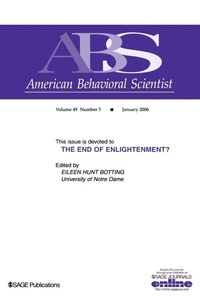
The End of Enlightenment?
1st Edition
Published on 12. January 2006
Book
Paperback/Softback
108 pages
978-1-4129-4023-8 (ISBN)
Description
From science to politics, the era of the the Enlightenment is widely recognized as a crucible for modern Western culture. It has shaped vast portions of the Western world view, including our conceptions and experiences of happiness, family life, the nation-state, and religious and ethnic identities. However, in recent years, scholars from both the sciences and the humanities have debated the question of how we should understand, and to what extent we should endorse, our debt to the Enlightenment.
The January 2006 issue of American Behavioral Scientist offers rigorous engagement of pro-Enlightenment and Counter-Enlightenment perspectives, continuing a debate that began in the late eighteenth century. The opening essays by James Schmidt and Graeme Garrard offer historically and linguistically nuanced defenses of plural uses of the term "enlightenment"- especially to capture the distinction between the process of enlightenment and the era of the Enlightenment. The remaining articles more closely
examine several questions about the Enlightenment's legacy for contemporary life:
Are we living out the aspirations of the Enlightenment in a critical or tacit manner?
Are we witnessing the end of the Enlightenment's pervasive influence on intellectual paradigms, social practices, and nation-states or making room for its further articulation?
Which, if any, of these relationships to the Enlightenment are sociologically accurate or normatively preferable?
The remaining essays by Darrin M. McMahon, Eileen Hunt Botting, Adam Sutcliffe, Russell Arben Fox, and Damon Linker review these questions from different perspectives and assess the value of the Enlightenment's legacy in various spheres of human life. McMahon's essay focuses on the Enlightenment's impact on the modern understanding of happiness and social welfare. Botting's essay concentrates on how Mary Wollstonecraft's Enlightenment philosophy contributed to the development of the "modern social imaginary" of the egalitarian family. Sutcliffe and Fox illustrate how Western conceptions of religious, ethnic, and national identities have been shaped in critical dialogue with, or in opposition to, the rationalistic, universalistic strands of Enlightenment thought. Linker argues that we should resist Heidegger's rejection of the philosophical process of enlightenment and that we should instead embrace the Enlightenment's promotion of the normative ideal and political practice of critical public discourse about our relationships to one another and the world around us.
This issue of American Behavioral Scientist offers an accessible survey of current research on the contemporary relevance of the Enlightenment and should be in the library of every political scientist, sociologist, historian, humanist, philosopher, and student!
The January 2006 issue of American Behavioral Scientist offers rigorous engagement of pro-Enlightenment and Counter-Enlightenment perspectives, continuing a debate that began in the late eighteenth century. The opening essays by James Schmidt and Graeme Garrard offer historically and linguistically nuanced defenses of plural uses of the term "enlightenment"- especially to capture the distinction between the process of enlightenment and the era of the Enlightenment. The remaining articles more closely
examine several questions about the Enlightenment's legacy for contemporary life:
Are we living out the aspirations of the Enlightenment in a critical or tacit manner?
Are we witnessing the end of the Enlightenment's pervasive influence on intellectual paradigms, social practices, and nation-states or making room for its further articulation?
Which, if any, of these relationships to the Enlightenment are sociologically accurate or normatively preferable?
The remaining essays by Darrin M. McMahon, Eileen Hunt Botting, Adam Sutcliffe, Russell Arben Fox, and Damon Linker review these questions from different perspectives and assess the value of the Enlightenment's legacy in various spheres of human life. McMahon's essay focuses on the Enlightenment's impact on the modern understanding of happiness and social welfare. Botting's essay concentrates on how Mary Wollstonecraft's Enlightenment philosophy contributed to the development of the "modern social imaginary" of the egalitarian family. Sutcliffe and Fox illustrate how Western conceptions of religious, ethnic, and national identities have been shaped in critical dialogue with, or in opposition to, the rationalistic, universalistic strands of Enlightenment thought. Linker argues that we should resist Heidegger's rejection of the philosophical process of enlightenment and that we should instead embrace the Enlightenment's promotion of the normative ideal and political practice of critical public discourse about our relationships to one another and the world around us.
This issue of American Behavioral Scientist offers an accessible survey of current research on the contemporary relevance of the Enlightenment and should be in the library of every political scientist, sociologist, historian, humanist, philosopher, and student!
More details
Series
Language
English
Place of publication
Thousand Oaks
United States
Target group
Professional and scholarly
Dimensions
Height: 229 mm
Width: 152 mm
Thickness: 6 mm
Weight
178 gr
ISBN-13
978-1-4129-4023-8 (9781412940238)
Copyright in bibliographic data and cover images is held by Nielsen Book Services Limited or by the publishers or by their respective licensors: all rights reserved.
Schweitzer Classification
Content
Introduction - Eileen Hunt Botting
What Enlightenment Was, What It Still Might Be, and Why Kant May Have Been Right After All - James Schmidt
The Enlightenment and Its Enemies - Graeme Garrard
Happiness and the Heavenly City of the Eighteenth-Century Philosophers: Carl Becker Revisited - Darrin M. McMahon
Mary Wollstonecraft's Enlightened Legacy: The 'Modern Social Imaginary' of the Egalitarian Family - Eileen Hunt Botting
Judaism and the Politics of Enlightenment - Adam Sutcliffe
On Metaphysics and Nationality: The Rival Enlightenments of Kant and Herder - Russell Arben Fox
Heidegger's Revelation: The End of Enlightenment - Damon Linker
What Enlightenment Was, What It Still Might Be, and Why Kant May Have Been Right After All - James Schmidt
The Enlightenment and Its Enemies - Graeme Garrard
Happiness and the Heavenly City of the Eighteenth-Century Philosophers: Carl Becker Revisited - Darrin M. McMahon
Mary Wollstonecraft's Enlightened Legacy: The 'Modern Social Imaginary' of the Egalitarian Family - Eileen Hunt Botting
Judaism and the Politics of Enlightenment - Adam Sutcliffe
On Metaphysics and Nationality: The Rival Enlightenments of Kant and Herder - Russell Arben Fox
Heidegger's Revelation: The End of Enlightenment - Damon Linker