

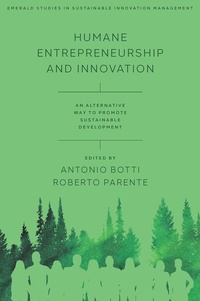
Humane Entrepreneurship and Innovation
An Alternative Way to Promote Sustainable Development
Published on 26. June 2024
Book
Hardback
248 pages
978-1-83797-375-0 (ISBN)
Description
Entrepreneurship is evolving rapidly due to positive phenomena, such as digitalization and the green transition, and negative ones, such as crises and global emergencies. In this fresh approach to the unique role entrepreneurship can play across environmental protection and social equity, leading scholars explore the world of Humane Entrepreneurship (HumEnt). Introducing a new model of entrepreneurship that considers the human side of sustainable development, they delve into elements of Entrepreneurship Orientation, Human Resource Orientation, and Sustainability Orientation, focusing on risk-taking, effective people management practices, and societal expectations.
Showing how HumEnt encourages employee engagement and promotes sustainability to leave positive impacts on society, the chapter authors examine how a human-centric approach to entrepreneurship can help achieve a balance between technological advancement and societal needs. Humane Entrepreneurship and Innovation provides a framework for entrepreneurs, students, and researchers to develop sustainable innovations that benefit society as a whole. This inclusive approach encourages entrepreneurs to consider the needs of all stakeholders, including employees, customers, and the environment.
The series "Emerald Studies in Sustainable Innovation Management" explores the advancements of innovation management in turbulent times, with special attention to the transition towards a sustainable economy. The practice of innovation management is evolving rapidly, as a consequence of positive phenomena, such as digitalization and the green transition, and negative ones, such as crises and global emergencies
Showing how HumEnt encourages employee engagement and promotes sustainability to leave positive impacts on society, the chapter authors examine how a human-centric approach to entrepreneurship can help achieve a balance between technological advancement and societal needs. Humane Entrepreneurship and Innovation provides a framework for entrepreneurs, students, and researchers to develop sustainable innovations that benefit society as a whole. This inclusive approach encourages entrepreneurs to consider the needs of all stakeholders, including employees, customers, and the environment.
The series "Emerald Studies in Sustainable Innovation Management" explores the advancements of innovation management in turbulent times, with special attention to the transition towards a sustainable economy. The practice of innovation management is evolving rapidly, as a consequence of positive phenomena, such as digitalization and the green transition, and negative ones, such as crises and global emergencies
More details
Series
Language
English
Place of publication
Bingley
United Kingdom
Target group
Professional and scholarly
Product notice
sewn/stitched
Cloth over boards
Dimensions
Height: 229 mm
Width: 152 mm
Thickness: 14 mm
Weight
490 gr
ISBN-13
978-1-83797-375-0 (9781837973750)
Copyright in bibliographic data and cover images is held by Nielsen Book Services Limited or by the publishers or by their respective licensors: all rights reserved.
Schweitzer Classification
Other editions
Additional editions
Antonio Botti | Roberto Parente
Humane Entrepreneurship and Innovation
An Alternative Way to Promote Sustainable Development
E-Book
06/2024
1st Edition
Emerald Publishing Limited
€98.49
Available for download
Persons
Antonio Botti is Full Professor of Management at the University of Salerno, Italy, and Affiliate Research Fellow at the IPAG Business School, France. He is member of the Italian Association of Management (SIMA) and the Italian Academy of Business Economics (AIDEA).
Roberto Parente is Full Professor of Entrepreneurship and Innovation at University of Salerno, Italy and Founder and Director of LISA Lab, a Research Centre whose main topics are on Science Based startup, Students Entrepreneurship, and Entrepreneurial Orientation. He's the Leader of the Entrepreneurship Group of SIMA.
Roberto Parente is Full Professor of Entrepreneurship and Innovation at University of Salerno, Italy and Founder and Director of LISA Lab, a Research Centre whose main topics are on Science Based startup, Students Entrepreneurship, and Entrepreneurial Orientation. He's the Leader of the Entrepreneurship Group of SIMA.
Content
Introduction ; Antonio Botti and Roberto Parente
Chapter 1. Beyond Profit: Sustainable Approaches To Entrepreneurship In The 21st Century; Ricky Celenta and Ivo Zander
Chapter 2. The Nexus Between Entrepreneurship and Ethics: A Bibliometric Analysis; Mirko Perano, Gian Luca Casali, Maria Vincenza Ciasullo, Claudio Del Regno, and Marco Pellicano
Chapter 3. Are Corporations Really Moving Towards Humanistic Management? An Attempt To Measure Their Progress; Gianluca Gionfriddo and Andrea Piccaluga
Chapter 4. Entrepreneurship: Where Is It Going?; Christina Theodoraki
Chapter 5. The Humane Entrepreneurship Framework; Massimiliano Vesci, Antonio Botti, and Roberto Parente
Chapter 6. Humane Entrepreneurial Orientation As Strategic Posture: A Proposal For Measurement and Enterprise Classification; Massimiliano Vesci, Antonio Botti, and Roberto Parente
Chapter 7. The Antecedents Of Humane Entrepreneurial Approach In Innovative Start-Ups; Valentina Cucino, Rosangela Feola, and Andrea Piccaluga
Chapter 8. Digital Transformation For A Better Society: The Role Of Digital Social Entrepreneurship; Rossella Canestrino, Pierpaolo Magliocca, and Marek Cwiklicki
Chapter 9. Entrepreneurial Mindsets Across Cultures; Bice Della Piana, Secil Bayraktar, and Alfredo Jimenez
Chapter 10. Humane Entrepreneurship and Startup Fundraising Strategies: Evidence From The U.S; Riccardo Tipaldi and Carmen Gallucci
Chapter 1. Beyond Profit: Sustainable Approaches To Entrepreneurship In The 21st Century; Ricky Celenta and Ivo Zander
Chapter 2. The Nexus Between Entrepreneurship and Ethics: A Bibliometric Analysis; Mirko Perano, Gian Luca Casali, Maria Vincenza Ciasullo, Claudio Del Regno, and Marco Pellicano
Chapter 3. Are Corporations Really Moving Towards Humanistic Management? An Attempt To Measure Their Progress; Gianluca Gionfriddo and Andrea Piccaluga
Chapter 4. Entrepreneurship: Where Is It Going?; Christina Theodoraki
Chapter 5. The Humane Entrepreneurship Framework; Massimiliano Vesci, Antonio Botti, and Roberto Parente
Chapter 6. Humane Entrepreneurial Orientation As Strategic Posture: A Proposal For Measurement and Enterprise Classification; Massimiliano Vesci, Antonio Botti, and Roberto Parente
Chapter 7. The Antecedents Of Humane Entrepreneurial Approach In Innovative Start-Ups; Valentina Cucino, Rosangela Feola, and Andrea Piccaluga
Chapter 8. Digital Transformation For A Better Society: The Role Of Digital Social Entrepreneurship; Rossella Canestrino, Pierpaolo Magliocca, and Marek Cwiklicki
Chapter 9. Entrepreneurial Mindsets Across Cultures; Bice Della Piana, Secil Bayraktar, and Alfredo Jimenez
Chapter 10. Humane Entrepreneurship and Startup Fundraising Strategies: Evidence From The U.S; Riccardo Tipaldi and Carmen Gallucci