

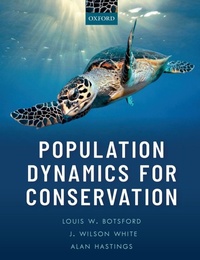
Population Dynamics for Conservation
Published on 1. October 2019
Book
Paperback/Softback
354 pages
978-0-19-875837-2 (ISBN)
Description
The management and conservation of natural populations relies heavily on concepts and results generated from models of population dynamics. Yet this is the first book to present a unified and coherent explanation of the underlying theory. This novel text begins with a consideration of what makes a good state variable, progressing from the simplest models (those with a single variable such as abundance or biomass) to more complex models with other key variables of population structure (including age, size, life history stage, and space). Throughout the book, attention is paid to concepts such as population variability, population stability, population viability/persistence, and harvest yield. Later chapters address specific applications to conservation such as recovery planning for species at risk, fishery management, and the spatial management of marine resources.
Population Dynamics for Conservation is suitable for graduate-level students. It will also be valuable to academic and applied researchers in population biology. This overview of population dynamic theory can serve to further their population research, as well as to improve their understanding of population management.
Population Dynamics for Conservation is suitable for graduate-level students. It will also be valuable to academic and applied researchers in population biology. This overview of population dynamic theory can serve to further their population research, as well as to improve their understanding of population management.
Reviews / Votes
This primer on population dynamics theory and its applications introduce the reader to the mathematical tools necessary to construct analytical models of plant and animal population dynamics ... The book will be useful as either a textbook for students or as a reference for experienced researchers. * Conservation Biology *More details
Language
English
Place of publication
Oxford
United Kingdom
Target group
College/higher education
Dimensions
Height: 246 mm
Width: 189 mm
Thickness: 19 mm
Weight
685 gr
ISBN-13
978-0-19-875837-2 (9780198758372)
Copyright in bibliographic data and cover images is held by Nielsen Book Services Limited or by the publishers or by their respective licensors: all rights reserved.
Schweitzer Classification
Other editions
Additional editions
Louis W. Botsford | J. Wilson White | Alan Hastings
Population Dynamics for Conservation
Book
10/2019
Oxford University Press
€165.70
Shipment within 15-20 days
Louis W. Botsford | J. Wilson White | Alan Hastings
Population Dynamics for Conservation
E-Book
09/2019
1st Edition
OUP eBook
€47.49
Available for download
Persons
Louis Botsford is Professor Emeritus at UC Davis and joined the faculty in 1980. He taught courses on population dynamics and population estimation of wildlife as well as on the conservation science of marine life. His research on population dynamics and management, primarily of marine organisms, is currently focused on Marine Protected Areas and the response of marine populations to a changing climate. He was involved in the U.S. GLOBEC program, which is part of the U.S. climate change program. He has served on Scientific advisory committees for management of California MPAs, and U.S. federal fisheries, as well as global issues of marine management at the Food and Agriculture Organization in Rome.
Wilson White is Professor at Oregon State University and uses mathematical models to link field observations to the population dynamic of marine species, particularly reef fishes and oysters. He also uses models to investigate the design and management of Marine Protected Areas. He has served on advisory panels for protected area design in several states and nations, and has provided expert testimony on population dynamics in a case heard by the U.S. Supreme Court. Professor White received his Ph.D. from UC, Santa Barbara, in 2007. After postdoctoral research at UC, Davis, he became an Assistant Professor at the University of North Carolina Wilmington in 2010. He joined the faculty of Oregon State University in 2017.
Alan Hastings is a Distinguished Professor of Environmental Science and Policy at UC, Davis, where he has taught since 1979. He received a B.A. from Cornell University in 1973 and a Ph.D. in Applied Mathematics in 1977, also from Cornell. His primary research interests lie at the interface between mathematics and biology, with particular interests in management of ecological populations including invasive species and marine protected areas. He has published nearly 300 peer reviewed articles. He is a Fellow of the US National Academy of Sciences and the American Academy of Arts and Sciences.
Wilson White is Professor at Oregon State University and uses mathematical models to link field observations to the population dynamic of marine species, particularly reef fishes and oysters. He also uses models to investigate the design and management of Marine Protected Areas. He has served on advisory panels for protected area design in several states and nations, and has provided expert testimony on population dynamics in a case heard by the U.S. Supreme Court. Professor White received his Ph.D. from UC, Santa Barbara, in 2007. After postdoctoral research at UC, Davis, he became an Assistant Professor at the University of North Carolina Wilmington in 2010. He joined the faculty of Oregon State University in 2017.
Alan Hastings is a Distinguished Professor of Environmental Science and Policy at UC, Davis, where he has taught since 1979. He received a B.A. from Cornell University in 1973 and a Ph.D. in Applied Mathematics in 1977, also from Cornell. His primary research interests lie at the interface between mathematics and biology, with particular interests in management of ecological populations including invasive species and marine protected areas. He has published nearly 300 peer reviewed articles. He is a Fellow of the US National Academy of Sciences and the American Academy of Arts and Sciences.
Author
Professor EmeritusProfessor Emeritus, Wildlife, Fish, & Conservation Biology, University of California, Davis, USA
Assistant ProfessorAssistant Professor, Department of Fisheries and Wildlife, Oregon State University, USA
ProfessorProfessor, Department of Environmental Science and Policy, University of California, Davis, USA
Content
1: Philosophical approach to population modeling
2: Simple population models
3: Linear, age-structured models and their long-term dynamics
4: Age-structured models: short-term transient dynamics
5: Size-structured models
6: Stage-structured models
7: Age-structured models with density-dependent recruitment
8: Age-structured models in a random environment
9: Spatial population dynamics
10: Applications to conservation biology
11: Population models in marine conservation
12: Thinking about populations
2: Simple population models
3: Linear, age-structured models and their long-term dynamics
4: Age-structured models: short-term transient dynamics
5: Size-structured models
6: Stage-structured models
7: Age-structured models with density-dependent recruitment
8: Age-structured models in a random environment
9: Spatial population dynamics
10: Applications to conservation biology
11: Population models in marine conservation
12: Thinking about populations