

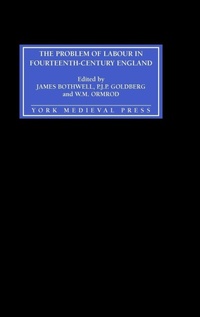
The Problem of Labour in Fourteenth-Century England
Published on 7. December 2000
Book
Hardback
164 pages
978-1-903153-04-8 (ISBN)
Description
Attitudes towards `labour', in the wake of the Black Death, shown to range from early protest literature to repressive authoritarianism.
At the very moment that the image of the honest labourer seemed to reach its apogee in the Luttrell Psalter or, a few decades later, in Piers Plowman, the dominant culture of the landed interests was increasingly suspiciousof what it described as the idleness, greed and arrogance of the lower orders. Labour was one of the central issues during the fourteenth century: the natural disasters and profound social changes of the period created not merelya "problem" of labour, but also new ways of discussing and (supposedly) solving that problem. These studies engage with the contrasting and often competing discourses which emerged, ranging from the critical social awareness of some of the early fourteenth-century protest literature to the repressive authoritarianism of the new national employment laws that were enforced in the wake of the Black Death, and were expressed in counter-cultures of resistanceand dissent.
JAMES BOTHWELL and P.J.P. GOLDBERG lecture in history, and W.M. ORMROD is Professor of History, at the University of York.
Contributors: CORDELIA BEATTIE, CHRISTOPHER DYER, RICHARD K. EMMERSON,P.J.P. GOLDBERG, KATE GILES, CHRIS GIVEN-WILSON, STEPHEN KNIGHT, DEREK PEARSALL, SARAH REES JONES.
At the very moment that the image of the honest labourer seemed to reach its apogee in the Luttrell Psalter or, a few decades later, in Piers Plowman, the dominant culture of the landed interests was increasingly suspiciousof what it described as the idleness, greed and arrogance of the lower orders. Labour was one of the central issues during the fourteenth century: the natural disasters and profound social changes of the period created not merelya "problem" of labour, but also new ways of discussing and (supposedly) solving that problem. These studies engage with the contrasting and often competing discourses which emerged, ranging from the critical social awareness of some of the early fourteenth-century protest literature to the repressive authoritarianism of the new national employment laws that were enforced in the wake of the Black Death, and were expressed in counter-cultures of resistanceand dissent.
JAMES BOTHWELL and P.J.P. GOLDBERG lecture in history, and W.M. ORMROD is Professor of History, at the University of York.
Contributors: CORDELIA BEATTIE, CHRISTOPHER DYER, RICHARD K. EMMERSON,P.J.P. GOLDBERG, KATE GILES, CHRIS GIVEN-WILSON, STEPHEN KNIGHT, DEREK PEARSALL, SARAH REES JONES.
Reviews / Votes
Interesting and stimulating collection. effectively illustrated the worth of subjecting traditional historiographical themes to further scrutiny and to new methodological approaches. * ECONOMIC HISTORY REVIEW *More details
Language
English
Place of publication
York
United Kingdom
Target group
Professional and scholarly
Product notice
Cloth over boards
Illustrations
11 b/w, 1 line illus.
Dimensions
Height: 241 mm
Width: 159 mm
Thickness: 19 mm
Weight
531 gr
ISBN-13
978-1-903153-04-8 (9781903153048)
Copyright in bibliographic data and cover images is held by Nielsen Book Services Limited or by the publishers or by their respective licensors: all rights reserved.
Schweitzer Classification
Other editions
Additional editions
James Bothwell | P. J. P. Goldberg | W. Mark Ormrod
The Problem of Labour in Fourteenth-Century England
E-Book
12/2000
1st Edition
De Gruyter
€48.99
Available for download
Persons
The late W. MARK ORMROD was Professor Emeritus of History at the University of York; he published extensively on later medieval history. Christopher Dyer is Emeritus Professor of History at the University of Leicester. He has written, edited, co-authored and co-edited many books, including William Dugdale, Historian, 1605-1686: His Life, his Writings and His County (Boydell, 2009). The late Derek Pearsall was Emeritus Gurney Professor of Middle English Literature at Harvard University; he wrote extensively on Chaucer, Gower, Langland and Lydgate, including biographies of Chaucer and Lydgate, an edition of the C-text of Langland's Piers Plowman. SARAH REES JONES is Professor Emeritus of Medieval History at the University of York, UK.
Content
The Problem of Women's Work Identities in Post Black Death England - Cordelia Beattie
Work Ethics in the Fourteenth Century - Christopher Dyer
'The Lord Geoffrey had me made': Lordship and Labour in the Luttrell Psalter (with P.J.P. Goldberg) - Richard K Emmerson
'The Lord Geoffrey had me made': Lordship and Labour in the Luttrell Psalter (with Richard K. Emmerson) - P J P Goldberg
Framing Labour: The Archaeology of York's Medieval Guildhalls - Kate Giles
The Problem of Labour in the Context of English Government, c.1350-1450 - Christopher Given-Wilson
The Voice of Labour in Fourteenth-Century English Literature - Stephen Knight
Piers Plowman and the Problem of Labour - Derek Pearsall
Household, Work and the Problem of Mobile Labour: The Regulation of Labour in Medieval English Towns - Sarah Rees Jones
Work Ethics in the Fourteenth Century - Christopher Dyer
'The Lord Geoffrey had me made': Lordship and Labour in the Luttrell Psalter (with P.J.P. Goldberg) - Richard K Emmerson
'The Lord Geoffrey had me made': Lordship and Labour in the Luttrell Psalter (with Richard K. Emmerson) - P J P Goldberg
Framing Labour: The Archaeology of York's Medieval Guildhalls - Kate Giles
The Problem of Labour in the Context of English Government, c.1350-1450 - Christopher Given-Wilson
The Voice of Labour in Fourteenth-Century English Literature - Stephen Knight
Piers Plowman and the Problem of Labour - Derek Pearsall
Household, Work and the Problem of Mobile Labour: The Regulation of Labour in Medieval English Towns - Sarah Rees Jones