


The Prehistory of Language
Published on 23. April 2009
Book
Paperback/Softback
368 pages
978-0-19-954588-9 (ISBN)
Description
'When, why, and how did language evolve?' 'Why do only humans have language?' This book looks at these and other questions about the origins and evolution of language. It does so via a rich diversity of perspectives, including social, cultural, archaeological, palaeoanthropological, musicological, anatomical, neurobiological, primatological, and linguistic. Among the subjects it considers are: how far sociality is a prerequisite for language; the evolutionary links between language and music; the relation between natural selection and niche construction; the origins of the lexicon; the role of social play in language development; the use of signs by great apes; the evolution of syntax; the evolutionary biology of language; the insights offered by Chomsky's biolinguistic approach to mind and language; the emergence of recursive language; the selectional advantages of the human vocal tract; and why women speak better than men.
The authors, drawn from all over the world, are prominent linguists, psychologists, cognitive scientists, archaeologists, primatologists, social anthropologists, and specialists in artificial intelligence. As well as explaining what is understood about the evolution of language, they look squarely at the formidable obstacles to knowing more - the absence of direct evidence, for example; the problems of using indirect evidence; the lack of a common conception of language; confusion about the operation of natural selection and other processes of change; the scope for misunderstanding in a multi-disciplinary field, and many more. Despite these difficulties, the authors in their stylish and readable contributions to this book are able to show just how much has been achieved in this most fruitful and fascinating area of research in the social, natural, and cognitive sciences.
The authors, drawn from all over the world, are prominent linguists, psychologists, cognitive scientists, archaeologists, primatologists, social anthropologists, and specialists in artificial intelligence. As well as explaining what is understood about the evolution of language, they look squarely at the formidable obstacles to knowing more - the absence of direct evidence, for example; the problems of using indirect evidence; the lack of a common conception of language; confusion about the operation of natural selection and other processes of change; the scope for misunderstanding in a multi-disciplinary field, and many more. Despite these difficulties, the authors in their stylish and readable contributions to this book are able to show just how much has been achieved in this most fruitful and fascinating area of research in the social, natural, and cognitive sciences.
More details
Series
Language
English
Place of publication
Oxford
United Kingdom
Target group
College/higher education
Professional and scholarly
Illustrations
Figures, Tables
Dimensions
Height: 233 mm
Width: 154 mm
Thickness: 19 mm
Weight
542 gr
ISBN-13
978-0-19-954588-9 (9780199545889)
Copyright in bibliographic data and cover images is held by Nielsen Book Services Limited or by the publishers or by their respective licensors: all rights reserved.
Schweitzer Classification
Other editions
Additional editions
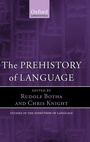
Rudolf Botha | Chris Knight
The Prehistory of Language
Book
04/2009
Oxford University Press
€226.30
Shipment within 15-20 days
Persons
Rudolf Botha is Professor of General Linguistics at the University of Stellenbosch, and a Fellow of the Netherlands Institute for Advanced Study. His books include Form and Meaning in Word Formation: A Study of Afrikaans Reduplication (CUP 1988) and Unravelling the Evolution of Language (Elsevier 2003).
Chris Knight is Professor of Anthropology at the University of East London. His publicatons include Blood Relations: Menstruation and the Origins of Culture (Yale UP 1995).
Chris Knight is Professor of Anthropology at the University of East London. His publicatons include Blood Relations: Menstruation and the Origins of Culture (Yale UP 1995).
Content
1. Introduction: Rewards and Challenges of Multi-perspectival Work on the Evolution of Language and Speech ; 2. Why Only Humans Have Language ; 3. Is Sociality a Crucial Prerequisite for the Emergence of Language? ; 4. Holistic Communication and the Co-evolution of Language and Music: Resurrecting an Old Idea ; 5. Music as a Communicative Medium ; 6. Cultural Niche construction: Evolution's Cradle of Language ; 7. Playing With Meaning: Normative Function and Structure in Play ; 8. The Ontogeny and Phylogeny of Non-verbal Deixis ; 9. The Directed Scratch: Evidence for a Referential Gesture in Chimpanzees? ; 10. The Origins of the Lexicon: How a Word-store Evolved ; 11. Language-symbolization and Beyond ; 12. Grammaticalization From a Biolinguistic Perspective ; 13. Recursion, Phonological Storage Capacity, and the Evolution of Modern Speech ; 14. Why Women Speak Better Than Men and its Significance for Evolution ; 15. Mosaic Neurobiology and Anatomical Plausibility ; References ; Index