

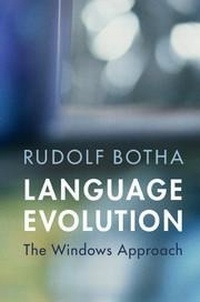
Language Evolution
The Windows Approach
Published on 3. March 2016
Book
Hardback
230 pages
978-1-107-13513-0 (ISBN)
Description
How can we unravel the evolution of language, given that there is no direct evidence about it? Rudolf Botha addresses this intriguing question in his fascinating new book. Inferences can be drawn about language evolution from a range of other phenomena, serving as windows into this prehistoric process. These include shell-beads, fossil skulls and ancestral brains, modern pidgin and creole languages, homesign systems and emergent sign languages, modern motherese, language use of modern hunter-gatherers, first language acquisition, similarities between language and music, and comparative animal behaviour. The first systematic analysis of the Windows Approach, it will be of interest to students and researchers in many disciplines, including anthropology, archaeology, linguistics, palaeontology and primatology, as well as anyone interested in how language evolved.
Reviews / Votes
'In 2006, Rudie Botha launched an all out attack on the legitimacy of the claim that the South African archaeological site of Blombos had evidence of 'fully syntactic' language 75,000 years ago. No one has been able to counter the logic of his argument, and this book applies that same relentless, illuminating logic to other claims in the study of language origins. In doing so, Botha shows just how carefully any claims must be justified, and just how powerful his Windows Approach is. Students and researchers in archaeology, primatology, linguistics, and comparative ethology cannot ignore this book.' Iain Davidson, University of New England 'This book will prove to be a milestone in the field ... a meticulous, rigorous, and yet highly readable guide.' Paul T. Roberge, University of North Carolina, Chapel HillMore details
Series
Language
English
Place of publication
Cambridge
United Kingdom
Target group
Professional and scholarly
Product notice
sewn/stitched
Cloth over boards
Illustrations
13 Line drawings, unspecified
Dimensions
Height: 237 mm
Width: 152 mm
Thickness: 22 mm
Weight
590 gr
ISBN-13
978-1-107-13513-0 (9781107135130)
Copyright in bibliographic data and cover images is held by Nielsen Book Services Limited or by the publishers or by their respective licensors: all rights reserved.
Schweitzer Classification
Other editions
Additional editions
Book
03/2016
Cambridge University Press
€36.50
Article not available at the moment
E-Book
03/2016
Cambridge University Press
€21.99
Available for download
E-Book
02/2016
Cambridge University Press
€24.99
Available for download
Person
Rudolf Botha is Emeritus Professor of General Linguistics at the University of Stellenbosch, South Africa, and Honorary Professor of Linguistics at Utrecht Institute of Linguistics, Utrecht University, The Netherlands.
Content
Part I. Preliminaries: 1. The Windows Approach; 2. Conceptual foundations of the approach; Part II. Correlate Windows: 3. Sea shells, ancient beads, and Middle Stone Age symbols; 4. Fossil skulls and ancestral brains; Part III. Analogue Windows: 5. Incipient pidgins and creoles; 6. Homesign systems and emergent sign languages; 7. Modern motherese; 8. Hunter-gatherers' use of language; 9. Language acquisition; Part IV. Abduction Windows: 10. Modern music and language; 11. Comparative animal behaviour; Part V. Epilogue: 12. A tool fit for demystifying language evolution?