

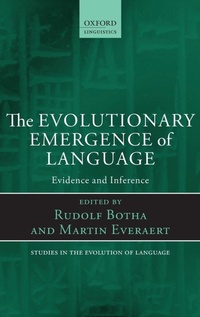
The Evolutionary Emergence of Language
Evidence and Inference
Published on 25. July 2013
Book
Hardback
356 pages
978-0-19-965484-0 (ISBN)
Description
The book presents new and stimulating approaches to the study of language evolution and considers their implications for future research. Leading scholars from linguistics, primatology, anthroplogy, and cognitive science consider how language evolution can be understood by means of inference from the study of linked or analogous phenomena in language, animal behaviour, genetics, neurology, culture, and biology. In their introduction the editors show how these approaches can be interrelated and deployed together through their use of comparable forms of inference and the similar conditions they place on the use of evidence.
The Evolutionary Emergence of Language will interest everyone concerned with this intriguing and important subject, including those in linguistics, biology, anthropology, archaeology, neurology, and cognitive science.
The Evolutionary Emergence of Language will interest everyone concerned with this intriguing and important subject, including those in linguistics, biology, anthropology, archaeology, neurology, and cognitive science.
More details
Series
Language
English
Place of publication
Oxford
United Kingdom
Target group
Professional and scholarly
Linguists, primatologists, cognitive scientists, neurologists, anthropologists, and archaeologists interested in the evolution of language
Illustrations
20 illustrations
Dimensions
Height: 240 mm
Width: 161 mm
Thickness: 25 mm
Weight
764 gr
ISBN-13
978-0-19-965484-0 (9780199654840)
Copyright in bibliographic data and cover images is held by Nielsen Book Services Limited or by the publishers or by their respective licensors: all rights reserved.
Schweitzer Classification
Other editions
Additional editions
Book
07/2013
Oxford University Press
€70.70
Shipment within 15-20 days
E-Book
07/2013
1st Edition
OUP eBook
€39.49
Available for download
Persons
Rudolf Botha is Professor of General Linguistics at the University of Stellenbosch, and a Fellow of the Netherlands Institute for Advanced Study. His books include Form and Meaning in Word Formation: A Study of Afrikaans Reduplication (CUP 1988), Unravelling the Evolution of Language (Elsevier 2003) and, co-edited with C. Knight, The Cradle of Language and The Prehistory of Language (both OUP 2009).
Martin Everaert is Professor of Linguistics and Director of the Institute of Linguistics at the University of Utrecht. His research interests include syntactic theory and the lexicon-syntax interface and his books The Syntax of Reflexivization, (Dordrecht: Foris 1986) and, as co-editor, The Unaccusativity Puzzle (OUP 2004), The Blackwell Companion to Syntax (2007), and The Theta Sytsem (OUP 2012).
Martin Everaert is Professor of Linguistics and Director of the Institute of Linguistics at the University of Utrecht. His research interests include syntactic theory and the lexicon-syntax interface and his books The Syntax of Reflexivization, (Dordrecht: Foris 1986) and, as co-editor, The Unaccusativity Puzzle (OUP 2004), The Blackwell Companion to Syntax (2007), and The Theta Sytsem (OUP 2012).
Content
1. Introduction: evidence and inference in the study of language evolution ; 2. What is special about the human language faculty and how did it get that way? ; 3. Language has evolved to depend on multiple-cue integration ; 4. Homesign as a way-station between co-speech gesture and sign language: the evolution of segmenting and sequencing ; 5. Kin selection, pedagogy and linguistic complexity: whence protolanguage? ; 6. Neanderthal linguistic abilities: an alternative view ; 7. The archaeology of number concept and its implications for the evolution of language ; 8. The evolution of semantics: sharing conceptual domains ; 9. Speech-gesture links and the ontogeny and phylogeny of gestural communication ; 10. Exploring the gaps between primate calls and human language ; 11. Talking about apes, birds, bees, and other living creatures: language evolution in light of comparative animal behaviour ; 12. FoxP2 and deep homology in the evolution of birdsong and human language ; 13. Genetics, evolution, and the innateness of language ; References ; Indexes