

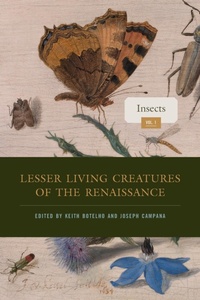
Lesser Living Creatures of the Renaissance
Volume 1, Insects
Published on 15. April 2025
Book
Paperback/Softback
294 pages
978-0-271-09447-2 (ISBN)
Description
Lesser Living Creatures examines literary and cultural texts from early modern England in order to understand how people in that era thought about-and with-insect and arachnid life. Designed for the classroom, the book comprises two volumes-Insects and Concepts-that can be used together or independently. Each addresses the collaborative, multigenerational research that produced early modern natural history and provides new insights into the old question of what it means to be human in a world populated by beasts large and small.
Volume 1, Insects, examines how insects burrowed into the literal and symbolic economies of the era. The contributors consider diminutive creatures-such as bees and beetles, flies and fleas, silkworms and spiders-and their depictions in plays, poetry, fables, natural histories, and more. In doing so, they illuminate how early modern science and literature worked as intersecting systems of knowledge production about the natural world and show definitively how insect life was, and remains, intimately entangled with human life.
In addition to the editors, contributors to this volume include Chris Barrett, Roya Biggie, Bruce Boehrer, Gary Bouchard, Dan Brayton, Eric Brown, Mary Baine Campbell, Perry Guevara, Shannon Kelley, Emily King, Karen Raber, Kathryn Vomero Santos, Donovan Sherman, and Steven Swarbrick.
Volume 1, Insects, examines how insects burrowed into the literal and symbolic economies of the era. The contributors consider diminutive creatures-such as bees and beetles, flies and fleas, silkworms and spiders-and their depictions in plays, poetry, fables, natural histories, and more. In doing so, they illuminate how early modern science and literature worked as intersecting systems of knowledge production about the natural world and show definitively how insect life was, and remains, intimately entangled with human life.
In addition to the editors, contributors to this volume include Chris Barrett, Roya Biggie, Bruce Boehrer, Gary Bouchard, Dan Brayton, Eric Brown, Mary Baine Campbell, Perry Guevara, Shannon Kelley, Emily King, Karen Raber, Kathryn Vomero Santos, Donovan Sherman, and Steven Swarbrick.
Reviews / Votes
"This is a superb and richly varied collection that does justice to the dazzling variety of entomological writing in the Renaissance. . . . Lesser Living Creatures of the Renaissance makes a significant contribution to animal studies, the environmental humanities and the history of science, particularly in its attention to scale and the ways that literary insects both underwrote and pressured the centrality of analogy as the episteme of pre-Enlightenment natural history."-Todd Andrew Borlik Renaissance Studies "Lesser Living Creatures of the Renaissance brings a welcome and timely focus on early modern understandings of insect life, ideas, and work that stood, as the authors convincingly argue, in the midst of the transformation of natural history 'as literary authority' to embodying the new scientific ideas and observational methods of the era. This two-volume work makes a significant scholarly contribution to literary studies and history by bringing insects and insect life into these conversations."
-Martha Few, author of Baptism Through Incision: The Postmortem Cesarean Operation in the Spanish Empire "There has not previously been such a wide-ranging collection as this. Lesser Living Creatures of the Renaissance is a vital new contribution to not only early modern studies, not only animal studies and ecocriticism, but also the history of science, the history of medicine, and current debates about the environment."
-Erica Fudge, author of Quick Cattle and Dying Wishes: People and Their Animals in Early Modern England
More details
Series
Language
English
Place of publication
University Park
United States
Target group
Professional and scholarly
Product notice
Paperback (trade)
Illustrations
11 Halftones, black and white
Dimensions
Height: 229 mm
Width: 152 mm
Thickness: 18 mm
Weight
484 gr
ISBN-13
978-0-271-09447-2 (9780271094472)
Copyright in bibliographic data and cover images is held by Nielsen Book Services Limited or by the publishers or by their respective licensors: all rights reserved.
Schweitzer Classification
Persons
Keith Botelho is Professor of English at Kennesaw State University. He is the author of Renaissance Earwitnesses: Rumor and Early Modern Masculinity.
Joseph Campana is William Shakespeare Professor of English and Director of the Center for Environmental Studies at Rice University. He is the author of The Pain of Reformation: Spenser, Vulnerability, and the Ethics of Masculinity and the coeditor, with Scott Maisano, of Renaissance Posthumanism.
Joseph Campana is William Shakespeare Professor of English and Director of the Center for Environmental Studies at Rice University. He is the author of The Pain of Reformation: Spenser, Vulnerability, and the Ethics of Masculinity and the coeditor, with Scott Maisano, of Renaissance Posthumanism.
Content
List of Illustrations
Acknowledgments
Introduction Creatures
Joseph Campana
1. Silkworm Thomas Moffett, Silkworm Laureate
Bruce Boehrer
2. Ants Go to the Pismire
Shannon Kelley
3. Flea Annihilating the Copulative Conceit: John Donne's Conversion of the "son of dust" into Uncertain Sacrilege
Gary M. Bouchard
4. Fly Of Flyes: The Insect Mind of Shakespeare's Titus Andronicus
Perry Guevara
5. Gnat The Clamor of Things: Moffett's Gnats, Spenser's Complaints
Steven Swarbrick
6. Maggot Mutable Maggots: Corruption, Generation, and Literary Legacy
Emily L. King
7. Bee "Some say the bee stings": Toward an Apian Poetics
Keith Botelho and Joseph Campana
8. Wasp What Is It Like to Be Like a Wasp?
Donovan Sherman
9. Butterflies and Moths Volatile Creatures and Elaborate Work
Chris Barrett
10. Grasshopper and Locust Antimonarchal Locusts: Translating the Grasshopper in the Aftermath of the English Civil Wars
Kathryn Vomero Santos
11. Beetle Sycorax's Beetles: Legacies of Science, the Occult, and Blackness
Roya Biggie
12. Spider The Renaissance of Spiders: Ambivalence, Beauty, Terror, Art
Mary Baine Campbell
13. Water Bugs Bugs Aquatic: Water Striders from Moffett to Marine Science
Dan Brayton
14. Worms Worms of Conscience
Karen Raber
15. Scorpions Flame of Fire Beaten: Scorpions in and out of Mind
Eric C. Brown
Epilogue Creatures
Keith Botelho
List of Contributors
Index
Acknowledgments
Introduction Creatures
Joseph Campana
1. Silkworm Thomas Moffett, Silkworm Laureate
Bruce Boehrer
2. Ants Go to the Pismire
Shannon Kelley
3. Flea Annihilating the Copulative Conceit: John Donne's Conversion of the "son of dust" into Uncertain Sacrilege
Gary M. Bouchard
4. Fly Of Flyes: The Insect Mind of Shakespeare's Titus Andronicus
Perry Guevara
5. Gnat The Clamor of Things: Moffett's Gnats, Spenser's Complaints
Steven Swarbrick
6. Maggot Mutable Maggots: Corruption, Generation, and Literary Legacy
Emily L. King
7. Bee "Some say the bee stings": Toward an Apian Poetics
Keith Botelho and Joseph Campana
8. Wasp What Is It Like to Be Like a Wasp?
Donovan Sherman
9. Butterflies and Moths Volatile Creatures and Elaborate Work
Chris Barrett
10. Grasshopper and Locust Antimonarchal Locusts: Translating the Grasshopper in the Aftermath of the English Civil Wars
Kathryn Vomero Santos
11. Beetle Sycorax's Beetles: Legacies of Science, the Occult, and Blackness
Roya Biggie
12. Spider The Renaissance of Spiders: Ambivalence, Beauty, Terror, Art
Mary Baine Campbell
13. Water Bugs Bugs Aquatic: Water Striders from Moffett to Marine Science
Dan Brayton
14. Worms Worms of Conscience
Karen Raber
15. Scorpions Flame of Fire Beaten: Scorpions in and out of Mind
Eric C. Brown
Epilogue Creatures
Keith Botelho
List of Contributors
Index