

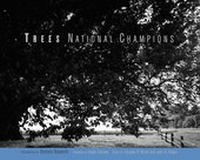
Trees
National Champions
Published on 19. August 2005
Book
Hardback
144 pages
978-0-262-02592-8 (ISBN)
Description
Trees capture our imagination because they are rooted solidly in the
earth but point ethereally toward the sky. They occupy a dimension that has as much
to do with time and patience as with place and landscape. They are vertical beings
to whom we attribute qualities both divine and human. Since 1991, photographer
Barbara Bosworth has been on a quest to photograph America's "champion" trees --
trees that are the biggest of their species, as recorded in the National Register of
Big Trees, a list established and maintained by the nonprofit conservation
organization American Forests. She has traveled down highways and up back roads,
walked through forests and across clear-cut land, sometimes led by local tree
enthusiasts, sometimes alone, to photograph trees that are remarkable not only for
their size but for their endurance.Bosworth finds champion trees in backyards,
fields, and forests, near roadways, power lines, and sidewalks. Her photographs
document the trees' magnificence but also show how they are markers of a changing
landscape. The yellow poplar, for example, stands on the fringes of a suburban
housing development, in the center of a park for the enjoyment and relaxation of
residents. The western red cedar stands alone in the middle of a clear-cut, saved
from logging only because it is recorded in the Register as the biggest of its kind.
The trees and their surroundings tell us about our relationship with nature and the
land.Bosworth captures the ineffable grace and dignity of trees with clarity and
directness: the green ash that shades a midwestern crossroads, the common pear that
blooms in a Washington field, and the Florida strangler fig with its mass of
entwining aerial roots. Her photographs, panoramic views taken with an 8 x 10
camera, show the immensity of the largest species and the hidden triumphs of the
smallest. Some trees are dethroned each year because of sickness or destruction, but
more often simpy because a new and bigger specimen is discovered; only three trees
from the original Register in 1940 are still living today. Bosworth's 70 photographs
of champion trees are not only a collection of tree portraits but the story of an
American adventure as well.A copublication with the Center for Creative Photography,
University of Arizona, Tucson.
earth but point ethereally toward the sky. They occupy a dimension that has as much
to do with time and patience as with place and landscape. They are vertical beings
to whom we attribute qualities both divine and human. Since 1991, photographer
Barbara Bosworth has been on a quest to photograph America's "champion" trees --
trees that are the biggest of their species, as recorded in the National Register of
Big Trees, a list established and maintained by the nonprofit conservation
organization American Forests. She has traveled down highways and up back roads,
walked through forests and across clear-cut land, sometimes led by local tree
enthusiasts, sometimes alone, to photograph trees that are remarkable not only for
their size but for their endurance.Bosworth finds champion trees in backyards,
fields, and forests, near roadways, power lines, and sidewalks. Her photographs
document the trees' magnificence but also show how they are markers of a changing
landscape. The yellow poplar, for example, stands on the fringes of a suburban
housing development, in the center of a park for the enjoyment and relaxation of
residents. The western red cedar stands alone in the middle of a clear-cut, saved
from logging only because it is recorded in the Register as the biggest of its kind.
The trees and their surroundings tell us about our relationship with nature and the
land.Bosworth captures the ineffable grace and dignity of trees with clarity and
directness: the green ash that shades a midwestern crossroads, the common pear that
blooms in a Washington field, and the Florida strangler fig with its mass of
entwining aerial roots. Her photographs, panoramic views taken with an 8 x 10
camera, show the immensity of the largest species and the hidden triumphs of the
smallest. Some trees are dethroned each year because of sickness or destruction, but
more often simpy because a new and bigger specimen is discovered; only three trees
from the original Register in 1940 are still living today. Bosworth's 70 photographs
of champion trees are not only a collection of tree portraits but the story of an
American adventure as well.A copublication with the Center for Creative Photography,
University of Arizona, Tucson.
More details
Language
English
Place of publication
Cambridge, Mass.
United States
Publishing group
MIT Press Ltd
Target group
Professional and scholarly
Illustrations
70 Duotone/Duplex-Fotos bzw. Rasterbilder
70 duotones
Dimensions
Height: 229 mm
Width: 279 mm
Thickness: 0 mm
Weight
907 gr
ISBN-13
978-0-262-02592-8 (9780262025928)
Copyright in bibliographic data and cover images is held by Nielsen Book Services Limited or by the publishers or by their respective licensors: all rights reserved.
Schweitzer Classification
Persons
Barbara Bosworth is a photographer whose work has been widely exhibited
and collected. She is on the faculty at Massachusetts College of Art.
John R. Stilgoe is Orchard Professor in the History of Landscape at
Harvard University.
Douglas R. Nickel is Director of the Center for Creative Photography and
Associate Professor of Art History at the University of Arizona, Tucson.
Roger Conover is a writer, curator, and Executive Editor of The MIT
Press.
and collected. She is on the faculty at Massachusetts College of Art.
John R. Stilgoe is Orchard Professor in the History of Landscape at
Harvard University.
Douglas R. Nickel is Director of the Center for Creative Photography and
Associate Professor of Art History at the University of Arizona, Tucson.
Roger Conover is a writer, curator, and Executive Editor of The MIT
Press.