

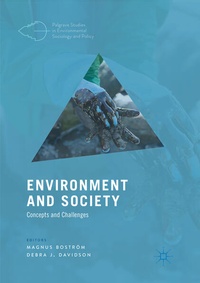
Environment and Society
Concepts and Challenges
Published on 12. January 2019
Book
Paperback/Softback
XXXIII, 394 pages
978-3-030-09483-6 (ISBN)
Description
This book offers a critical analysis of core concepts that have influenced contemporary conversations about environment-society relations in academic, political, and civil circles. Considering these conceptualizations are currently shaping responses to environmental crises in fundamental ways, critical reflections on concepts such as the Anthropocene, metabolism, risk, resilience, environmental governance, environmental justice and others, are well-warranted. Contributors to this volume, working across a multitude of areas within environmental social science, scrutinize underlying worldviews and assumptions, asking a common set of key questions: What are the different concepts able to explain? How do they take into account society-environment relations? What social, cultural, or geo-political biases and blinders are inherent? What actions or practices do the concepts inspire?
The transdisciplinary engagement and reflexivity regarding concepts ofenvironment-society relations represented in these chapters is needed in all spheres of society-in academia, policy and practice-not the least to confront current tendencies of anti-reflexivity and denialism.
The transdisciplinary engagement and reflexivity regarding concepts ofenvironment-society relations represented in these chapters is needed in all spheres of society-in academia, policy and practice-not the least to confront current tendencies of anti-reflexivity and denialism.
Reviews / Votes
"Bringing together some of the leading researchers in the field, Environment & Society poses the fundamental question of what it means to live in the Anthropocene and how our concepts and approaches across the social sciences must respond. The volume heralds a call for a more reflexive approach to policy and practice, capable of opening up the discussion of how society is configuring environmental change and how in turn social futures are being made. The book is both a guide and a provocation to rethink the concepts we use and their implications for achieving the kinds of futures we want and will be a valuable reference for students, researchers and practitioners alike." (Professor Harriet Bulkeley, Durham University, UK)More details
Product info
Previously published in hardcover
Series
Edition
Softcover Reprint of the Original 1st 2018 ed.
Language
English
Place of publication
Cham
Switzerland
Publishing group
Springer International Publishing
Target group
Primary & secondary/elementary & high school
Illustrations
3 s/w Abbildungen
XXXIII, 394 p. 3 illus.
Dimensions
Height: 210 mm
Width: 148 mm
Thickness: 24 mm
Weight
550 gr
ISBN-13
978-3-030-09483-6 (9783030094836)
DOI
10.1007/978-3-319-76415-3
Schweitzer Classification
Other editions
Additional editions
Book
07/2018
Palgrave Macmillan
€90.94
Shipment within 10-15 days
Persons
Magnus Boström is Professor of Sociology at Örebro University, Sweden, with a theoretical interest and research profile in environmental sociology. His research interest generally concerns politics, representation, consumption and action in relation to a broad variety of transnational environmental and sustainability issues.
Debra J. Davidson is Professor of Environmental Sociology in the Department of Resource Economics and Environmental Sociology at the University of Alberta, USA. Her key areas of teaching and research include social responses to climate change, and crises and transitions in food and energy systems.
Debra J. Davidson is Professor of Environmental Sociology in the Department of Resource Economics and Environmental Sociology at the University of Alberta, USA. Her key areas of teaching and research include social responses to climate change, and crises and transitions in food and energy systems.
Content
Ch 1. Introduction: Conceptualizing environment-society relations - Magnus Boström and Debra J. Davidson.- Ch. 2. The Anthropocene: A Narrative in the Making - Rolf Lidskog and Claire Waterton.- Ch. 3. Metabolism - Debra J. Davidson.- Ch. 4. Risk and Resilience - Marja Ylönen.- Ch. 5. Global Environmental Networks and Flows addressing Global Environmental Change - Peter Oosterveer.- Ch. 6. The environmental state and environmental governance - Arthur P.J. Mol.- Ch. 7. Economic Valuation of the Environment - Steve Yearley.- Ch. 8. Environmental Expertise - Rolf Lidskog and Göran Sundqvist.- Ch. 9. The Practice of Green Consumption - Emily Huddart Kennedy and Darcy Hauslik.- Ch. 10. Minding the mundane: Everyday practices as central pillar of sustainability thinking and research - Henrike Rau.- Ch. 11. Environmental Justice - J. Timmons Roberts, David Pellow and Paul Mohai .- Ch. 12. Environmental Democracy: Participation, Deliberation and Citizenship - Frank Fisher.- Ch. 13. Joining people with things. The commons and environmental sociology - Luigi Pellizzoni.- Ch. 14. Spatial frames and the quest for institutional fit - C.S.A. (Kris) Van Koppen and Simon R. Bush.- Ch. 15. Conflicting temporalities of social and environmental change? - Stewart Lockie and Catherine Mei Ling Wong.- Ch. 16. Conclusion - A proposal for a brave new world of conceptual reflexivity - Magnus Boström, Debra J. Davidson, and Stewart Lockie.- Afterword: Irony and Contrarian Imaginations - Matthias Gross.