

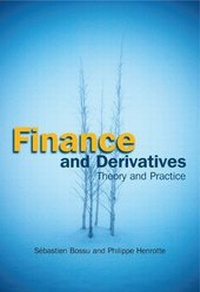
Finance and Derivatives
Theory and Practice
1st Edition
Published on 21. October 2005
Book
Paperback/Softback
220 pages
978-0-470-01433-2 (ISBN)
Description
Finance and Derivatives teaches all of the fundamentals of quantitative finance clearly and concisely without going into unnecessary technicalities. You'll pick up the most important theoretical concepts, tools and vocabulary without getting bogged down in arcane derivations or enigmatic theoretical considerations.
--Paul Wilmott
Finance and Derivatives: Theory and Practice is a collection of exercises accompanied by the relevant financial theory, covering key topics that include: present value, arbitrage pricing, portfolio theory, derivates pricing, delta-hedging and the BlackScholes model.
As well as being ideally placed to complement undergraduate and postgraduate studies, Finance and Derivatives: Theory and Practice is also highly valuable as a self-study guide for practitioners.
Key Features:
* No prior finance background is required, as the book starts with basic notions and gradually increases in difficulty through each chapter, ending with more advanced concepts.
* Students can make progress at their own pace as each chapter includes course notes, exercises and solutions.
* The authors have an excellent knowledge of both the academic environment and the finance industry, making the book well balanced between theory and practice.
* Supplementary material for readers and lecturers is provided on an accompanying website.
--Paul Wilmott
Finance and Derivatives: Theory and Practice is a collection of exercises accompanied by the relevant financial theory, covering key topics that include: present value, arbitrage pricing, portfolio theory, derivates pricing, delta-hedging and the BlackScholes model.
As well as being ideally placed to complement undergraduate and postgraduate studies, Finance and Derivatives: Theory and Practice is also highly valuable as a self-study guide for practitioners.
Key Features:
* No prior finance background is required, as the book starts with basic notions and gradually increases in difficulty through each chapter, ending with more advanced concepts.
* Students can make progress at their own pace as each chapter includes course notes, exercises and solutions.
* The authors have an excellent knowledge of both the academic environment and the finance industry, making the book well balanced between theory and practice.
* Supplementary material for readers and lecturers is provided on an accompanying website.
More details
Edition
1., Auflage
Language
English
Place of publication
Chichester
United Kingdom
Publishing group
John Wiley and Sons Ltd
Target group
Professional and scholarly
Illustrations
Illustrations
Dimensions
Height: 24.6 cm
Width: 16.7 cm
Thickness: 16 mm
Weight
400 gr
ISBN-13
978-0-470-01433-2 (9780470014332)
Schweitzer Classification
Other editions
New editions
Book
04/2012
2nd Edition
Wiley
€55.90
Article exhausted; check different version
Person
Sbastien Bossu graduated from HEC Paris and then went on to obtain his Masters in Financial Mathematics at the University of Chicago. He joined JPMorgans Equity Derivatives Group in 2003 and was recently appointed Vice-President at Dresdner Kleinwort Wasserstein.
Philippe Henrotte is an affiliate professor of finance at HEC Paris and a partner at Ito33, a financial software company providing cutting edge models to the quantitative finance community. He received his Ph.D. in Finance from Stanford University in 1993.
Philippe Henrotte is an affiliate professor of finance at HEC Paris and a partner at Ito33, a financial software company providing cutting edge models to the quantitative finance community. He received his Ph.D. in Finance from Stanford University in 1993.
Content
Foreword.
Preface.
1 Interest Rate.
1.1 Measuring Time.
1.2 Interest Rate.
1.3 Discounting.
Exercises.
Solutions.
2 Investment Decision Criteria.
2.1 Rate of Return. Time of Return.
2.2 Net Present Value (NPV).
2.3 Internal Rate of Return (IRR).
2.4 Other Investment Criteria.
Further Reading.
Exercises.
Solutions.
3 Bonds.
3.1 Financial Markets.
3.2 Bonds.
3.3 Yields.
3.4 Zero-Coupon Yield Curve. Arbitrage Price.
Further Reading.
Exercises.
Solutions.
4 Derivatives.
4.1 Introduction.
4.2 Forward Contracts.
4.3 'Plain Vanilla' Options.
Exercises.
Solutions.
5 Portfolio Theory.
5.1 Summary of Portfolio Valuation.
5.2 Risk and Return.
5.3 Gains of Diversification. Portfolio Optimization.
5.4 Capital Asset Pricing Model.
Further Reading.
Exercises.
Solutions.
6 Binomial Model.
6.1 Introduction.
6.2 Binomial Trees.
Further Reading.
Exercises.
Solutions.
7 Lognormal Model.
7.1 Lognormal Model.
7.2 Closed-Form Formulae.
7.3 Monte Carlo Method.
Further Reading.
Exercises.
Solutions.
8 Dynamic Hedging.
8.1 Introduction.
8.2 Delta-Hedging.
8.3 Other Risk Parameters: The Greek Letters.
Further Reading.
Exercises.
Solutions.
9 Models for Asset Prices in Continuous Time.
9.1 Continuously Compounded Interest Rate.
9.2 Introduction to Models for the Behaviour of Asset Prices in Continuous Time.
9.3 Introduction to Stochastic Processes.
9.4 Introduction to Stochastic Calculus.
References and Further Reading.
Exercises.
Solutions.
10 The Black-Scholes Model.
10.1 The Black-Scholes Partial Differential Equation.
10.2 Black-Scholes Formulae.
10.3 Volatility.
References and Further Reading.
Exercises.
Solutions.
Appendix A Probability Review.
A.1 States of Nature. Random Variables. Events.
A.2 Probability. Expectation. Variance.
A.3 Distribution. Normal Distribution.
A.4 Independence. Correlation.
A.5 Probability Formulae.
A.6 Chebyshev's Inequality. Central-Limit Theorem.
Further Reading.
Appendix B Calculus Review.
B.1 Functions of Two Variables x and y.
B.2 Taylor Expansions.>Appendix C Finance Formulae.
C.1 Rates and Yields.
C.2 Present Value. Arbitrage Price.
C.3 Forwards and Futures.
C.4 Options.
C.5 Risk.
C.6 Stochastic Processes and Stochastic Calculus.
C.7 Greeks.
Preface.
1 Interest Rate.
1.1 Measuring Time.
1.2 Interest Rate.
1.3 Discounting.
Exercises.
Solutions.
2 Investment Decision Criteria.
2.1 Rate of Return. Time of Return.
2.2 Net Present Value (NPV).
2.3 Internal Rate of Return (IRR).
2.4 Other Investment Criteria.
Further Reading.
Exercises.
Solutions.
3 Bonds.
3.1 Financial Markets.
3.2 Bonds.
3.3 Yields.
3.4 Zero-Coupon Yield Curve. Arbitrage Price.
Further Reading.
Exercises.
Solutions.
4 Derivatives.
4.1 Introduction.
4.2 Forward Contracts.
4.3 'Plain Vanilla' Options.
Exercises.
Solutions.
5 Portfolio Theory.
5.1 Summary of Portfolio Valuation.
5.2 Risk and Return.
5.3 Gains of Diversification. Portfolio Optimization.
5.4 Capital Asset Pricing Model.
Further Reading.
Exercises.
Solutions.
6 Binomial Model.
6.1 Introduction.
6.2 Binomial Trees.
Further Reading.
Exercises.
Solutions.
7 Lognormal Model.
7.1 Lognormal Model.
7.2 Closed-Form Formulae.
7.3 Monte Carlo Method.
Further Reading.
Exercises.
Solutions.
8 Dynamic Hedging.
8.1 Introduction.
8.2 Delta-Hedging.
8.3 Other Risk Parameters: The Greek Letters.
Further Reading.
Exercises.
Solutions.
9 Models for Asset Prices in Continuous Time.
9.1 Continuously Compounded Interest Rate.
9.2 Introduction to Models for the Behaviour of Asset Prices in Continuous Time.
9.3 Introduction to Stochastic Processes.
9.4 Introduction to Stochastic Calculus.
References and Further Reading.
Exercises.
Solutions.
10 The Black-Scholes Model.
10.1 The Black-Scholes Partial Differential Equation.
10.2 Black-Scholes Formulae.
10.3 Volatility.
References and Further Reading.
Exercises.
Solutions.
Appendix A Probability Review.
A.1 States of Nature. Random Variables. Events.
A.2 Probability. Expectation. Variance.
A.3 Distribution. Normal Distribution.
A.4 Independence. Correlation.
A.5 Probability Formulae.
A.6 Chebyshev's Inequality. Central-Limit Theorem.
Further Reading.
Appendix B Calculus Review.
B.1 Functions of Two Variables x and y.
B.2 Taylor Expansions.>Appendix C Finance Formulae.
C.1 Rates and Yields.
C.2 Present Value. Arbitrage Price.
C.3 Forwards and Futures.
C.4 Options.
C.5 Risk.
C.6 Stochastic Processes and Stochastic Calculus.
C.7 Greeks.