

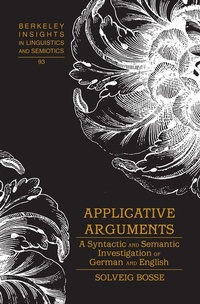
Applicative Arguments
A Syntactic and Semantic Investigation of German and English
1st Edition
Published on 25. March 2015
Book
Hardback
246 pages
978-1-4331-2726-7 (ISBN)
Description
Applicative Arguments: A Syntactic and Semantic Investigation of German and English
presents formal semantic and syntactic analyses of German and English applicative arguments. These arguments are nominal elements that are not obligatory parts of a sentence. Both German and English have several types of applicative arguments, including so-called benefactive and malefactive constructions. More specifically, the research relies on tests to differentiate the different types of applicative arguments based on this contribution to meaning: Some applicatives contribute only not-at-issue meaning, whereas others contribute only at-issue meaning, and still others contribute both types of meaning. These tests are applied to both German and English to uniquely identify the applicative arguments in each language. Formal analyses of the identified type of applicative arguments are presented that provide an account for each type of applicative identified for each language, explaining the applicatives' differences and similarities.
More details
Other editions
Additional editions
E-Book
04/2015
300th Edition
Peter Lang Verlag
€78.49
Available for download
E-Book
04/2015
Peter Lang Verlag
€78.49
Available for download
Persons
Solveig Bosse received her PhD in linguistics from the University of Delaware. She is currently Assistant Professor of Theoretical Linguistics in the Department of English at East Carolina University. Her research focuses on syntactic and formal semantic analyses of German and English with occasional other cross-linguistic comparisons.
Content
Content: Preliminaries - Affected Experiencers - Not-At-Issue Applicative Arguments - Benefactives - Part-Whole Applicatives.