

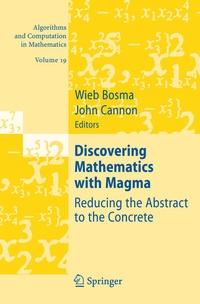
Discovering Mathematics with Magma
Reducing the Abstract to the Concrete
Published on 23. October 2006
Book
Hardback
XXIV, 364 pages
978-3-540-37632-3 (ISBN)
Description
The appearance of this volume celebrates the ?rst decade of Magma, a new computeralgebrasystemlaunchedattheFirstMagmaConferenceonCom- tational Algebra held at Queen Mary and West?eld College, London, August 1993. This book introduces the reader to the role Magma plays in advanced mathematical research. Each paper examines how the computer can be used to gain insight into either a single problem or a small group of closely related problems. The intention is to present su?cient detail so that a reader can (a), gain insight into the mathematical questions that are the origin of the problems,and(b),developanunderstandingastohowsuchcomputations are speci?edinMagma.Itishopedthatthereaderwillcometoarealisationofthe important rolethatcomputational algebracanplayinmathematical research. Readers not primarily interested in using Magma will easily acquire the skills needed to undertake basic programming in Magma, while experienced Magma users can learn both mathematics and advanced computational methods in areas related to their own. The core of the volume comprises 14 papers. The authors were invited to submit articles on designated topics and these articles were then reviewed by referees. Although by no means exhaustive, the topics range over a consid- ablepartofMagma'scoverageofalgorithmicalgebra:fromnumbertheoryand algebraicgeometry,viarepresentationtheoryandcomputationalgrouptheory to some branches of discrete mathematics and graph theory. The papers are preceded by an outline of the Magma project, a brief summary of the papers and some instructions on reading the Magma code. A basic introduction to the Magma language is given in an appendix. Theeditorsexpresstheirgratitudetothecontributorstothisvolume,both for the work put into producing the papers and for theirpatience.
More details
Series
Edition
2006 ed.
Language
English
Place of publication
Berlin
Germany
Publishing group
Springer Berlin
Target group
Professional and scholarly
Research
Illustrations
XXIV, 364 p.
Dimensions
Height: 241 mm
Width: 160 mm
Thickness: 27 mm
Weight
770 gr
ISBN-13
978-3-540-37632-3 (9783540376323)
DOI
10.1007/978-3-540-37634-7
Schweitzer Classification
Other editions
Additional editions
Book
11/2010
Springer
€106.99
Shipment within 7-9 days
E-Book
07/2007
1st Edition
Springer
€96.29
Available for download
Persons
Cannon:
1) Principal designer of the Magma system
2) Extensive contributions to the field of group theory algorithms
3) Awards:
- 1993 CSIRO Medal (for Computer Algebra)
- 2001 ATSE Clunies Ross Award (for Cryptography and Computer Algebra)
- 2006 Richard D. Jenks Memorial Prize for Excellence in Software Engineering Applied to Computer Algebra.
Bosma: co-designer of Magma, active in computational number theory and computer algebra
Content
Some computational experiments in number theory.- Applications of the class field theory of global fields.- Some ternary Diophantine equations of signature (n, n, 2).- Studying the Birch and Swinnerton-Dyer conjecture for modular abelian varieties using Magma.- Computing with the analytic Jacobian of a genus 2 curve.- Graded rings and special K3 surfaces.- Constructing the split octonions.- Support varieties for modules.- When is projectivity detected on subalgebras?.- Cohomology and group extensions in Magma.- Computing the primitive permutation groups of degree less than 1000.- Computer aided discovery of a fast algorithm for testing conjugacy in braid groups.- Searching for linear codes with large minimum distance.- Colouring planar graphs.- Appendix: The Magma language.