

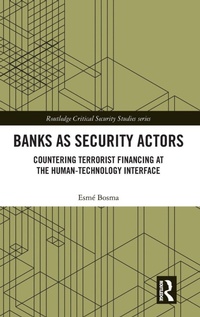
Banks as Security Actors
Countering Terrorist Financing at the Human-Technology Interface
1st Edition
Published on 22. April 2025
Book
Hardback
196 pages
978-1-032-76090-2 (ISBN)
Description
This book analyses how banks implement counter-terrorist financing measures and experiment with technologies to assess risks and make security decisions.
Banks have become private security actors. As "gatekeepers" of the financial system, they are legally obliged to conduct customer research and monitor bank accounts for unusual or suspicious transactions. Given the sheer volume of financial transactions that banks process daily, detection of financial crime heavily relies on digital security technologies that help analysts categorise and identify risky customers and financial transactions. Drawing from theories at the intersection of International Relations and Science and Technology Studies, the book advances the concept of 'de-scription' to offer a framework for analysing experimentation with security and digital technologies in practice. The research is based on fieldwork conducted in the financial crime sector in the Netherlands and the United Kingdom. It explores how political and ethical choices materialise at the human-technology interface and analyses the production of customer risk profiles, the design and use of transaction monitoring systems, and the emergence of public-private partnerships to counter terrorist financing.
This book will be of interest to students and researchers in International Relations, Science and Technology Studies, and Critical Security Studies.
Banks have become private security actors. As "gatekeepers" of the financial system, they are legally obliged to conduct customer research and monitor bank accounts for unusual or suspicious transactions. Given the sheer volume of financial transactions that banks process daily, detection of financial crime heavily relies on digital security technologies that help analysts categorise and identify risky customers and financial transactions. Drawing from theories at the intersection of International Relations and Science and Technology Studies, the book advances the concept of 'de-scription' to offer a framework for analysing experimentation with security and digital technologies in practice. The research is based on fieldwork conducted in the financial crime sector in the Netherlands and the United Kingdom. It explores how political and ethical choices materialise at the human-technology interface and analyses the production of customer risk profiles, the design and use of transaction monitoring systems, and the emergence of public-private partnerships to counter terrorist financing.
This book will be of interest to students and researchers in International Relations, Science and Technology Studies, and Critical Security Studies.
More details
Series
Language
English
Place of publication
London
United Kingdom
Publishing group
Taylor & Francis Ltd
Target group
College/higher education
Professional and scholarly
Postgraduate, Professional Reference, and Undergraduate Advanced
Illustrations
7 s/w Abbildungen, 7 s/w Zeichnungen, 5 s/w Tabellen
5 Tables, black and white; 7 Line drawings, black and white; 7 Illustrations, black and white
Dimensions
Height: 240 mm
Width: 161 mm
Thickness: 16 mm
Weight
485 gr
ISBN-13
978-1-032-76090-2 (9781032760902)
Copyright in bibliographic data and cover images is held by Nielsen Book Services Limited or by the publishers or by their respective licensors: all rights reserved.
Schweitzer Classification
Other editions
Additional editions
E-Book
04/2025
Routledge
€60.99
Available for download
E-Book
04/2025
Routledge
€60.99
Available for download
Person
Esme Bosma obtained her PhD in Political Science from the University of Amsterdam, as part of the FOLLOW project funded by the European Research Council. She is the co-editor of Secrecy and Methods in Security Research. A Guide to Qualitative Fieldwork (2019).
Content
Chapter 1: Banks As Security Actors Chapter 2: A De-Scriptive Approach To Studying Security Practices Chapter 3: A Multi-Sited Ethnography Of Digital Security Technologies Chapter 4: Know Your Data As The New Know Your Customer Chapter 5: De-Scription Of Transaction Monitoring Systems Chapter 6: Techno-Legal Gateways Of Financial Information-Sharing Partnerships Chapter 7. Conclusions Appendices