

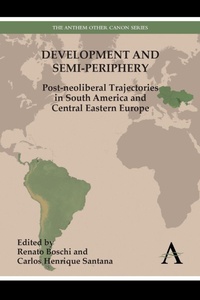
Development and Semi-periphery
Post-neoliberal Trajectories in South America and Central Eastern Europe
Published on 1. November 2013
Book
Paperback/Softback
336 pages
978-1-78308-060-1 (ISBN)
Description
'Development and Semi-periphery' presents a collection of articles that focus on comparative analysis of development trajectories in the semi-peripheral countries of South America and Central Eastern Europe. As opposed to the transitology studies that were prevalent in the 1990s, and that treated the neoliberal context in these two regions separately, the articles in this book instead offer a new comparative analysis focusing on the consequences of neoliberal reforms and the new actors that deal with their results. The essays discuss the various forms of state that have unfolded in different peripheral countries, their role in the social engineering of economic models and social policies, and the impact of state capacities and ideas on institutional innovation. The volume also compares transformations in political culture, collective identities and contentious politics in both areas.
More details
Series
Language
English
Place of publication
London
United Kingdom
Target group
Professional and scholarly
Illustrations
38+ figures and tables
Dimensions
Height: 229 mm
Width: 152 mm
Thickness: 21 mm
Weight
550 gr
ISBN-13
978-1-78308-060-1 (9781783080601)
Copyright in bibliographic data and cover images is held by Nielsen Book Services Limited or by the publishers or by their respective licensors: all rights reserved.
Schweitzer Classification
Other editions
Additional editions
Renato Boschi | Carlos Henrique Santana
Development and Semi-periphery
Post-neoliberal Trajectories in South America and Central Eastern Europe
E-Book
11/2013
Anthem Press
€30.99
Available for download
Persons
Renato Boschi holds a PhD in political science from the University of Michigan, and is currently Full Professor in Political Science at the Institute of Social and Political Studies, IESP-UERJ.
Carlos Henrique Santana holds a PhD in political science from the Institute of Social and Political Studies, IESP-UERJ, was formerly Assistant Professor in Political Science at the Federal University of Rio de Janeiro (UFRJ), and is currently a researcher at the International Celso Furtado Center for Development Policies and at the NEIC-IESP.
Carlos Henrique Santana holds a PhD in political science from the Institute of Social and Political Studies, IESP-UERJ, was formerly Assistant Professor in Political Science at the Federal University of Rio de Janeiro (UFRJ), and is currently a researcher at the International Celso Furtado Center for Development Policies and at the NEIC-IESP.
Content
List of Tables and Figures; Introduction - Renato Boschi and Carlos Henrique Santana; PART I DEVELOPMENT, MACROECONOMIC POLICIES AND VARIETIES OF CAPITALISM; Chapter 1. Postsocialist States in the System of Global Capitalism: A Comparative Perspective - David Lane; Chapter 2. Politics and Development: Lessons from Latin America - Renato Boschi and Flavio Gaitan; Chapter 3. Managing the Faustian Bargain: Monetary Autonomy in the Pursuit of Development in Eastern Europe and Latin America - Joseph Nathan Cohen; Chapter 4. Development and Dependency, Developmentalism and Alternatives - Jose Mauricio Domingues; PART II POLITICAL CULTURE, IDENTITY POLITICS AND POLITICAL CONTENTION; Chapter 5. Indigenous Movements in Bolivia, Ecuador and Peru - Xavier Albo; Chapter 6. Path Dependence versus Adaptation in Estonian Ethnopolitics - Raivo Vetik; Chapter 7. Integration Parliaments in Europe and Latin America: Explaining Variations - Juliana Erthal; PART III IDEAS AND THE ROLE OF ELITES AND ADVOCACY NETWORKS: TRANSLATING AND LEGITIMATING THE FRONTIERS OF INSTITUTIONAL REFORMS; Chapter 8. Marketing Professional Expertise by (Re)Inventing States: Professional Rivalries between Lawyers and Economists as Hegemonic Strategies in the International Market for the Reproduction of National State Elites - Yves Dezalay and Bryant Garth; Chapter 9. Identity, Policy Preferences and the Perception of the European Integration Process among the Hungarian Elites - Gyoergy Lengyel and Borbala Goencz; Chapter 10. Critical Junctures, Institutional Legacies and Epistemic Communities: A Development Agenda in Brazil - Carlos Henrique Santana; PART IV ECONOMIC REFORMS, PUBLIC POLICIES AND DEVELOPMENT; Chapter 11. Development and Citizenship in the Semi-periphery: Reflecting on the Brazilian Experience - Krista Lillemets; Chapter 12. The Periphery Paradox in Innovation Policy: Latin America and Eastern Europe Compared - Rainer Kattel and Annalisa Primi; Chapter 13. The Lula Government and the Social Democratic Experience in Brazil - Fabiano Santos